
The wind moves differently here.
It slips low across the open fields, catching on scrubby grass and stunted trees that seem to grow sideways instead of up. Underfoot, the ground feels unfamiliar—rocky, thin, tinged with a faint green-gray hue that doesn’t quite match the rest of Chester County. The land looks stubborn, almost resistant, as if it has decided what it will allow and what it won’t.
In Nottingham, even the earth has a personality.
A hiker pauses along a trail in Nottingham County Park, looking out over a stretch of serpentine barrens that feel more like a distant landscape than something just north of the Maryland line. “It doesn’t feel like Pennsylvania,” he says, brushing dust from his hands. “It feels older than that.”
That sense of difference is what makes Nottingham matter now.
At a time when much of southern Chester County is defined by steady suburban expansion, Nottingham remains shaped as much by geology as by growth. Its rare serpentine soils—nutrient-poor, mineral-rich, and difficult to cultivate—have limited development for centuries, preserving an ecological landscape that exists in only a handful of places along the East Coast. What once made the land difficult to farm now makes it invaluable to protect, turning Nottingham into a place where natural history still dictates the boundaries of modern life.
The story begins long before the roads.
By the early 1700s, Quaker settlers aligned with William Penn had begun establishing communities across the Nottingham area, forming what would become East and West Nottingham Townships. The land was agricultural, the communities close-knit, and the rhythms of life tied to soil, season, and faith.
Then, in the 19th century, the ground revealed something else.
Chromite—an ore critical for industrial processes—was discovered in the serpentine barrens, and by 1826, mining operations had begun. Under the expansion of industrial chemist Isaac Tyson Jr., Nottingham became a center of global chromite production, its rugged landscape transformed into pits, quarries, and processing sites that fed a growing industrial world.
“You can still see it,” a local resident says, gesturing toward a low depression along the trail. “The land remembers where it was opened.”
The boom did not last forever.
By the late 1800s, chromite mining declined, giving way to feldspar quarrying and a new wave of labor, including Italian immigrants who worked the land in different ways. Over time, industry receded, and the landscape began its slow return—not to what it had been, but to something shaped equally by extraction and recovery.
Today, those layers remain visible, if you know where to look.
Nottingham County Park, spanning more than 650 acres, preserves both the ecological rarity of the barrens and the industrial history etched into them. Trails wind past exposed rock, reclaimed pits, and stretches of open savanna where grasses and hardy plants thrive in soil that resists almost everything else. It is a place where the land tells its own story, without needing much interpretation.
Just beyond the park, a different kind of landmark rises.
The Herr Foods plant, founded in 1946, sits along Baltimore Pike as a reminder that Nottingham’s identity has always balanced between rural tradition and regional industry. The scent of cooking oil and salt drifts faintly through the air on certain days, a modern counterpoint to the older, earthier smells of the barrens.
“It’s funny,” the resident says with a smile. “You can smell chips one minute and raw ground the next.”
That contrast defines daily life here.
Nottingham is not a town in the conventional sense. It is an unincorporated community, divided between East and West Nottingham Townships, centered at the intersection of U.S. Route 1 and PA Route 272. About 1,260 people live here, spread across 3.25 square miles of largely open land . There are no dense neighborhoods, no concentrated downtown. Instead, the community unfolds in pockets—homes set back from roads, businesses spaced along corridors, the landscape always present in between.
Movement comes through rather than into Nottingham.
Route 1 carries traffic north and south, linking the area to Oxford, Kennett Square, and beyond. Route 272 cuts across more quietly, connecting neighboring townships and rural stretches that feel unchanged. The roads define access, but they do not define the place.
“You’re not here by accident,” the resident says. “You come here because you want the space.”
That space extends beyond geography.
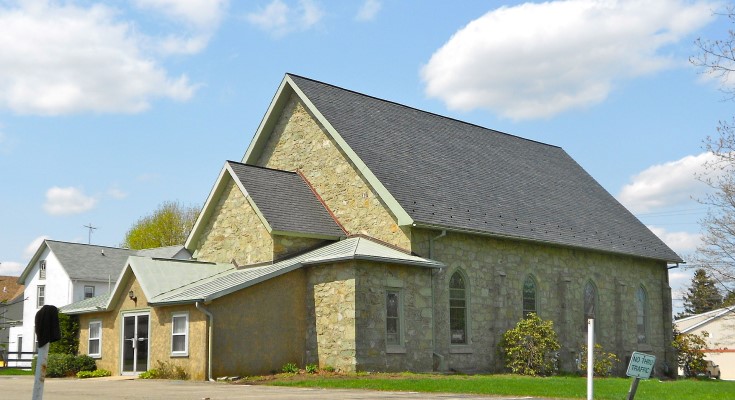
Community life in Nottingham tends to gather around what already exists rather than what needs to be built. Programs at Nottingham County Park, school events through the Oxford Area School District, and the steady presence of institutions like Nottingham Presbyterian Church create a network of connection that feels informal but enduring.
And then, in winter, something shifts.
The Herrs’ Christmas lights display transforms the company’s grounds into a sprawling, glowing landscape—thousands of lights, animated scenes, cars moving slowly through a shared ritual of celebration. For a few weeks each year, Nottingham becomes a destination, its quiet roads filling with families who return year after year.
“It’s the one time everything lights up at once,” the resident says. “You see just how many people this place means something to.”
By late afternoon, the wind returns to the barrens.
It moves across the same ground that once held mines, that now holds rare plants, that continues to resist easy definition. The trails empty. The light lowers. And the land, as it has for centuries, settles back into itself.
“You can’t really change this place,” the resident says, looking out across the open stretch. “You just learn how to live with it.”
In Nottingham, that may be the lesson the land has been offering all along—that some places are not meant to be reshaped, only understood.
Support the local news that supports Chester County. MyChesCo delivers reliable, fact-based reporting and essential community resources—free for everyone. If you value that, click here to become a patron today.