
The morning train slips quietly into Berwyn Station as commuters gather beneath the platform canopy, coffee cups warming their hands against the cool air. A few blocks away, traffic hums along Lancaster Avenue, tracing a route first established when horse-drawn wagons carried travelers between Philadelphia and the Pennsylvania frontier. Just beyond the bustle, stone walls disappear beneath ivy, church bells echo through mature trees, and winding roads lead toward landscapes that have changed surprisingly little in three centuries.
Easttown Township exists in a place where layers of history overlap so naturally that they can be easy to miss.
A driver heading to work may pass a Revolutionary War landmark before stopping at a modern shopping center. A family walking through a preserved creek valley may unknowingly follow paths shaped by mill workers, farmers, and Welsh settlers generations ago. Here, the past rarely announces itself loudly. Instead, it reveals itself gradually, woven into the landscape.
That connection between preservation and progress helps explain why Easttown remains one of Chester County’s most distinctive communities. As development continues across the greater Philadelphia region, Easttown has spent decades balancing growth with a determination to protect the landscapes, villages, and historic places that define its identity. The result is a township that feels both deeply rooted and remarkably current—a Main Line community where history remains part of daily life.
Its story begins long before the arrival of commuter rail stations and stately suburban neighborhoods.
The land that became Easttown was originally part of William Penn’s ambitious Welsh Tract, a vast 40,000-acre grant intended to create a self-governing community where Welsh settlers could conduct business and civic affairs in their native language. Though that vision never fully materialized, the Welsh influence remains visible in place names, cultural traditions, and the township’s enduring sense of place.
By the early eighteenth century, Easttown had become home to overwhelmingly Welsh Anglicans and Welsh Quakers, alongside some English settlers. Their farms, churches, mills, and villages established patterns that would shape the community for generations.
Few figures loom larger in that story than General Anthony Wayne.
Born at Waynesborough in 1745, Wayne grew from a young surveyor into one of the most celebrated military leaders of the American Revolution. His courage on the battlefield earned him the nickname “Mad Anthony,” but the estate where he was raised reveals a more nuanced story—a man shaped by family, agriculture, and the rolling countryside of Chester County.
Today, Waynesborough remains one of Pennsylvania’s most important Revolutionary-era homes. The stone residence stands much as it did during Wayne’s lifetime, overlooking a landscape that still reflects the rural character he would have known.
The Revolution left its mark elsewhere in Easttown as well.
In January 1778, during the bitter Valley Forge winter, the sharp crack of musketry shattered the quiet of Signal Hill. There, a tiny contingent of American soldiers under Captain Henry “Light-Horse Harry” Lee barricaded themselves inside a stone farmhouse, successfully repelling a surprise assault by roughly two hundred of Banastre Tarleton’s British dragoons. Though overshadowed by the larger campaigns of the Revolution, this fierce underdog defense remains the township’s only direct military engagement of the war—a reminder that the struggle for independence reached right into the heart of Easttown.
The centuries that followed brought profound change.
The Philadelphia-Lancaster Turnpike transformed regional travel. Later, the expansion of the Pennsylvania Railroad reshaped settlement patterns, encouraging growth around new transportation hubs. Villages such as Berwyn evolved from modest crossroads into thriving centers deeply connected to the broader Main Line corridor.
Yet despite its prosperity and accessibility, Easttown never fully surrendered its historic character.
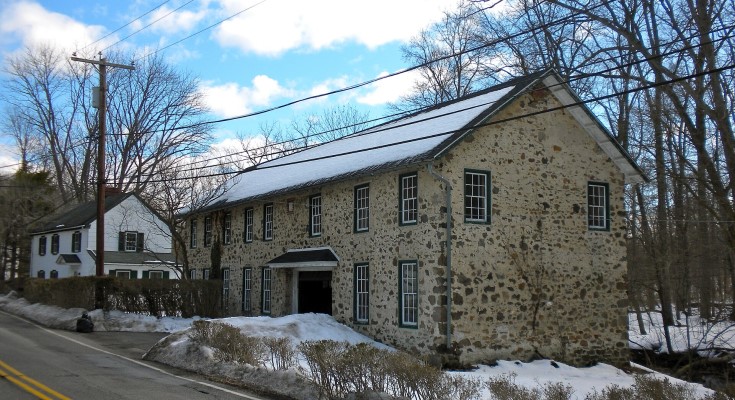
At Waterloo Mills, a narrow valley unfolds beneath a canopy of trees where stone buildings, old farm lanes, and gently rolling fields create one of Chester County’s most atmospheric historic landscapes. The district feels almost suspended in time. The sounds of traffic fade. Little Darby Creek moves quietly through the woods. Stone farmhouses and mill structures seem to emerge naturally from the terrain.
Elsewhere, the tiny Village of Leopard preserves another chapter of local history. Here, a handful of eighteenth- and nineteenth-century buildings still cluster around narrow roads, offering a glimpse into a world that existed long before suburban expansion transformed the Main Line.
Roughwood tells a different story.
Its deep green serpentine stone walls and carefully preserved structure reflect the bustling era of the Philadelphia-Lancaster Turnpike, when the property served travelers as the historic Lamb’s Tavern. Later transformed by renowned local architect R. Brognard Okie, the property remains one of the township’s most distinguished historic landmarks, illustrating how Easttown’s early commercial roots were preserved and woven into its suburban identity.
But Easttown’s history is not solely defined by architecture or famous names.
The township also occupies an important place in the story of civil rights. During the 1930s, Easttown and neighboring Tredyffrin Township became the focus of the Berwyn School Fight, a landmark challenge to racial segregation that helped foreshadow later battles in the modern civil rights movement. The struggle demonstrated that even quiet suburban communities could become arenas for larger questions of equality and justice.
Today, Easttown continues to evolve.
Its schools rank among the best in Pennsylvania. Its neighborhoods attract families from around the world. Tree-lined streets, thriving village centers, and access to rail transportation have helped maintain its appeal while supporting a population that is both highly educated and increasingly diverse.
Yet what distinguishes Easttown is not simply wealth or location.
It is the way the township has chosen to remember.
Historic estates remain preserved. Rural landscapes endure. Churches founded three centuries ago continue to serve congregations. Old transportation routes still guide modern movement. The past is not isolated behind museum walls but integrated into the rhythms of everyday life.
As evening settles across the Main Line, sunlight filters through the trees surrounding Waynesborough. Commuter trains glide westward toward Paoli while traffic follows the ancient path of Lancaster Avenue. The landscape changes, as it always has, but traces of every generation remain visible.
In Easttown, history does not stand still. It travels alongside the present, quietly shaping the road ahead.
Support the local news that supports Chester County. MyChesCo delivers reliable, fact-based reporting and essential community resources—free for everyone. If you value that, click here to become a patron today.