
The creek moves quietly beneath the trees, its surface broken only where it slips over stone and settles again into shadow. Along its banks, the ground rises just enough to reveal what’s left—subtle depressions in the earth, a shift in the tree line, the faint outline of where something once stood. There are no towering remnants here, no industrial ruins demanding attention. Only the sense that something important happened—and never fully left.
Coventryville does not announce its past. It lets you find it.
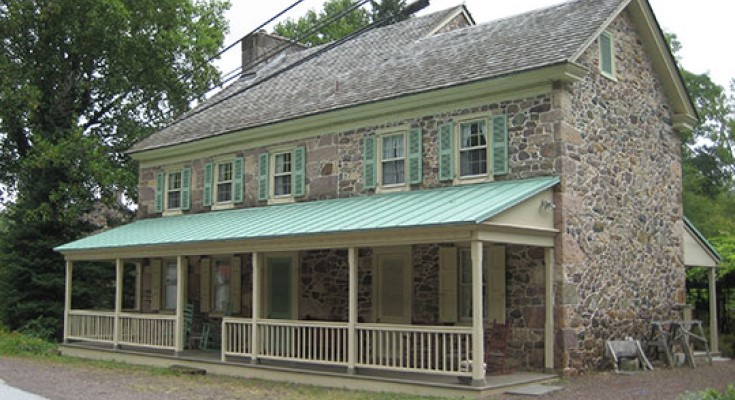
The village gathers along Old Ridge Road and Coventryville Road in a way that feels almost instinctive—houses set close to the land, stone walls holding their edges, buildings aligned not for display but for use. It is compact, contained, and remarkably intact, a place where the shape of the 18th century still defines the present.
That continuity is what gives Coventryville its weight now. In a region where early industry has often been erased or obscured by later growth, this small valley preserves one of Pennsylvania’s original ironmaking communities—not as a reconstruction, but as a landscape that simply endured.
“It’s all still here,” a local resident says, standing near the bend where the road dips toward French Creek. “You just have to know how to see it.”
The story begins with fire and water.
In 1717, Samuel Nutt established Coventry Forge at the confluence of the creek’s branches, drawn by the raw materials that defined early industry—iron ore, limestone, timber for charcoal, and a steady flow of water to power the works. It was the first forge in Chester County, among the earliest in Pennsylvania, and it set in motion a network of production that would extend far beyond the valley.
The work was relentless.
Charcoal burned hot in the furnaces. Iron was shaped and reshaped, hauled along rough roads to other sites—Warwick, Reading—where experimentation pushed the boundaries of what the material could become. During the Revolution, that output took on urgency, supplying munitions for a war that reached even into places as quiet as this.
“It wasn’t a big place,” the resident says. “But it mattered.”
What grew around the forge was not a town in the modern sense, but a system.
Workers’ houses lined the roads—modest, practical, built close to one another. An inn served travelers and teamsters moving between furnaces. A church anchored the community, offering structure beyond the work itself. At the center, Coventry Hall rose above it all, a stone house that reflected both the ambition and the authority of the ironmasters who ran the operation.
Even now, it holds that presence.
Set slightly apart, Coventry Hall carries its history in proportion and material—thick walls, deep fireplaces, rooms that were designed as much for administration as for living. It is not ornamental. It is declarative.
“You can tell who ran things from where they stood,” the resident says, glancing up toward the house. “That hasn’t changed.”
What has changed is the industry itself.
By the mid-19th century, the charcoal-based system that sustained Coventryville could no longer compete with newer methods fueled by anthracite coal. Production slowed, then stopped entirely by 1871. The fire went out. The work ended.
But the village remained.
Unlike many industrial sites, Coventryville was not dismantled or replaced. It settled. The houses stayed occupied. The roads held their paths. The land, once cleared and worked, began to soften again, the forest returning in measured ways.
Today, the result is something rare—a complete early-industrial landscape preserved not through intervention, but through continuity.
“It didn’t get wiped clean,” the resident says. “It just… carried on.”
Beyond the village core, the terrain rises into the Nantmeal hills, their slopes wooded and quiet. Trails wind through nearby Warwick County Park, where the connection to the past becomes less visible but no less present. The same water that powered the forge still moves through the valley, unchanged in its purpose, if not its use.
There are no large events here, no single attraction that defines the place for visitors. Instead, Coventryville offers something quieter—a chance to step into a landscape where the layers remain intact, where the boundaries between history and daily life have never been fully drawn.
“It’s not a destination the way people think of one,” the resident says. “You come here because you’re curious.”
As the day begins to fade, the light settles low across the valley, catching on the stone surfaces and the edges of the creek. The roads quiet. The air cools. For a moment, everything feels held in place—not frozen, but steady.
The water continues its slow movement through the valley. The houses remain. The land holds its shape.
And in that stillness, Coventryville reveals what it has always been—not just a place where iron was made, but a place where the work of a different kind continues quietly, the past and present moving together, one layer at a time.
Support the local news that supports Chester County. MyChesCo delivers reliable, fact-based reporting and essential community resources—free for everyone. If you value that, click here to become a patron today.