
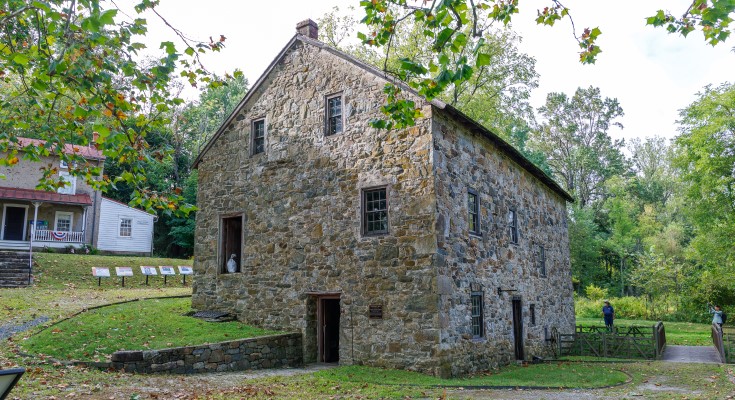
The wheel turns slowly, almost reluctantly, as water spills over the edge of the sluice and into Pickering Creek below. Inside the mill, the air carries a fine dusting of grain—sweet, dry, and faintly warm—while wooden gears engage with a steady, deliberate rhythm. Nothing here feels hurried. It hasn’t for centuries.
Chester Springs unfolds much the same way—quietly, deliberately, without needing to prove anything.
The roads curve rather than cut, following the natural lines of the land. Fields rise and fall in long, measured stretches, interrupted by stands of trees and stone buildings that seem less constructed than settled. It is not a place that reveals itself all at once. You arrive in pieces—first the landscape, then the structures, then the sense that everything belongs exactly where it is.
That sense of belonging is what gives Chester Springs its relevance now. In a region where growth often arrives with sharp edges—new construction, expanding corridors, a faster pace of life—this community has absorbed change without losing its foundation. It remains one of the few places where preservation is not a project, but a condition.
“It’s not something we’re trying to hold onto,” a resident says, standing near the edge of a field as the light begins to shift. “It’s just… still here.”
That continuity reaches back to the earliest days of settlement.
In the 18th century, congregations gathered along Clover Mill Road, building stone churches that still stand, their cemeteries extending quietly into the surrounding landscape. Nearby, the Mill at Anselma began operation in 1747, powered by the same water that continues to turn its machinery today. The system has been maintained, not replaced—layered with time rather than stripped of it.
The effect is subtle but unmistakable.
Where other places mark history with plaques and boundaries, Chester Springs carries it in function. The mill still grinds grain. The churches still hold services. The roads still follow routes established long before they were paved.
“You don’t visit history here,” the resident says. “You move through it.”
That movement extends beyond the past.
Chester Springs today is one of the region’s more affluent communities, its population spread across a wide geographic area that stretches through multiple townships. The homes—often set back from the road, framed by acreage and open space—reflect both prosperity and restraint. Nothing feels compressed. The scale allows for distance, for quiet, for a different kind of pace.
Yet the community is not isolated.
Routes like 113 connect residents to nearby employment centers in Downingtown, Phoenixville, and beyond. Many who live here work in professional and technical fields, commuting outward before returning to a landscape that feels intentionally separate from the demands of those roles.
“It’s a reset,” another resident says, pulling into a long driveway lined with trees. “You come back, and everything slows down again.”
That slowing is reinforced by the places that anchor the community.
At Historic Yellow Springs, the buildings cluster in a way that feels almost intimate—stone structures arranged along paths that wind through woods and open space. Once a mineral spring resort, then a hospital, then an arts school, the village has carried each identity without discarding the last. Today, it hums with a different kind of activity—artists, visitors, quiet gatherings that unfold without spectacle.
“There’s always something happening,” the resident says. “But it never feels crowded.”
Elsewhere, the Larkin Covered Bridge stands as a red-framed gateway over the township trails. No longer carrying the weight of wagons over Marsh Creek, it remains a preserved relic of the 19th century, set against a backdrop of trees that change with the seasons. It is a reminder of a time when even infrastructure was built with a sense of permanence.
That idea—of permanence without rigidity—runs through Chester Springs.
The schools draw families seeking stability and quality. The preserved lands maintain ecological continuity. The community itself expands, but not at the expense of what defines it.
As the day begins to fade, the light settles across the hills, catching on stone walls and the edges of fields before slipping into shadow. The sound of the mill continues, steady and unbroken, blending with the softer rhythms of the landscape.
“It’s not about going backward,” the resident says, glancing toward the water as it turns the wheel once more. “It’s about knowing what’s worth keeping.”
The wheel keeps turning. The water keeps moving. And in the space between past and present, Chester Springs remains—measured, enduring, and quietly certain of itself.
Support the local news that supports Chester County. MyChesCo delivers reliable, fact-based reporting and essential community resources—free for everyone. If you value that, click here to become a patron today.