
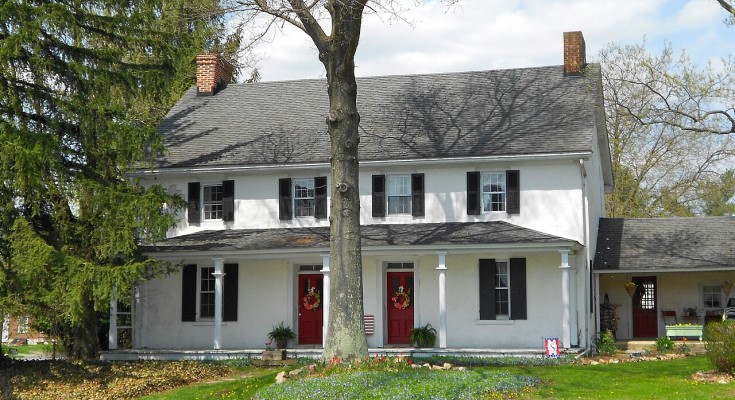
Morning comes softly to Franklin Township, settling first in the low fields along Big Elk Creek. Mist gathers above the water and drifts up toward the old roads, blurring fence lines, stone walls, and the quiet buildings of Kemblesville resting on the ridge. A truck rolls past the village crossroads on Route 896, then disappears toward the Maryland line, leaving the valley to the quiet sound of creek water moving through the borderlands.
Franklin Township has always belonged to the borderlands.
Here in southern Chester County, the landscape carries the marks of old boundaries — the London Tract, New Munster, the Mason–Dixon Line, and the wooded creek corridors that shaped where people settled, farmed, milled, and traveled. The township is close enough to Wilmington and Newark to feel the pull of modern growth, yet rural enough that open fields, wooded streambanks, and old crossroads still define its character.
That balance gives Franklin Township its identity today. As suburban development pushes farther into southern Chester County, the township remains rooted in a landscape shaped by agriculture, Scotch-Irish settlement, Quaker influence, and the enduring presence of Big Elk Creek.
The story begins with land.
In 1699, William Penn granted the 65,000-acre London Tract to the London Company, laying the foundation for settlement across this corner of Chester County. The area later became part of New London Township before Franklin Township was incorporated in 1852 and named for Benjamin Franklin, who owned land in the region.
Long before those colonial boundaries were drawn, the Lenni Lenape lived across the region, cultivating crops, managing forests, and moving through the creek valleys that later became settlement corridors. Their presence forms the earliest human layer in a township whose later history would be shaped by competing claims, migration, and the slow work of farming.
The southern portion of the township once sat within territory disputed by Pennsylvania and Maryland until the Mason–Dixon Line settled the boundary. That history helped shape New Munster, a Scotch-Irish settlement area whose farms, mills, and churches gave this part of Chester County a distinct cultural character.
Big Elk Creek tied much of it together.
The creek winds through Franklin Township as both natural corridor and historical spine. Its banks supported early mills, farmsteads, and crossings, including Wooleston Mill, also known as Tweed’s Mill and later Mackey’s Mill. Built to grind grain from surrounding farms, the mill became one of the township’s early industrial landmarks and a focal point for the New Munster settlement.
Kemblesville grew from that same rural pattern.
Centered along Route 896 just east of the Big Elk Creek valley, the village became the township’s informal civic heart — a small service center for surrounding farms, churches, schools, and local businesses. Its historic buildings, former mill sites, and Kemblesville Methodist Church still preserve the scale of a 19th-century crossroads community.
Franklin’s modern life remains closely tied to that landscape.
Agriculture still defines much of the township’s visual character. Fields, pastures, and wooded edges stretch between scattered homes and small businesses. The soils remain productive. The roads still follow old alignments. Even as new development appears, the township retains the feel of a place where the land has not fully yielded to suburbia.
Its proximity to Delaware adds another layer.
Many residents look south as naturally as east, commuting toward Wilmington, Newark, and northern Delaware while returning home to a quieter Chester County setting. Just across the state line, Fair Hill offers thousands of acres of trails, equestrian land, and protected open space, reinforcing the township’s connection to the rural and horse-country traditions of the border region.
But Franklin’s most enduring landmark may still be the creek.
Big Elk Creek carries the township’s environmental and historical memory through wooded banks, wetlands, meadows, and old mill corridors. Its clean water and riparian habitat support wildlife while preserving the scenic quality that gives the township much of its appeal.
By evening, the fields outside Kemblesville turn gold beneath the lowering sun. The roads quiet. Shadows gather along the creek. Somewhere near the village, porch lights begin appearing one by one.
And Big Elk Creek keeps moving through Franklin Township, carrying with it the old stories of borders, mills, farms, and families who learned to build their lives around the land.
Support the local news that supports Chester County. MyChesCo delivers reliable, fact-based reporting and essential community resources—free for everyone. If you value that, click here to become a patron today.