
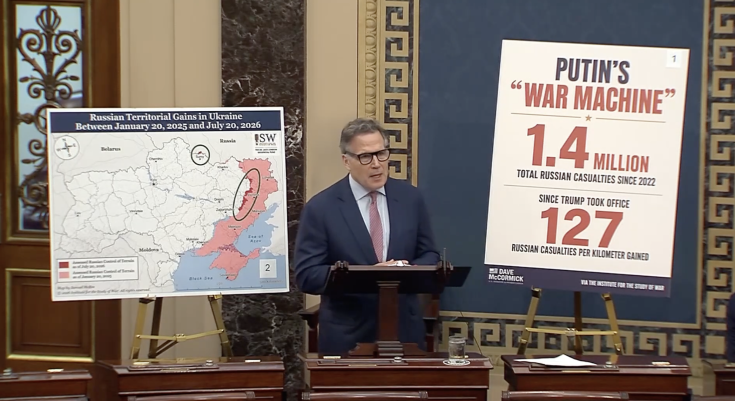
WASHINGTON, D.C. — U.S. Sen. Dave McCormick urged the Senate on Thursday to advance two sanctions bills targeting Russian oil revenue and financial networks, arguing that additional economic pressure would give President Donald Trump greater leverage to seek an end to the war in Ukraine.
The Pennsylvania Republican backed the Lindsey O. Graham Sanctioning Russia Act and the Decreasing Russian Oil Profits Act, known as the DROP Act, during a Senate floor speech.
McCormick framed the legislation as an effort to exploit what he described as a shift in battlefield momentum toward Ukraine while reducing the revenue available to finance Russia’s military operations.
“The tide is turning,” McCormick told senators. “Ukraine is doing its part on the battlefield. Now the United States Senate must capitalize on this strategic opportunity to weaken Putin’s Russia.”
The Graham legislation would authorize sanctions against Russian officials, oligarchs, banks, state-controlled entities and vessels accused of helping Russia evade existing restrictions.
It would also allow the president to impose tariffs of as much as 100% on leading importers of Russian crude oil or natural gas and on countries identified as major facilitators of sanctions evasion.
Additional provisions would prohibit U.S. investment in Russia, purchases of Russian sovereign debt and certain financial transfers involving the Russian government, according to McCormick’s description of the bill.
“The message is simple: if you bankroll Putin’s war, you will pay a price in the American market,” he stated.
The DROP Act, introduced by McCormick with Sens. Chris Coons, Jon Husted and Elizabeth Warren, would require targeted sanctions against purchasers, shippers, financiers and executives involved in transactions involving Russian-origin oil.
McCormick characterized oil as the Kremlin’s most important source of war funding and argued that the legislation would close gaps in the current sanctions framework.
His remarks also tied U.S. policy toward Russia to broader deterrence concerns involving China and Taiwan. McCormick argued that the Senate’s response to the Ukraine war would influence how Beijing assesses Washington’s willingness to oppose territorial aggression.
McCormick cited assessments from the Institute for the Study of War and battlefield casualty estimates to support his contention that Russia’s offensive has stalled. Those figures and conclusions were presented as part of his argument and were not independently verified in the speech materials.
He also credited Ukraine’s expanding use of drones and long-range attacks on Russian refineries, airfields, ammunition depots and logistics infrastructure with increasing pressure on Moscow.
McCormick acknowledged continued concerns about corruption in Ukraine but maintained that President Volodymyr Zelenskyy had demonstrated a willingness to negotiate, while Russian President Vladimir Putin had continued military attacks.
“We cannot confuse current momentum with victory,” McCormick warned, arguing that Russia remains capable of prolonging the conflict if oil revenue continues to support its military.
The senator called on congressional leaders to bring both measures forward without delay, contending that tougher sanctions would strengthen the president’s negotiating position rather than commit U.S. troops to the conflict.
Support the local news that supports Chester County. MyChesCo delivers reliable, fact-based reporting and essential community resources—free for everyone. If you value that, click here to become a patron today.