
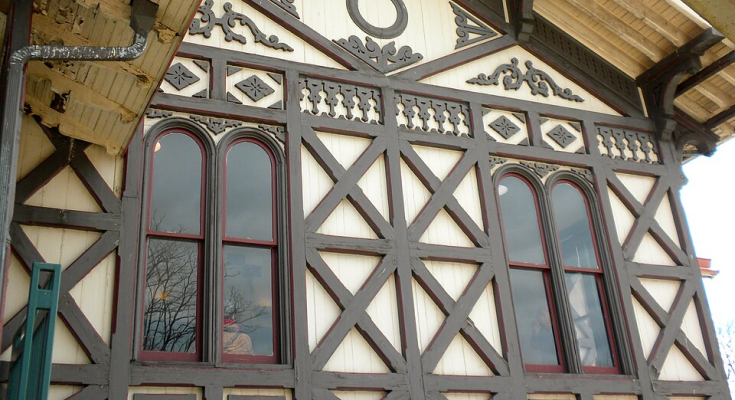
The platform is already half full when the train horn sounds in the distance, a low, familiar warning that cuts through the morning air. Light filters through the wooden eaves of the station, catching on the intricate brackets and beams that give the structure its quiet elegance. Commuters stand with practiced stillness—coffee cups in hand, briefcases slung over shoulders—glancing down the tracks as if measuring time by instinct rather than schedule. The air carries the faint scent of damp wood and diesel, and when the train finally arrives, it does so with a rush of wind and noise that briefly overwhelms the calm before settling again into routine.
By the time the last passenger boards, the platform empties just as quickly as it filled.
Strafford has always existed in that rhythm—departure and return, movement and pause. It is a place defined not by what happens within it, but by how it connects people to somewhere else. And yet, for those who live here, it is also where they choose to stay.
Strafford matters now because it represents a version of the Main Line that has managed to evolve without losing its underlying coherence. As development pressures reshape suburban landscapes across the region, this unincorporated community—spanning Tredyffrin and Radnor townships—still reflects a layered history of colonial settlement, railroad expansion, and early suburban planning that continues to shape daily life.
“It’s not just a stop,” one longtime resident says, watching the train pull away. “It’s the reason the place exists the way it does.”
The station itself tells that story. Built in the 1870s and relocated to Strafford in 1887, the wooden depot carries the craftsmanship of another era—its decorative trusses and carved details standing in contrast to the efficiency it now serves. What began as a rail outpost helped transform farmland into one of the region’s earliest commuter suburbs, linking residents directly to Philadelphia while allowing them to live at a remove.
Before the tracks, there was only land—rolling fields settled by German and Welsh families in the mid-18th century. Names like Sharraden and Werkiser marked the earliest farms, part of a broader pattern of settlement tied to land originally granted by William Penn. The center of that early community still stands along Old Eagle School Road, where a stone building from 1788 rises modestly beside a small graveyard.
The Old Eagle School was never just a school. It served as a church, a meeting place, a site for militia drills—a space where the lines between civic, religious, and daily life blurred together. Inside, students once sat on rough benches near a central fireplace, their voices filling the same room where sermons and debates unfolded.
“It’s hard to picture now,” the resident says. “But everything happened in one place back then. That was the community.”
That sense of shared space would evolve, but never disappear. By the early 20th century, Strafford began to take on the shape of a modern suburb. In 1939, developer Stephan Schifter introduced Strafford Village—a planned community of 78 homes that reflected a new way of living. Tree-lined streets curved gently through the neighborhood. Houses balanced uniformity with variation, drawing from Colonial and Tudor styles. Inside, features like central heating and built-in dishwashers signaled a shift toward convenience and comfort.
“It was modern for its time,” another resident says, walking along one of those quiet streets. “But it still feels intentional. Like it was designed for people, not just for space.”
That intention remains visible in the landscape. Mature trees arch over narrow roads. Homes sit back just enough to create a sense of privacy without isolation. The neighborhood feels settled, not static—lived in, but not overbuilt.
Beyond the residential streets, institutions anchor the community in quieter ways. The Tredyffrin Library, with its sweeping curves and glass-lined spaces, offers a contrast to the older architecture around it. Designed in the 1970s, it reflects a different moment in Strafford’s evolution—one focused on openness, access, and shared knowledge.
“It’s where everything overlaps,” the resident says. “Kids, families, people working remotely—it all comes together there.”
Education, too, carries a certain weight here. Schools in the Tredyffrin/Easttown district consistently rank among the region’s strongest, drawing families who see Strafford not just as a place to live, but as a place to invest in a future.
And yet, for all its advantages, Strafford resists feeling overly polished. Its boundaries are fluid, its identity shaped as much by habit as by designation. It belongs to two townships, two counties, and yet maintains a cohesion that feels distinctly its own.
“You don’t think about the lines,” the first resident says. “You think about where you go every day. The station. The library. Home.”
By late afternoon, the rhythm begins again in reverse. The platform fills once more as trains arrive from the city, carrying back the same steady flow of commuters. The light shifts, casting long shadows across the tracks and catching the station’s wooden frame in a warmer glow.
The doors open. People step off, adjusting bags, checking phones, moving quickly at first before slowing as they reach the parking lot or turn onto a familiar street.
“It’s a cycle,” the resident says, watching the crowd disperse. “You leave, you come back. That’s the whole point.”
As evening settles in, the station grows quiet again. The last train pulls away, its sound fading into the distance. The platform empties. The air stills.
And for a moment, before the next morning begins, Strafford holds that silence—steady, grounded, and waiting for the rhythm to start again.
Support the local news that supports Chester County. MyChesCo delivers reliable, fact-based reporting and essential community resources—free for everyone. If you value that, click here to become a patron today.