
The morning light arrives gently in Kennett Township. It spills across rows of mushroom houses tucked behind hedgerows, glints off weathered stone walls, and filters through towering oaks that have watched centuries unfold. Along winding roads, horses graze in pastures bordered by split-rail fences. Church steeples rise above rolling fields. In the distance, commuters merge onto Route 1, heading toward Wilmington or Philadelphia, while just beyond the roadway, a landscape shaped by Quakers, farmers, abolitionists, and revolutionaries remains remarkably intact.
Here, history does not sit behind museum glass. It lives in the contours of the land.
Long before modern subdivisions and commuter traffic arrived, the region that would become Kennett Township was part of a vast tract granted by William Penn to his children. Surveyed in 1701 as Stenning Manor, the area became home to English Quaker settlers and Lenape families whose presence stretched back generations. Among them was Hannah Freeman—known locally as Indian Hannah—whose life would come to symbolize the final chapter of traditional, independent Lenni-Lenape residency in southern Chester County.
Today, Kennett Township stands at an unusual intersection of past and present. As Chester County continues to grow and evolve, this community of more than 8,200 residents remains one of the region’s strongest examples of how preservation, agriculture, and modern life can coexist. The township’s story matters now because it reflects a broader challenge facing southeastern Pennsylvania: how to embrace growth without losing the character, landscapes, and values that made a place distinctive in the first place.
The answer, at least in Kennett Township, appears written across the countryside.
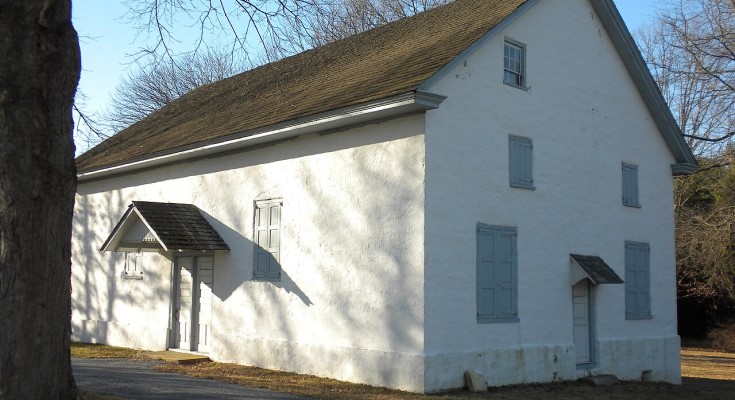
Few places in Chester County carry as much historical weight as the Old Kennett Meetinghouse. Built in 1710 and expanded in 1731, the modest stone structure stands amid a quiet burial ground where echoes of the Revolutionary War still linger. On Sept. 11, 1777, as British and American forces clashed during the Battle of Brandywine, fighting spilled into the surrounding area. Local Quakers, committed to pacifism, documented the violence with characteristic restraint, recording events that would become part of the township’s enduring narrative.
The meetinghouse later became a center of another struggle—one fought not with muskets, but with moral conviction.
Throughout the 19th century, Kennett Township emerged as an important hub of Underground Railroad activity. Quaker families such as John and Hannah Cox, Dinah and Isaac Mendenhall, and Dr. Bartholomew Fussell quietly transformed homes and meetinghouses into places of refuge for freedom seekers moving north. Their efforts reflected a deeply held belief that faith demanded action.
Their legacy remains woven into the community’s identity.
That sense of stewardship extends beyond history and into the land itself. Agriculture remains central to Kennett Township’s character, and nowhere is that more evident than in its connection to the mushroom industry. What began around 1885 when William Swayne introduced mushroom cultivation to the region would ultimately transform southern Chester County into the mushroom capital of the United States. Today, more than half of the mushrooms consumed nationwide are produced within the broader Kennett area, linking local farms to dinner tables across America.
Yet the township’s appeal cannot be measured solely in economic output.
In Hamorton, a compact village shaded by mature trees, stone houses and Colonial Revival homes create a streetscape that feels suspended between centuries. The carefully preserved architecture reflects both the area’s rural origins and the influence of industrialist Pierre S. du Pont, whose planning efforts helped shape the village’s enduring character.
Elsewhere, the Chandler Mill Bridge arches gracefully over the West Branch of the Red Clay Creek. Built in 1910, its stone masonry blends almost seamlessly into the wooded landscape surrounding it. Nearby, the Harlan Log House—constructed around 1715—stands as one of southeastern Pennsylvania’s oldest surviving log dwellings, a reminder of the practical craftsmanship that defined the region’s earliest settlers.
The Wiley-Cloud House tells a similar story. Expanded over generations yet retaining its historic integrity, the stone homestead reflects the continuity that has long defined rural life in the Brandywine Valley.
For residents, these landmarks are more than historical curiosities. They are touchstones.
With a median household income exceeding $118,000 and a population that reflects both longstanding families and newer arrivals, Kennett Township has evolved considerably from its colonial beginnings. Yet preservation remains a guiding principle. Open-space protection, environmental stewardship, and thoughtful planning continue to shape local decision-making, helping safeguard the streams, farmland, and wooded corridors that define the landscape.
Those priorities resonate with residents who value both heritage and quality of life.
The township’s location provides easy access to major employment centers while maintaining a distinctly rural atmosphere. Families are served by the Kennett Consolidated School District, whose schools have become a source of community pride. Seasonal festivals, historic commemorations, and conservation initiatives bring neighbors together throughout the year, reinforcing connections that stretch beyond municipal boundaries.
As evening settles over Kennett Township, the pace slows again.
Sunlight fades across mushroom houses and farm fields. The stone walls of the Old Kennett Meetinghouse glow softly beneath the last light of day. Along quiet country roads, the landscape looks much as it did generations ago—a place shaped by faith, labor, courage, and an enduring respect for the land.
And perhaps that is what makes Kennett Township remarkable.
In a region where change often arrives quickly, it remains a community that understands the value of remembering where it came from, even as it continues moving forward.
Support the local news that supports Chester County. MyChesCo delivers reliable, fact-based reporting and essential community resources—free for everyone. If you value that, click here to become a patron today.