
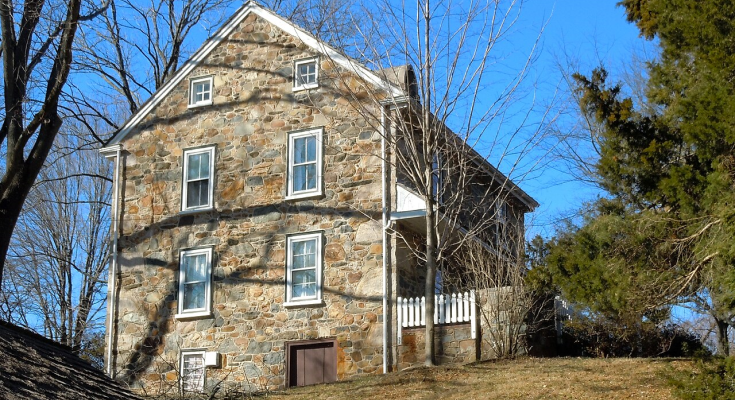
Morning arrives slowly in Birchrunville. Mist gathers in the low meadows before lifting through the trees along Birch Run. The old general store sits quietly at the bend in the road, its mansard roof and deep porch catching the first light. Nearby, stone farmhouses and barns appear between wooded slopes, looking less like relics than neighbors that have simply stayed put.
West Vincent Township rewards that kind of attention.
It is not a place that announces itself with grand entrances or commercial corridors. Its identity lives in smaller gestures: a narrow road following an old travel path, a preserved schoolhouse, a village post office still woven into daily life, a trail disappearing into the woods toward Valley Forge and beyond.
That restraint matters now.
As northern Chester County continues to grow, West Vincent has become a study in how a prosperous community can absorb change while holding onto the landscapes, villages, and historic structures that give it meaning. Its affluence is visible in household incomes and home values, but its deeper wealth lies in what it has chosen to keep: open land, old roads, wooded hillsides, and village-scale places that still feel human.
The township’s modern story began in 1832, when the original Vincent Township was divided into East and West Vincent.
Its older story reaches further back. Before colonial boundaries, Lenni Lenape communities moved through the region, using travel corridors that later influenced roads such as Conestoga Road and Nantmeal Road. Those paths helped shape settlement, commerce, and movement long before Route 401 carried modern traffic across the township.
During the Revolutionary War, those roads took on national meaning.
After the Battle of Brandywine, George Washington’s army moved through the region on its way toward Valley Forge. Local residents also supported the Yellow Springs military hospital, part of the broader wartime landscape that made northern Chester County more than a backdrop to the Revolution. Here, history passed not only through battlefields, but along roads, farms, and houses pressed into service by crisis.
That layered past remains visible in Birchrunville.
The village is one of Chester County’s most evocative historic districts, a compact rural settlement of stone houses, frame dwellings, barns, and small commercial buildings arranged along quiet lanes. Birch Run once powered local industry. Farms surrounded the village. The general store became the place where daily life gathered.
It still does.
Built in 1898, the Birchrunville General Store remains the architectural and social heart of the village. Its fish-scale slate, bay window, porch, and layered history as store, post office, meeting place, creamery, and café give it the kind of continuity that cannot be manufactured. It is both preserved and useful, which may be the highest form of preservation.
West Vincent’s historic farms tell the same story in a quieter register.
The Deery Family Homestead, French Creek Farm, Nicholas East House, Robert Rooke House, and Strickland-Roberts Homestead all preserve the township’s agricultural past in stone, timber, lanes, fields, and outbuildings. Their value is not merely architectural. It is spatial. They remain tied to the land that made them possible.
That relationship between building and landscape defines the township.
West Vincent’s houses do not stand apart from their settings. They belong to slopes, streams, meadows, and tree lines. The surrounding land explains the buildings, and the buildings give memory to the land.
Few properties connect local history to national life more directly than the Strickland-Roberts Homestead.
Owen J. Roberts, associate justice of the U.S. Supreme Court, purchased the farmstead in 1927 and lived there until his death in 1955. In Washington, he became a pivotal figure in the constitutional battles of the New Deal era. In West Vincent, he found a rural retreat in the Birchrunville countryside, a place where national consequence and local quiet could coexist.
The township has produced other remarkable lives.
Graceanna Lewis, the naturalist, suffragist, and anti-slavery activist whose family roots were deeply tied to the Birchrunville area, carried the moral and intellectual traditions of rural Chester County into the wider worlds of science and reform. Charles Lewis Fussell, her nephew and a landscape painter trained at the Pennsylvania Academy of the Fine Arts, shared this artistic tradition, and the two would later share a home in Media during their final years. Henry Shimer, born in West Vincent, carried his early curiosity into medicine, education, and entomology.
Their stories suggest something essential about the township.
Its quiet did not produce isolation.
It produced observation.
The land encouraged looking closely—at birds, insects, fields, light, law, and community. That habit of attention remains part of West Vincent’s identity today.
Nature reinforces it.
The township lies partly within the Hopewell Big Woods, one of southeastern Pennsylvania’s most important forest systems. French Creek, wooded slopes, conserved farms, and protected open spaces help preserve biodiversity while maintaining the rural character residents prize.
The Horseshoe Trail passes through the township on its route between Valley Forge National Historical Park and its junction with the Appalachian Trail on the crest of Stony Mountain, north of Hershey. For hikers and riders, it offers more than recreation. It is a living corridor through history, carrying travelers across old roads, farm lanes, and landscapes that still feel connected to their origins.
Modern West Vincent is prosperous and highly educated, with a growing population and strong professional ties to the Philadelphia region.
Yet its center of gravity remains local.
Civic life turns on land preservation, zoning, environmental stewardship, school district ties, village identity, and the everyday work of maintaining a rural community in a region where rural land is increasingly rare.
As evening settles over Birchrunville, the general store glows softly against the darkening road. The fields beyond the village fall into shadow. Somewhere along the Horseshoe Trail, the woods close around the path, and French Creek moves quietly through the valley.
The roads still carry people forward.
But in West Vincent Township, they also carry memory—of villages, farms, reformers, soldiers, judges, artists, and the enduring landscape that held them all.
Support the local news that supports Chester County. MyChesCo delivers reliable, fact-based reporting and essential community resources—free for everyone. If you value that, click here to become a patron today.