
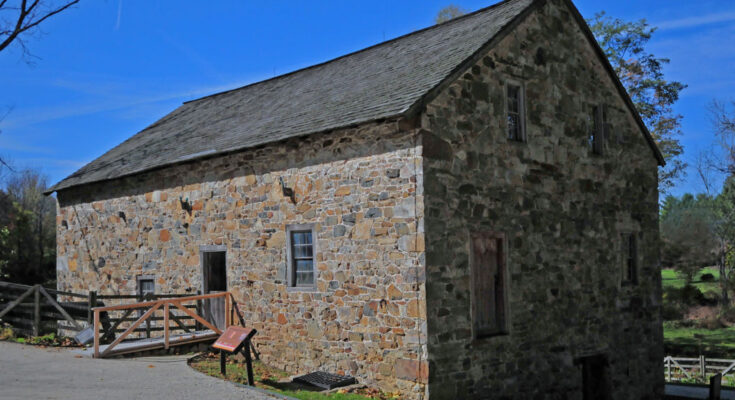
Morning light falls softly across the old stone buildings of Chester Springs. Mist gathers in the low places along Pickering Creek, curling around fieldstone walls, studio doors, and wooded paths worn smooth by generations of students, artists, farmers, and visitors. The air carries the damp scent of leaves and mineral springs. Beyond the village, the roads rise into rolling hills where farmhouses sit back from the lane and open fields give way to shaded valleys.
West Pikeland Township does not feel like a place built around a single center.
It feels assembled from landscapes: a mill valley, an arts village, a preserved farm, a collector’s sanctuary, a quiet park, a road bending toward another historic house. Each piece tells part of the story, but Chester Springs gives the township its soul.
That soul matters now.
As northern Chester County continues to absorb growth from the Philadelphia region, West Pikeland has become a rare example of a prosperous community that still treats history, land, and culture as civic assets rather than decorative afterthoughts. Its preserved landscapes, National Register sites, open-space programs, and arts institutions have allowed the township to remain both highly desirable and deeply rooted.
Its history begins with water.
Long before West Pikeland became known for high household incomes and preserved acreage, people came to Yellow Springs for the mineral water. The springs drew Indigenous communities, colonial travelers, physicians, soldiers, reformers, and eventually artists. Over time, the village became one of Chester County’s most layered historic landscapes.
During the Revolutionary War, Yellow Springs served as the Continental Congress’s first commissioned military hospital.
The same springs once promoted for healing became part of a wartime medical landscape, where wounded and sick soldiers arrived from campaigns that tested the young nation’s endurance. The village later became a social reform site through the Chester Springs Soldiers’ Orphan School before taking on yet another identity in the 20th century as the Pennsylvania Academy of the Fine Arts’ country school.
That transformation gave West Pikeland one of its most enduring cultural legacies.
From 1916 to 1952, PAFA brought artists and educators into the countryside, turning Chester Springs into a seasonal art colony. Students painted outdoors, studied in studios, and absorbed a landscape of stone buildings, wooded ravines, fields, and changing light. The village became a place where formal instruction met rural atmosphere.
That legacy remains alive at Historic Yellow Springs.
Today, the nonprofit campus preserves more than buildings. It preserves an idea: that art, history, nature, and community can occupy the same ground. Exhibitions, workshops, festivals, and heritage programs continue the creative current that once flowed through the PAFA Country School.
The township’s milling past is never far away.
Along the Pickering Creek valley, the Lightfoot Mill and Clinger-Moses Mill Complex recall a time when waterpower drove local life. Farmers brought grain to be ground. Roads followed the creek. Houses, barns, and workshops clustered around the machinery that sustained the surrounding countryside.
The mills give the landscape its working memory.
Their stone walls and former water systems reveal a township shaped by practical labor long before it became known for arts, affluence, and open-space preservation. They remind visitors that beauty here was never separate from utility.
West Pikeland’s farmsteads tell the same story.
Rice-Pennebecker Farm preserves the agricultural world that supported the village around Chester Springs. Its stone farmhouse, barns, springhouse, and fields reflect the continuity of rural life across the 18th and 19th centuries. Like many of the township’s historic resources, it matters not simply because it is old, but because its setting remains legible.
That relationship between building and landscape is one of West Pikeland’s defining strengths.
Historic homes still sit within wooded slopes and open fields. Trails pass through preserved natural areas. Roads retain the curved logic of topography rather than the straight efficiency of suburbia. The result is a township where history can still be read in context.
No figure embodies that union of art and place more distinctively than Dr. Albert C. Barnes.
At Ker-Feal, his secluded 18th-century stone farmhouse, the legendary collector created a private sanctuary for American folk art, hand-wrought iron, and Pennsylvania German pottery. Named after his favorite dog, Ker-Feal offered a more intimate glimpse into Barnes’s vision—less monument than a lived-in philosophy where masterpiece paintings gave way to the simple, enduring beauty of early American craftsmanship.
The house reflects his belief that art belonged in daily life.
Doors, chairs, rooms, and objects became part of one creative environment. In West Pikeland, even domestic space could become a living gallery.
That creative tradition continues to shape the township’s identity.
West Pikeland is residential and affluent, with a highly educated population and strong ties to regional employment centers. Yet its sense of place depends less on conventional markers of prosperity than on the choices residents and local institutions have made to preserve what gives the township distinction.
Open space is central to that effort.
Pine Creek Park, township trails, conservation easements, and preserved natural areas protect stream valleys, woodlands, meadows, and scenic views. The township’s Environmental Advisory Council, Historic Commission, HARB, Parks & Recreation Board, and local land trust reflect a civic culture organized around stewardship.
That stewardship is visible everywhere.
In the quiet around Chester Springs.
In the survival of mills and farms.
In trails that lead through woods rather than around them.
In a village where art still feels connected to water, stone, and land.
As evening settles over West Pikeland, the last light slips across the roofs of Historic Yellow Springs. Pickering Creek darkens beneath the trees. Studio windows glow softly, and the fields beyond Chester Springs fall into shadow.
The springs still run.
The mills still stand.
And in West Pikeland Township, the countryside remains what it has been for centuries: a place where people come seeking restoration, work, beauty, and a deeper connection to the land.
Support the local news that supports Chester County. MyChesCo delivers reliable, fact-based reporting and essential community resources—free for everyone. If you value that, click here to become a patron today.