
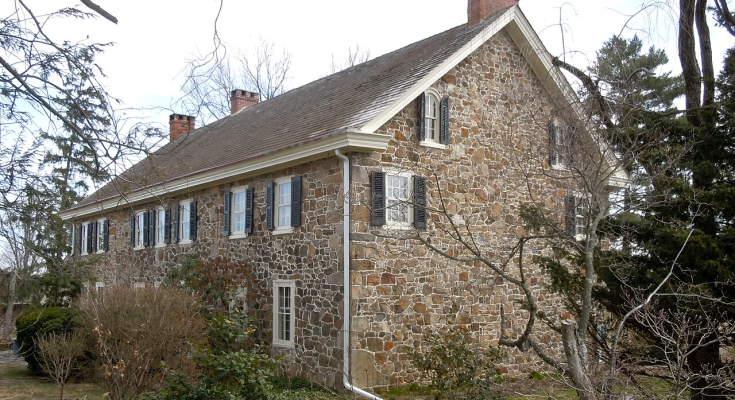
Morning settles gently over West Nantmeal Township. Mist gathers in the low fields near Isabella Road, softening the edges of stone farmhouses, old barns, and wooded ridgelines. Along a quiet country lane, the air carries the scent of damp leaves and turned soil. Beyond the fields, the forest thickens toward the Hopewell Big Woods, where deer move through the understory and the remnants of an ironmaking past still sit hidden in the landscape.
This is a township that does not reveal itself quickly.
Its history is layered into roads, furnaces, farmsteads, and schoolhouses—places that speak quietly rather than announce themselves. In a region increasingly shaped by suburban growth, West Nantmeal remains one of northern Chester County’s most rural and historically grounded communities, a place where agriculture, industry, and conservation still define the character of daily life.
That continuity matters now.
As development pressure spreads across southeastern Pennsylvania, West Nantmeal offers a different model of community identity. Its farms remain visible. Its forests remain intact. Its historic iron sites and early homesteads continue to anchor a landscape that has been shaped by work, settlement, and stewardship for more than three centuries.
The township’s story begins with Welsh settlers.
Between 1700 and 1710, families from Wales arrived in this part of Chester County and named the area Nantmel after a village in Radnorshire. The original Nantmeal Township would later be divided again and again—first into East and West Nantmeal in 1739, then reshaped by the creation of Honey Brook Township in 1789 and Wallace Township in 1852.
What remained was a rural community tied closely to land and labor.
Farms spread across the rolling countryside. Roads connected mills, churches, schools, and homesteads. Families built lives around planting seasons, livestock, timber, and the practical demands of rural life.
Then came iron.
By the 19th century, West Nantmeal had become part of northern Chester County’s charcoal-iron landscape. The most enduring reminder is Isabella Furnace, built around 1835 by members of the Potts family and operated for nearly six decades. The furnace complex once produced pig iron for regional foundries, drawing upon local forests, ore, water, and labor.
Today, Isabella Furnace remains one of the township’s most powerful historic landmarks.
Its stone furnace stack, casting house, ironmaster’s mansion, and surrounding landscape preserve the memory of an industrial world that depended entirely on its rural setting. Charcoal came from the woods. Workers lived near the furnace. Farms helped sustain the operation. Industry and agriculture were not separate forces here; they were part of the same economy.
That relationship also shaped Pleasant Hill Plantation, also known as the Van Leer Place.
The National Register-listed farmstead reflects the wealth, craftsmanship, and influence of early ironmaking families in northern Chester County. Its stone dwelling, historic outbuildings, and agricultural setting evoke a period when rural homesteads were not isolated retreats but centers of production, family life, and civic influence.
West Nantmeal’s famous names often emerge from that same landscape.
The Potts family helped shape the township’s industrial identity through Isabella Furnace. Samuel Van Leer, a Revolutionary War captain and ironmaster, connects the township to both early American industry and military service. Mordecai Lincoln, the great-great-grandfather of President Abraham Lincoln, appears in early Nantmeal-era records, tying this rural community to one of the nation’s most consequential family migrations.
Even George Lippard, the 19th-century novelist and crusading journalist, belongs to this landscape; he was born in West Nantmeal in 1822, grounding the township within the wider cultural history of American gothic literature and social reform.
Yet the township’s identity has never rested solely on notable names.
It is equally found in modest landmarks.
The former Central School, closed in 1966, now serves as the municipal building, a quiet example of rural adaptation. Historic bridges and churches preserve the township’s transportation and religious life. The Goodwill M.E. Church and early Brandywine crossings reflect a landscape where local institutions were built to serve scattered families across a broad countryside.
Nature remains just as central.
Portions of West Nantmeal lie within the Hopewell Big Woods, the largest remaining contiguous forest ecosystem in southeastern Pennsylvania. State Game Lands No. 43 provide hunting, hiking, wildlife habitat, and an undeveloped woodland buffer that helps maintain the township’s rural character.
The forest gives the township a sense of depth.
Roads pass from open fields into shadowed woodland. Stone houses appear and disappear behind tree lines. Seasonal changes arrive visibly here—in the bright green of spring fields, the deep shade of summer woods, the copper hillsides of autumn, and the bare quiet of winter.
Modern West Nantmeal remains small but steady.
Its population has grown gradually, reaching just over 2,200 residents by 2020. The township retains high household incomes, low poverty, and a strong tradition of local governance through its Board of Supervisors, Planning Commission, and other appointed boards.
Community life remains practical and close to home.
Residents gather for township meetings, parks and recreation programs, historical commission work, and events such as Music in the Park. These are not grand civic spectacles. They are the routines that keep a rural township connected.
That modesty is part of West Nantmeal’s appeal.
It has not become a major commercial destination. It has not traded its farms and woods for dense development. Its value lies instead in the quiet persistence of place—in the sense that the landscape still remembers what it was built to do.
As evening settles over West Nantmeal, the last light catches the stonework at Isabella Furnace. Fields darken beyond the old roads. In the woods, the sound of birds gives way to the hush of night.
The furnace fires are gone.
The farms remain.
And across this quiet corner of Chester County, West Nantmeal Township continues to hold its history in the land itself.
Support the local news that supports Chester County. MyChesCo delivers reliable, fact-based reporting and essential community resources—free for everyone. If you value that, click here to become a patron today.