
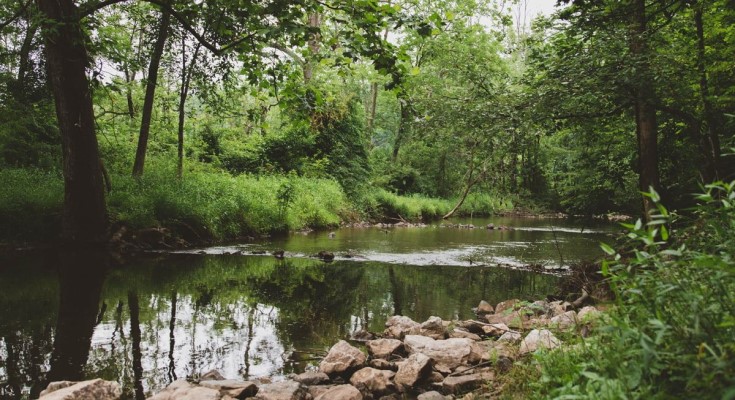
French Creek moves quietly through Warwick County Park, slipping past stone banks and beneath thick stands of hardwood trees that cast shifting shadows across the water. In the early morning, the air carries the scent of wet leaves, moss, and earth still cooling from the night before. Along the Horse-Shoe Trail, hikers pause instinctively when the forest opens toward the creek, where mist hangs low above the water and the distant creak of the old Fink Truss bridge rises faintly through the trees.
Nothing about Warwick County Park feels rushed.
By midmorning, the woods begin to fill gently with movement. Members of the Warwick Walkers gather in the upper parking lot, trading greetings before heading out along the trail at an easy pace. A cyclist disappears beneath the tree canopy near the Iron Heritage Loop. At the ADA-accessible fishing deck, an older man adjusts his tackle box while watching sunlight break across the surface of French Creek, one of Pennsylvania’s protected Exceptional Value waterways.
Warwick matters now because it preserves a version of Chester County that once powered early America but has largely disappeared from public memory. Beneath its forests, trails, and wetlands lies the physical infrastructure of Pennsylvania’s colonial iron industry—charcoal hearths, cart paths, forge routes, and waterways that fueled a regional economy long before railroads or factories dominated the landscape. In an era when open space often exists separately from history, Warwick County Park allows the two to remain inseparable.
“You walk here long enough and you start noticing the land differently,” one regular visitor says while standing beside a trail cut deep into the hillside. “The woods aren’t just woods. They were working.”
That work shaped nearly every acre of the park.
During the 18th and 19th centuries, Warwick’s forests supplied the charcoal essential to nearby iron operations, including Coventry Forge and Warwick Furnace—two of the region’s most important industrial centers during colonial America and the early republic. Before coal transformed industry, ironmaking depended on enormous quantities of timber burned slowly into charcoal, and the surrounding hillsides were harvested repeatedly to keep the furnaces operating.
The traces remain surprisingly visible.
Along the Charcoal Trail, circular depressions mark former charcoal hearths where workers once tended smoldering wood piles for days at a time. Old cart roads still curve through the forest floor, softened by leaves and roots but unmistakably shaped by generations of industrial use. Even the quiet flow of French Creek once served as part of the region’s manufacturing network.
“It feels hidden in plain sight,” the visitor says. “Most people probably walk right past it without realizing what they’re looking at.”
The park’s connection to early American ironmaking also runs through the story of Rebecca Grace—known locally as Lady Grace of Coventryville—whose legacy still lingers across the landscape. Born in 1718, Grace inherited Coventry Forge and Warwick Furnace at a time when women rarely held authority in industrial enterprises. Yet she became one of Pennsylvania’s most influential ironmakers, sustaining the region’s economic importance while also emerging as a patriot and early Methodist leader.
Her home, Coventry House, famously hosted Benjamin Franklin, who tested his Pennsylvania Fireplace design there.
“She was operating in a world that wasn’t built for women to lead industry,” the visitor says. “And she did it anyway.”
That sense of endurance seems woven into Warwick itself.
The park’s 535 acres move seamlessly between meadow, wetland, creek corridor, and dense woodland, creating a landscape that feels less curated than preserved. French Creek remains the emotional center of it all, winding quietly through the park beneath steep wooded slopes and historic crossings.
Near the creek stands Pennsylvania’s only surviving Fink Truss footbridge, built in 1870 and now functioning as both overlook and artifact. Its iron framework stretches delicately above the water, connecting modern visitors to the engineering ambitions of another century.
Standing on the bridge, it becomes easy to understand why people linger here.
The creek below moves slowly enough to reflect the surrounding trees in long, broken patterns. Trout rise occasionally near shaded banks. In warmer months, kayakers and anglers drift through sections of the waterway framed by sycamores and overhanging branches.
“It’s peaceful,” says a member of the Warwick Walkers group after finishing a morning loop along the Horse-Shoe Trail. “But not empty. You can feel the history sitting underneath it.”
That walking group has quietly become part of the park’s identity. Three mornings a week, participants gather to walk a little over two miles at their own pace before heading to a nearby bakery for coffee and pastries afterward. The routine is simple, but perhaps that simplicity explains its appeal.
“We started coming for exercise,” the walker says with a smile. “Now it’s more about seeing each other—and seeing the seasons change.”
And Warwick changes dramatically with the seasons.
Spring floods the wetlands with birdsong and new growth along the creek banks. Summer thickens the forest canopy into deep green shade. In autumn, the hillsides ignite in copper and gold above the trails. Winter strips the woods bare, exposing old stonework and forgotten industrial contours hidden during warmer months.
By late afternoon, the park grows quieter again. Sunlight filters low through the hardwood trees, illuminating patches of moss beside the trails while French Creek darkens beneath the fading sky. Somewhere in the distance, hoofbeats echo briefly along one of the multi-use paths before disappearing into the woods.
The visitor pauses near the old bridge, looking out across the creek as the last light settles over the water.
“You realize places like this are rare now,” he says softly. “Not just protected land. Land that still remembers what it was.”
As evening settles over Warwick County Park, the forest closes slowly around the trails while French Creek continues its steady course beneath the old iron bridge. The woods grow quiet again, but the marks of furnaces, charcoal fires, and centuries of footsteps remain embedded beneath the trees—waiting for anyone willing to slow down enough to notice them.
Support the local news that supports Chester County. MyChesCo delivers reliable, fact-based reporting and essential community resources—free for everyone. If you value that, click here to become a patron today.