
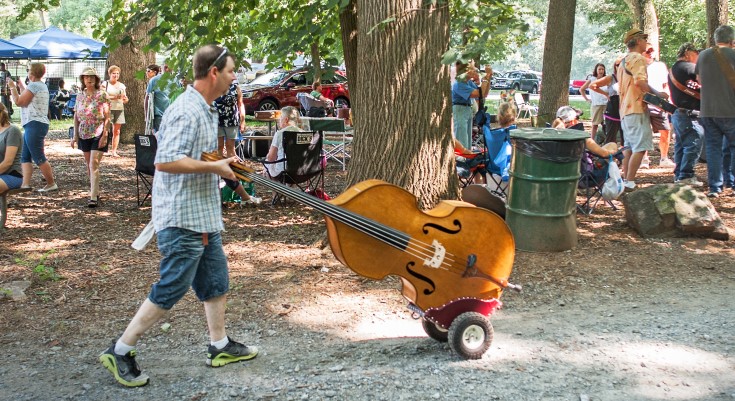
The music carries through the trees long before the musicians come into view. A fiddle strikes a quick, bright rhythm somewhere near the campground while the low pulse of an upright bass drifts across the grass beside Chambers Lake. Folding chairs sink into the earth beneath old shade trees as families unpack coolers and children chase one another between clusters of pickers tuning instruments by ear. Smoke from food trucks and campfires hangs lightly in the August air, mingling with the scent of pine needles, damp soil, and the lake beyond.
For one weekend every summer, Hibernia County Park sounds like another century.
By afternoon, the Old Fiddler’s Picnic has spread across the hillside in loose circles of music and conversation. Bluegrass spills into old-time folk. Banjo players nod to strangers who already seem familiar. Nearby, wagon rides rattle slowly along the gravel roads while campers settle into sites tucked beneath the woods. The atmosphere feels communal rather than programmed, as though the park itself has simply resumed a tradition older than anyone currently attending.
Hibernia matters now because it remains one of the rare places in Chester County where recreation, history, and landscape still feel inseparable. The 900-acre park northwest of Coatesville preserves not only woodlands, trails, and waterways, but the layered remnants of the county’s industrial past—an iron plantation transformed over generations into a public space where people now gather to fish, paddle, camp, hike, and listen to music beneath the same hills once shaped by furnaces and forges.
“It doesn’t feel manufactured here,” one longtime visitor says while standing near a jam circle beside the campground. “You can still feel the age of the place underneath everything.”
That history begins with iron.
Long before the land became a county park, Hibernia functioned as a sprawling iron estate owned by prominent ironmasters whose operations helped shape the economic backbone of 19th-century Chester County. Furnaces, worker settlements, roads, and industrial infrastructure once spread across the property, leaving behind traces still visible along trails winding through the woods today.
The park’s Forest Hill and Forge trails pass old ruins and stone remnants softened by moss and time. Crumbling foundations emerge unexpectedly beside the paths. Old railroad grades cut through the hillsides beneath dense tree cover. The landscape feels layered, carrying visible evidence of labor beneath the calm of the present-day park.
“You’ll be walking through the woods and suddenly there’s a wall or a foundation sitting there,” the visitor says. “It reminds you this wasn’t wilderness. It was somebody’s livelihood.”
At the center of the estate stands Hibernia Mansion, rising above the park on a wooded hillside overlooking Chambers Lake. Built and expanded in stages during the late 18th and 19th centuries, the mansion reflects the evolution of the iron industry itself—Federal symmetry giving way to Victorian additions as wealth and influence expanded.
Its position above the surrounding landscape still conveys authority.
During public tours, visitors move through rooms shaped by generations of ironmasters, their lives tied directly to the furnaces and workers below. Candlelight tours in December add another layer of atmosphere, the mansion glowing against winter darkness as though the estate never fully left the 19th century behind.
But Hibernia’s identity today belongs as much to the outdoors as to its architecture.
Chambers Lake stretches quietly across the center of the park, a 90-acre reservoir where gas motors are prohibited and the dominant sounds are paddles slipping through water and fishing lines cutting the air. Kayakers move slowly along the shoreline at sunrise while anglers settle into coves shaded by trees along Birch Run Trail.
“It’s peaceful in a way that’s getting harder to find,” says a fisherman casting toward the edge of the lake as mist lifts from the surface. “No jet skis. No engine noise. Just water.”
The park’s trails reinforce that sense of immersion. The Rim Trail climbs across rocky hillsides and old railroad beds, shifting between dense woodland and open views across the lake. Birch Run Trail follows the creek toward fishing access points where the water narrows into quieter pockets beneath overhanging branches.
In warmer months, the campgrounds fill steadily. Families return year after year to the wooded Fiddler’s Loop or the more open Lake Loop, setting up tents and campers beneath tall trees that soften the edges of neighboring sites. Nights at Hibernia tend to unfold slowly—campfires glowing between the woods, conversations stretching long after sunset.
“You come here and time works differently,” the fisherman says with a laugh. “People actually sit still.”
That slower rhythm may explain why the Old Fiddler’s Picnic has endured for nearly a century. What began 97 years ago as a gathering of regional musicians has evolved into one of Chester County’s most beloved traditions without losing its informal spirit. Hundreds of musicians and visitors now fill the park each August, but the event still feels deeply local—less performance than shared inheritance.
Children dance barefoot near the stage. Elderly musicians trade songs beneath folding canopies. Strangers drift naturally into harmonies they somehow already know.
“It’s one of the last things around here that still feels completely authentic,” the visitor says, listening as another fiddle tune rises through the trees. “Nobody’s pretending to be part of a tradition here. They just are.”
As evening settles across Hibernia County Park, the lake darkens beneath the hills while music continues drifting between campsites and wooded paths. Fireflies flicker above the grass. Somewhere near the pavilion, another song begins.
And beneath the sound of fiddles, laughter, and softly moving water, the old iron landscape remains—changed, reclaimed, and still very much alive.
Support the local news that supports Chester County. MyChesCo delivers reliable, fact-based reporting and essential community resources—free for everyone. If you value that, click here to become a patron today.