
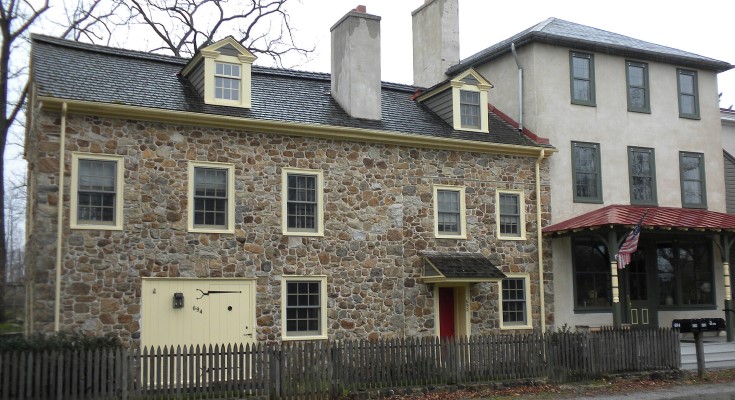
The intersection arrives gradually, almost quietly, as narrow roads curve through rolling Willistown countryside before converging beneath a canopy of old trees and weathered stone buildings. Tires hum softly over the pavement, slowing instinctively as drivers approach the crossroads. A breeze moves through the branches overhead, carrying the scent of damp earth and cut grass across the village green. Near the center of it all, the faded outline of a tavern sign hangs against pale stone walls that have watched travelers come and go for more than two centuries.
Sugartown does not announce itself. It reveals itself slowly.
By late morning, the village settles into the kind of calm that feels increasingly rare in Chester County. Sunlight catches the uneven glass of old windows. Gravel crunches beneath footsteps outside the former general store. Somewhere behind the historic buildings, a barn door creaks open, then closes again. The roads remain active, but only just—drivers slowing instinctively as they pass through, as though the village itself demands a different pace.
Sugartown matters now because so few places like it remain intact. While surrounding communities evolved around rail lines, suburban growth, and commercial expansion, this crossroads village in Willistown Township largely escaped reinvention. Never connected to a railroad or trolley system, Sugartown remained rooted in the geography and rhythms that shaped it in the late 18th and 19th centuries. Today, its fourteen preserved buildings form one of Chester County’s most cohesive surviving village landscapes—a place where the architecture, roads, and open land still reflect the life of a rural service community.
“It still feels human in scale,” one local historian says while standing near the intersection of Sugartown and Boot roads. “You can understand immediately how people lived here. Nothing is oversized. Nothing is disconnected.”
The village began as a practical necessity. Farmers traveling toward Philadelphia needed places to stop, repair wagons, buy supplies, or rest horses. Blacksmiths, wheelwrights, cabinetmakers, and shoemakers established shops near the crossroads, creating a compact center of trade and community life amid the surrounding farmland.
At the center stood the Sign of the Spread Eagle Tavern.
Built around 1790 and operated by Eli Shugart—the tavern keeper whose name eventually evolved into “Sugartown”—the stone inn became the social and commercial heart of the village. Farmers gathered there after long days in the fields. Travelers stopped for meals and lodging before continuing east. Community meetings and auctions unfolded within its walls.
“It was the place where everything crossed paths,” the historian says. “Business, politics, gossip, travel—it all happened there.”
The tavern no longer serves drinks or meals, but its presence still defines the village. The thick stone walls and balanced Georgian proportions remain remarkably preserved, standing at the convergence of the same five roads that shaped the community centuries ago.
Just steps away, the Sugartown Store recalls another layer of village life. Built around 1800, the structure once supplied local families with tools, dry goods, and household necessities while doubling as an informal gathering place where news traveled as reliably as merchandise.
“You didn’t come just to buy something,” the historian says. “You came because that’s where you found out what was happening.”
Education carried equal importance in Sugartown’s early identity. The Friends School and adjacent Schoolmaster’s House, dating to the 1780s, remain among the village’s most evocative buildings. The modest stone structures reflect the Quaker ideals that shaped much of early Willistown Township—simplicity, discipline, and community responsibility.
Inside the original school, generations of children learned in a single shared space, their lessons unfolding beside a central hearth during winter months. The schoolmaster lived only steps away, reinforcing how deeply woven education was into daily village life.
Today, Historic Sugartown, Inc. preserves and interprets those spaces, hosting tours, workshops, and seasonal events that reconnect visitors to the village’s craft traditions and rural history. Bookbinding classes and marbling workshops unfold inside buildings where earlier generations once practiced trades essential to survival.
“There’s something tactile about this place,” says a volunteer involved with the organization. “People come here because they want to experience history with their hands, not just read about it.”
That tactile quality extends beyond the buildings themselves. Much of Sugartown’s surrounding landscape remains open and agricultural, preserving the visual relationship between village and countryside that defined its original purpose. Barns and stables still sit on historic lots. Tree lines follow old property boundaries. The village remains physically connected to the land around it.
By late afternoon, the light softens across the crossroads, warming the stone façades in shades of amber and gray. Long shadows stretch across the intersection where wagon wheels once cut deep grooves into dirt roads leading toward Philadelphia.
The traffic remains light.
“It’s amazing that this survived,” the volunteer says, glancing down the quiet road. “Most places either disappeared or got swallowed up by something bigger.”
As evening approaches, the sounds of the village grow faint again—the rustle of leaves, the distant hum of a passing car, the soft creak of old wood settling with the cooling air. The crossroads empties, but never feels abandoned.
The roads still meet here, just as they always have.
And in Sugartown, that still seems to matter.
Support the local news that supports Chester County. MyChesCo delivers reliable, fact-based reporting and essential community resources—free for everyone. If you value that, click here to become a patron today.