
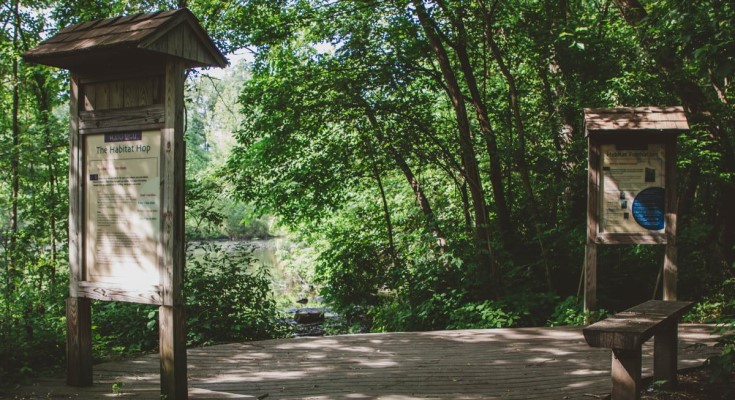
The first sound at Black Rock Sanctuary is usually the birds. Red-winged blackbirds cut through the morning stillness with sharp, metallic calls while great blue herons move slowly above the wetlands, their wings casting brief shadows across the water below. Along the edge of the interpretive trail, reeds sway gently in the breeze, brushing against one another with a dry whispering sound. The air smells faintly of river mud and wet grass, especially after rain, and in the distance the Schuylkill River moves steadily past the trees toward the Black Rock Dam.
By midmorning, the sanctuary feels suspended somewhere between wilderness and recovery.
Walkers move quietly along the ADA-accessible loop trail circling Black Rock Lake, pausing at overlooks where the wetlands open into broad stretches of shallow water and cattails. A child leans over the rail of the fishing pond, staring into water darkened by reflected clouds. Near the basin edge, a turtle slips from a log and disappears beneath the surface without a sound.
Black Rock Sanctuary matters now because it represents a rare environmental reversal—a landscape once shaped by industrial damage that has gradually been reclaimed by wildlife, water, and careful restoration. What was originally constructed as a desilting basin to trap coal waste flowing downstream from Pennsylvania’s anthracite regions has evolved into one of Chester County’s most ecologically dynamic public spaces. In a region where development often narrows the line between nature and suburbia, Black Rock offers something increasingly uncommon: a functioning wetland ecosystem woven directly into the Schuylkill River corridor.
“It’s amazing when you realize what this place used to be,” one regular visitor says while watching a pair of egrets pick through the shallows. “Now it feels alive in every direction.”
The sanctuary’s history is written into the shape of the land itself.
During the height of Pennsylvania’s coal era, the Schuylkill River carried enormous amounts of coal silt downstream from upstream mining operations. To manage the buildup, engineers created a series of desilting basins along the river, including the basin that would eventually become Black Rock Sanctuary. The site functioned as industrial infrastructure first—a practical attempt to contain environmental damage already in motion.
But over time, nature adapted to the altered landscape.
Seasonal water fluctuations created new wetland conditions. Marsh grasses and aquatic plants spread through the basin. Migratory birds began using the area as part of the Atlantic Flyway, transforming the once-industrial site into a critical habitat corridor.
“You can come here in spring migration and hear birds before you even leave the parking lot,” the visitor says. “It feels like the whole marsh wakes up overnight.”
The sanctuary’s 119 acres now support an extraordinary mix of ecosystems—wetlands, meadows, woodlands, shallow water habitat, and river edge—all compressed into a relatively compact space beside Route 113 just west of Phoenixville.
That variety is part of what makes the landscape feel so alive. Along the Meadow Trail, tall grasses ripple in the wind while dragonflies hover just above the vegetation. The Basin Trail moves closer to the water, where frogs call from hidden pockets of marsh and fish occasionally break the surface in widening rings.
The interpretive trail, fully ADA-accessible and looping roughly 0.8 miles around the basin, invites visitors to move slowly through the environment rather than simply observe it from a distance. Educational stations explain the site’s geology, wildlife, and ecological restoration, but the sanctuary’s appeal is ultimately sensory.
The wetlands smell different after rain. The bird activity changes with the seasons. Water levels rise and fall dramatically throughout the year, reshaping where animals gather and what visitors experience on any given day.
“No two visits are really the same,” says a local birder adjusting binoculars near the water’s edge. “Sometimes it’s quiet. Sometimes there are hundreds of birds moving through. The whole place changes with migration.”
The connection to the river remains central to everything here.
Just beyond the sanctuary sits Black Rock Dam, where a modern fish passage now allows American shad to migrate upstream during spring spawning runs—a journey blocked for generations after dam construction altered the Schuylkill in the 19th century. The restoration of fish migration routes has become one more layer in the sanctuary’s broader story of ecological recovery.
Even the small fishing pond beside the trail reflects that philosophy. The water supports largemouth bass, bluegill, and sunfish, but the pond is strictly catch-and-release, emphasizing stewardship over harvest.
“It teaches patience,” the birder says with a smile, watching a young boy cast carefully toward the reeds. “That’s kind of what this whole place does.”
Black Rock’s balance between conservation and accessibility helped earn it the Pennsylvania Department of Conservation and Natural Resources Green Park Award in 2011, recognizing sustainable park design and environmental management. Planned improvements—including canoe access, picnic spaces, and expanded trail connections—aim to deepen that relationship between public use and ecological protection rather than overwhelm it.
By late afternoon, the sanctuary grows quieter again. The light softens over the wetlands, turning the surface of the basin gold and bronze beneath the lowering sun. Birds begin settling into the reeds. The breeze cools slightly off the river.
From the far side of the trail, the sound of water moving through the dam carries faintly through the trees.
“It’s peaceful,” the visitor says softly, looking back across the marsh before heading toward the parking lot. “But it doesn’t feel untouched. It feels healed.”
As dusk settles across Black Rock Sanctuary, the wetlands darken into silhouette while the river continues moving steadily beside them—past the dam, past the trails, and through a landscape that, against long odds, found its way back to life.
Support the local news that supports Chester County. MyChesCo delivers reliable, fact-based reporting and essential community resources—free for everyone. If you value that, click here to become a patron today.