
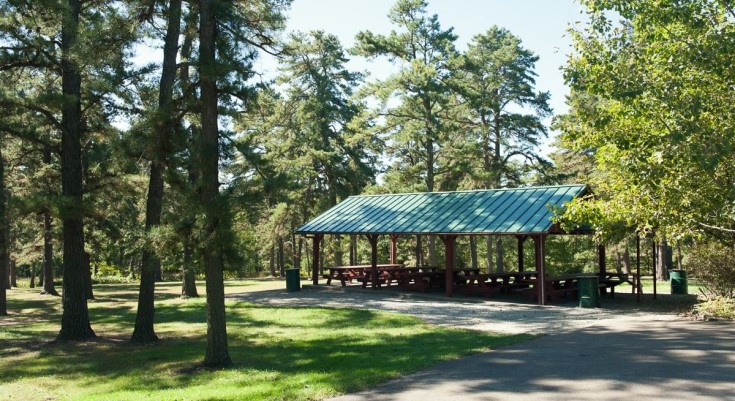
The ground at Nottingham County Park doesn’t look quite like the rest of Chester County. The grass grows thinner here, interrupted by exposed stone and stretches of rust-colored earth that seem sunbaked even in cooler weather. Pitch pines lean against the horizon in twisted silhouettes while low shrubs spread unevenly across the open barrens. Along the trails, the air smells faintly metallic after rain, and beneath the quiet rustle of wind through dry grasses, Black Run moves slowly past concrete ruins half-swallowed by the landscape.
At first glance, the park feels almost out of place.
By midday, hikers move carefully along narrow paths cutting through prairie-like openings and rocky outcrops unlike anything found elsewhere in the county. Interpretive signs point toward abandoned quarry pits and serpentine stone formations, while farther down the trail, the crumbling piers of a long-vanished chromite processing plant rise unexpectedly beside the creek. The landscape shifts constantly between woodland, savanna, wetland, and open barrens, creating a terrain that feels older and harsher than the rolling farmland surrounding it.
Nottingham matters now because it preserves one of the rarest ecosystems in the eastern United States—a serpentine barren landscape so ecologically unusual that it earned designation as a National Natural Landmark in 2008. At a time when development pressure continues reshaping southern Chester County, the park protects not only open space, but an environment where fragile soils, rare plants, industrial remnants, and human history remain deeply intertwined.
“It doesn’t feel like Pennsylvania sometimes,” one regular visitor says while standing near an exposed serpentine outcrop along the Heritage Hike trail. “It feels almost untamed.”
That sense of difference begins underground.
The park’s unusual landscape was shaped by serpentine bedrock rich in heavy metals and low in nutrients—conditions hostile to many forms of plant life but ideal for rare species uniquely adapted to survive there. The result is a sparse, open ecosystem more commonly associated with dry western grasslands than the forests of southeastern Pennsylvania.
In summer, the barrens take on muted shades of bronze, green, and gray beneath a wide, exposed sky. Low grasses ripple across rocky soil while scattered pitch pines rise from the landscape in irregular clusters. Certain plants grow nowhere else nearby, surviving precisely because the ground itself resists intrusion.
“It’s beautiful because it’s difficult,” the visitor says. “Most things can’t just take over here.”
Long before the land became Chester County’s first county park in 1963, the same geology that created the barrens also drew industry. During the 19th century, the region became one of America’s major chromite mining centers, supplying material essential to steelmaking and industrial production. Later, feldspar quarrying carved deeper into the hillsides, leaving visible scars that remain embedded in the landscape today.
The remnants appear suddenly along the trails.
Quarry pits open unexpectedly between stands of pine. Broken stone slopes descend into quiet depressions filled with brush and water. Near Black Run, the concrete foundations of a World War I-era chromite processing plant still stand beside the creek, weathered and cracked but unmistakably industrial.
“It’s strange how nature absorbed it all,” the visitor says while tracing the edge of one of the old foundations with a boot. “The ruins are still here, but the land keeps moving around them.”
That tension between fragility and resilience defines much of Nottingham County Park.
The serpentine soils are so sensitive that even recreational use requires careful management. The park’s equestrian riding ring—one of its more unusual amenities—opens only under dry conditions to prevent damage to the fragile turf and erosion-prone ground. Trails remain hiking-only specifically to protect the barrens ecosystem from overuse.
Even the silence feels protected.
Unlike more heavily programmed parks, Nottingham’s atmosphere leans toward observation rather than activity. The Serpentine Barrens Heritage Hike guides visitors through geology and mining history, while the Fitness Trail loops quietly through open grassland and woodland edge. Birdsong carries long distances across the exposed terrain, interrupted occasionally by the creak of insects or the distant sound of wind moving through pines.
By late afternoon, the light changes dramatically across the barrens. The rocky soil deepens into shades of copper and burnt orange while the open fields glow gold beneath the lowering sun. Shadows stretch long across abandoned quarry edges and along the banks of Black Run.
The landscape begins to feel even older then.
“It reminds you that not every beautiful place is comfortable,” the visitor says softly while looking across the open grasslands near the trailhead. “Some places survive because they’re hard.”
That difficulty may be exactly what saved Nottingham.
The same harsh soils that complicated farming and development preserved a landscape now recognized as ecologically irreplaceable. What once appeared barren or unproductive has become one of Chester County’s most important protected environments—a place where geology dictates ecology, and where history remains physically embedded in the earth itself.
As evening settles across Nottingham County Park, the wind moves steadily through the grasses while the quarry walls darken beneath the fading light. The old concrete ruins beside Black Run fall back into shadow. Somewhere beyond the pines, a hawk circles once before disappearing into the dusk.
And across the serpentine barrens, the land remains exactly what it has always been—difficult, uncommon, and stubbornly alive.
Support the local news that supports Chester County. MyChesCo delivers reliable, fact-based reporting and essential community resources—free for everyone. If you value that, click here to become a patron today.