
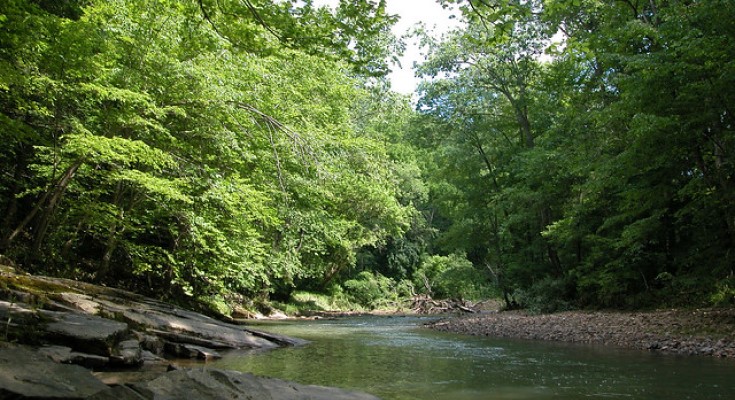
On a cool morning in southern Chester County, mist hangs low over the meadows of White Clay Creek. The only sounds are the rush of water over stone, the distant call of a red-tailed hawk, and the soft crunch of boots on a woodland trail disappearing beneath a canopy of oak and tulip poplar. Sunlight filters through the leaves in shifting patterns, illuminating patches of wildflowers along the creek bank before vanishing again into the shadows.
A few miles away, narrow country roads wind past weathered barns and carefully tended fields. Stone farmhouses sit on gentle rises overlooking pastures that stretch toward the Maryland border. The landscape feels remarkably unchanged, as though the centuries have passed quietly here.
That sense of continuity is part of what makes London Britain Township distinctive. In a county increasingly defined by growth and development pressures, this small municipality of just over 3,100 residents remains one of Chester County’s most intact rural landscapes—a place where conservation, history, and agriculture continue to shape everyday life. At a time when communities across southeastern Pennsylvania are grappling with how to accommodate change while preserving character, London Britain offers a living example of what long-term stewardship can look like.
Its story begins long before Pennsylvania’s borders were firmly established.
The township traces its roots to the colonial era, when overlapping land claims created uncertainty across the region. Organized in 1725 from lands owned by the London Company of Great Britain, the community occupied a strategic position along a contested frontier. For decades, portions of the area fell within Maryland’s claim to the New Munster tract, making it a gateway for Scotch-Irish settlers moving northward into Pennsylvania.
The eventual surveying of the Mason-Dixon Line brought clarity to the border. Yet traces of that earlier era remain embedded in the landscape.
Few places illustrate that history more vividly than Lunn’s Tavern. Standing quietly amid the countryside, the stone structure recalls a time when taverns served as far more than places to eat or sleep. Travelers moving between Pennsylvania, Delaware, and Maryland gathered there to exchange news, conduct business, and navigate the complexities of life along a disputed colonial boundary.
Nearby, Thompson Farm tells a different chapter of the township’s story. Its stone farmhouse and agricultural buildings remain remarkably intact, preserving the architectural traditions and family-centered farming culture that shaped southern Chester County for generations. The fields surrounding it still reflect patterns established centuries ago, creating a visual connection between past and present.
Yet history is only part of London Britain’s identity.
The township’s defining feature may be its relationship with the land itself.
At the heart of that relationship is White Clay Creek Preserve, a protected landscape encompassing nearly 1,300 acres within the township alone. This local sanctuary expands into a massive, bi-state park system protecting well over 5,000 continuous acres across Pennsylvania and Delaware, anchoring one of the region’s most ecologically significant watersheds.
Walking its trails offers a rare kind of quiet.
The creek bends through shaded ravines where ferns crowd the forest floor. Deer move cautiously through the underbrush. Anglers cast lines into clear water flowing beneath overhanging sycamores. In spring, the woods fill with birdsong; in autumn, hillsides ignite with gold, crimson, and amber.
The White Clay Creek watershed received federal recognition as a National Wild and Scenic River in 2000, a designation reserved for waterways possessing exceptional natural, cultural, and recreational value. For local residents, however, its importance is often measured less formally.
It is where families hike on Saturday mornings.
Where children learn to identify birds and wildflowers.
Where neighbors gather for conservation projects and community events.
And where many come simply to experience a landscape that feels increasingly rare in the Mid-Atlantic.
That commitment to preservation extends well beyond the creek corridor. Local organizations, including the London Britain Township Land Trust, have helped protect open space throughout the township, reinforcing a culture that views conservation not as an obstacle to progress but as an investment in the future.
The results are visible almost everywhere.
Unlike many suburban communities, London Britain remains defined by broad viewsheds, active farmland, and a road network that follows the contours of the land rather than reshaping it. The township’s 40 miles of local roads connect neighborhoods without overwhelming the rural character that residents value.
Economic prosperity has accompanied that approach. With a median household income exceeding $194,000 and a poverty rate of just 2.4%, the township has attracted residents seeking both quality of life and proximity to employment centers in Pennsylvania, Delaware, and Maryland.
Yet wealth alone does not explain the township’s appeal.
The attraction is something less tangible.
It is the sight of fog lifting from a pasture at dawn.
The silhouette of a stone farmhouse against a winter sky.
The feeling of standing beside White Clay Creek and knowing the water flowing past has followed the same path for thousands of years.
As evening settles across London Britain Township, the last sunlight catches the tops of the trees along the creek corridor. Shadows lengthen across fields that have been farmed for generations. The roads grow quiet. A breeze moves through the woods, carrying the scent of earth and water.
The landscape remains much as it has for centuries—not frozen in time, but carefully protected from being lost to it.
And in that fading light, London Britain Township offers a reminder that some places endure not because they resist change, but because they choose, generation after generation, what is worth preserving.
Support the local news that supports Chester County. MyChesCo delivers reliable, fact-based reporting and essential community resources—free for everyone. If you value that, click here to become a patron today.