
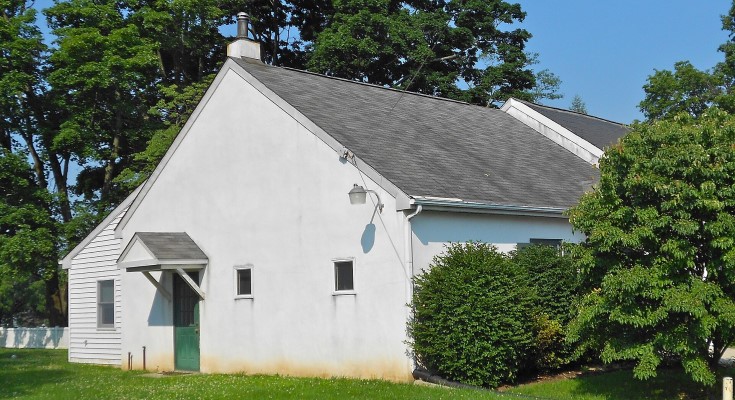
The gravel crunches softly underfoot as the path curves toward a low stone building, its walls weathered but steady, its windows catching the morning light in muted reflection. A breeze moves through the trees overhead, stirring leaves that seem to whisper rather than rustle. The Fallowfields Friends Meeting House sits back from the road, unassuming, its simplicity almost deliberate—as if it were never meant to draw attention, only to hold it.
Inside, the quiet feels intentional.
There are no raised voices here, no ornament, no spectacle. Just benches, worn smooth by generations, and a stillness that suggests something more than absence. It is the kind of space where words were chosen carefully—because they mattered.
That restraint, that insistence on purpose over performance, is what defines Ercildoun even now. At a time when many communities are rediscovering or reshaping their histories to fit the present, this small hamlet in East Fallowfield Township offers something rarer: a place where conviction once lived out loud and where its echoes remain embedded in the landscape.
“It wasn’t a loud place,” a local historian says, standing just beyond the meetinghouse door. “But what happened here carried weight far beyond it.”
In the early 19th century, that weight took shape in action.
Ercildoun, founded by Quaker families in the late 1700s, became one of Chester County’s most active centers of abolitionist thought and organizing. By 1835, the East Fallowfield Anti-Slavery Society had formed here, drawing together farmers, laborers, and reformers under a shared belief that silence, in the face of injustice, was not an option.
At the center of that movement stood James Fulton Jr., a man whose influence reached far beyond the village’s modest footprint. He wrote, lectured, organized—his voice traveling across counties and into national conversations, even as his home remained rooted in this quiet crossroads community.
“He believed ordinary people had a responsibility to speak,” the historian says. “And here, they did.”
Not all of those voices fit neatly within the bounds of tradition.
In 1845, residents built People’s Hall—a simple frame structure that, at the time, represented something radical: a place for open discourse, free from church control. Within its walls, abolitionists gathered alongside advocates for women’s rights and temperance, hosting speakers, organizing support networks, and, quietly, aiding those seeking freedom along the Underground Railroad.
“It was about creating space,” the historian explains. “Not just physically, but socially. A place where ideas could move.”
The village itself grew slowly around these ideals.
Fields were divided into smaller parcels. Homes—stone, brick, and frame—took shape along the roads, their forms reflecting both practicality and permanence. The Lukens Pierce House, with its unusual octagonal design, hinted at a willingness to experiment, while the John Bailey Farm spoke to the steady rhythms of agricultural life that sustained the community.
Even change, when it came, arrived with a kind of restraint.
A tornado in 1877 tore through the hamlet, destroying several early structures, yet much of Ercildoun endured. By the early 20th century, the Brandywine Building & Loan Association introduced a row of modest homes nearby, marking a shift toward a more modern kind of development—without overwhelming what had come before.
Today, the village remains small—barely a hundred residents—but its scale belies its significance.
The roads are still narrow. The fields still open outward. The meetinghouse still anchors the landscape, its presence unchanged in purpose if not in time. There are no crowds, no markers directing visitors toward a single defining feature. Instead, the history reveals itself gradually, in the alignment of buildings, in the persistence of place.
“It doesn’t announce itself,” the historian says. “You have to understand what you’re looking at.”
That understanding comes not from spectacle, but from continuity.
Ercildoun’s legacy is not preserved in isolation—it lives in the relationships between its spaces. The meetinghouse and the hall. The farms and the homes. The quiet roads that once carried voices outward into a wider world.
As the light shifts later in the day, the stone walls take on a warmer tone, and the air settles into a deeper stillness. The meetinghouse, unchanged in its simplicity, stands as it always has—present, but not imposing.
“It’s still doing what it was built to do,” the historian says, pausing before stepping away. “It’s still holding space.”
The leaves move again, softly this time, as if in agreement.
And in that quiet, Ercildoun remains what it has always been: a place where conviction didn’t need volume to be heard.
Support the local news that supports Chester County. MyChesCo delivers reliable, fact-based reporting and essential community resources—free for everyone. If you value that, click here to become a patron today.