
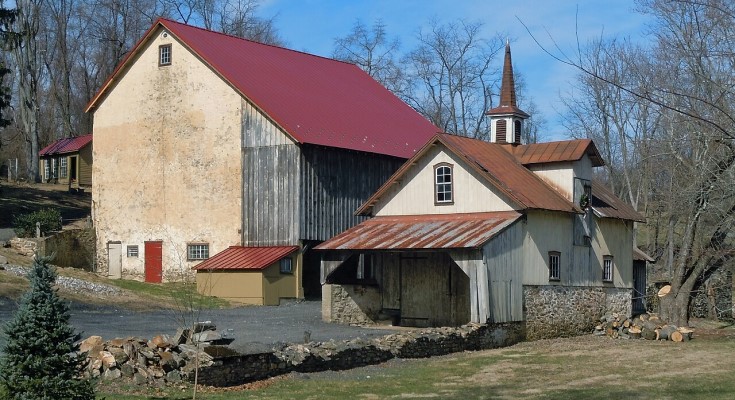
Fog hangs low above the East Branch of the Brandywine Creek as morning traffic begins to build along Horseshoe Pike. Near Guthriesville, old stone houses sit close to the road behind weathered maples, their walls catching the first pale light of the day while commuters stream east toward Downingtown, Exton, and the wider Philadelphia suburbs. Just beyond the traffic, fields still open wide behind split-rail fences, and the creek continues winding quietly through land that, in many places, has looked remarkably similar for generations.
The contrasts arrive quickly in East Brandywine Township.
Subdivision entrances stand only minutes from preserved farmland. Modern cul-de-sacs branch off roads first established during the colonial era. Along portions of the township, the pressure of Chester County’s suburban expansion feels unmistakable. Yet woven through it all are stone bridges, mill remnants, Quaker settlement patterns, and broad agricultural landscapes that continue resisting complete transformation.
That tension — between preservation and growth, memory and momentum — increasingly defines East Brandywine’s identity.
Originally settled around 1700 by English Quaker families drawn by William Penn’s land policies, the township grew along the power and geography of the Brandywine Creek. Mills, sawmills, and ironworks once lined the waterway, their success tied directly to the creek’s steady current and the fertile farmland surrounding it. Today, although much of the township has evolved into an affluent residential community, traces of that earlier landscape remain deeply embedded in its roads, villages, and preserved open space.
“You still feel the older Chester County here,” says a resident walking near Guthriesville on an early autumn morning. “Not untouched — but connected to where it came from.”
That connection survives most visibly along the township’s historic corridors.
At Bridge Mill Farm, the layers of East Brandywine’s past rise almost all at once from the landscape: the late-18th-century stone grist mill, the towering 1842 stone banked farmhouse, the stone barn, late-19th-century carriage house, and arch bridge gathered beside Culbertson Run in a composition that still reflects the rhythm of a working milling complex. The property remains one of Chester County’s most complete surviving agricultural-industrial sites, preserving the architecture of a time when the Brandywine powered much of the region’s economy.
A short distance away, Marshall’s Bridge spans Culbertson Run with the quiet elegance typical of Chester County stonework. Built in 1903, the two-span (double-arch) masonry bridge, accented with unique rows of brick arch rings, still carries local traffic across the water beneath a canopy of trees, its reflection breaking softly in the current below just before the stream joins the East Branch of the Brandywine.
“People rush through here now,” the resident says, glancing toward the roadway. “But these structures were built for a completely different pace of life.”
That older pace still lingers in Guthriesville.
Centered around the intersection of U.S. Route 322 and Bondsville Road, the historic village retains much of its linear 18th- and 19th-century form. Stone homes, former tavern sites, and remnants of the old commercial crossroads remain stitched into the modern streetscape, even as traffic volumes and residential development continue increasing around them.
The township itself has changed dramatically over the last several decades.
Population growth continues steadily. Median household incomes rank among the highest in the region. More than 5,000 acres of farmland remain preserved, yet new residential neighborhoods increasingly occupy land that once formed uninterrupted agricultural corridors. Large percentages of residents now work remotely or commute into nearby employment centers, reinforcing East Brandywine’s role as both suburb and rural holdover.
Still, the township’s geography continues shaping its character as much as its demographics do.
Rolling hills and wooded creek valleys naturally break up development patterns. Open meadows still separate clusters of homes. Along portions of the Brandywine corridor, long views across fields and tree lines remain largely uninterrupted, preserving visual continuity with the township’s agricultural past.
The Brandywine itself acts almost like a stabilizing force.
Its bends and floodplains helped determine where roads, mills, and settlements originally formed, and they continue limiting how densely parts of the township can develop today. Conservation efforts surrounding the creek corridor have helped preserve not just environmental quality, but also the township’s broader sense of spatial openness.
As evening settles over East Brandywine, traffic thins again along Horseshoe Pike. The creek darkens beneath Marshall’s Bridge while porch lights flicker on across old farmhouses and newer subdivisions alike. In Guthriesville, headlights briefly illuminate stone walls that have stood beside the roadway for centuries before disappearing into the dusk.
And somewhere beneath the steady momentum of suburban growth, the older Brandywine landscape still quietly holds its ground.
Support the local news that supports Chester County. MyChesCo delivers reliable, fact-based reporting and essential community resources—free for everyone. If you value that, click here to become a patron today.