
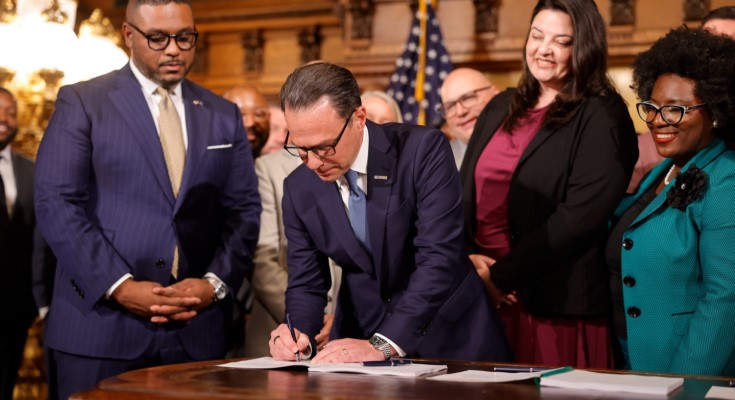
HARRISBURG, PA — Gov. Josh Shapiro signed Pennsylvania’s $50.85 billion fiscal 2026-27 budget into law Sunday, preserving roughly $8 billion in reserves while increasing spending on education, workforce development, transportation, public safety and economic development without raising taxes. The bipartisan spending plan passed after negotiations in the state’s divided legislature and incorporates priorities backed by both Democratic and Republican leaders.
The budget, which takes effect for the fiscal year that began July 1, expands funding for K-12 schools, career and technical education, state police recruitment, mental health services, child care workforce initiatives and business development while maintaining the Commonwealth’s Rainy Day Fund, according to the governor’s office.
Shapiro said the agreement continues a pattern of bipartisan budget negotiations despite divided control of the General Assembly.
“In a divided legislature, we’ve proven time and again that Democrats and Republicans can come together to get stuff done for the good people of Pennsylvania — cutting taxes, investing in education and workforce development, and keeping the economy growing,” Shapiro said.
House Republican Leader Jesse Topper, R-Bedford/Fulton, also credited the final agreement with preserving the state’s fiscal position.
“The budget passed by the General Assembly today continues our recent history of scouring every corner of state government for existing taxpayer dollars to avoid tax increases, cuts to government services or tapping into the Commonwealth’s Rainy Day fund,” Topper said.
The spending plan includes more than $678 million in additional education funding, including a $565 million increase through the adequacy and tax equity formula, $58 million more for Basic Education Funding and $55 million more for Special Education. Total K-12 education subsidies will reach $11.85 billion under the budget, according to the administration.
Lawmakers also approved a $10 million increase for career and technical education, bringing annual workforce development funding to $193 million. The budget expands the Grow PA scholarship program by $10 million, increases funding for child care workforce recruitment and retention to $30 million, and raises funding for student teacher stipends to $40 million.
Topper pointed to workforce and higher education initiatives as notable features of the package.
“I am also glad to see important investments in education where we are combatting the ongoing issue of growing waitlists at career and technical centers, expanding the successful GROW PA program to ensure Pennsylvania’s graduates have incentive to stay here, and ensuring our largest state-related universities receive funding based upon meeting new performance metrics and accountability provisions,” he said.
The budget establishes a new $125 million Innovate in PA 2.0 program intended to provide capital for startups and life sciences projects while continuing scheduled reductions in the Corporate Net Income Tax rate, which falls to 6.99%. It also maintains funding for Main Street business programs and historically disadvantaged businesses.
Transportation funding includes $775 million over two fiscal years for state-owned road projects, including $500 million this year and $275 million next year. The budget also finances four additional Pennsylvania State Police cadet classes with a $16.2 million appropriation and continues funding for violence prevention programs.
Additional appropriations include $10 million in dedicated funding for the 988 crisis hotline, $5 million for mental health walk-in centers, $12 million in additional support for rape crisis centers, $10 million in grants for fruit growers affected by spring freezes, and $7 million to modernize Supplemental Nutrition Assistance Program electronic benefit transfer cards with chip technology.
The budget also provides cost-of-living adjustments for eligible retired teachers, firefighters, law enforcement officers and other state employees who retired before 2001, while authorizing one-time transfers of $20 million for hazardous site cleanup and $19 million for abandoned well plugging.
Senate Republicans also characterized the spending plan as fiscally responsible, saying they prevented tax increases while preserving reserves and securing tax relief for small businesses.
“The PA State Senate passed a final budget that will not increase taxes on Pennsylvanians while delivering funding for critical services across the Commonwealth,” Senate Republican Campaign Committee Communications Director Michael Straw said. “The hard-working families of Pennsylvania want real fiscal leadership that addresses affordability, prevents crushing tax increases, and protects our Rainy-Day Fund.”
Despite supporting the agreement, Topper said lawmakers still face longer-term fiscal challenges.
“While revenues higher than budget estimates have shown some of the Republican-led policy wins in prior budgets are starting to have an impact, we must continue the work of providing pathways for significant economic growth and development in Pennsylvania if we stand any chance at reversing the challenging demographics of our ever-shrinking population,” Topper said.
Alongside the budget, Shapiro signed multiple related budget implementation bills into law Sunday. According to the administration, the Commonwealth is projected to retain approximately $8 billion in reserves by July 1, 2027.
Support the local news that supports Chester County. MyChesCo delivers reliable, fact-based reporting and essential community resources—free for everyone. If you value that, click here to become a patron today.