
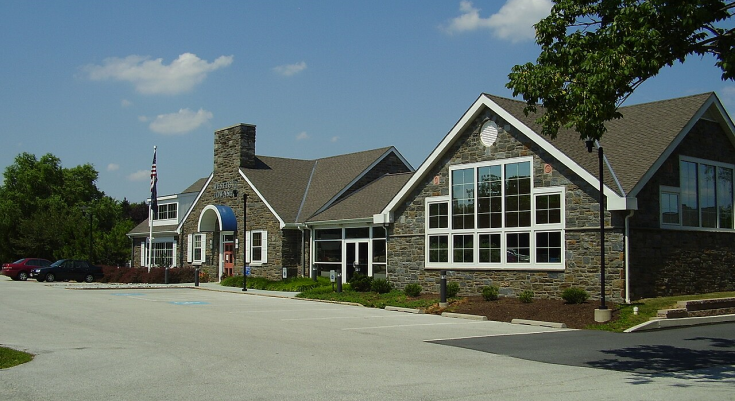
Morning light moves slowly across Oakbourne Park. It catches first on the tower of the old mansion, then slips across the formal gardens and the wide lawns beyond. Joggers follow the trails before the day turns busy. A dog noses through the grass near the path. In the distance, traffic gathers along Route 202, but here, beneath the mature trees, Westtown Township still feels connected to an older rhythm.
The contrast is part of its character.
Westtown sits close to some of Chester County’s busiest corridors, yet its identity remains tied to farms, estates, stone bridges, historic crossroads, and civic places where residents continue to gather. It is suburban now, certainly, but not placeless. Its landscape still remembers what came before.
That memory matters now.
As central Chester County continues to grow, Westtown offers a compelling example of how a community can become modern without surrendering its sense of place. Its schools, neighborhoods, parks, and commercial access give it present-day appeal, while its historic landscapes and civic engagement keep the township rooted in local identity.
Westtown’s documented history is written in farms, roads, and estates.
For generations, agriculture shaped the land now crossed by Shiloh Road, Oakbourne Road, Route 926, and the corridors leading toward West Chester and Delaware County. Farmsteads, fields, hedgerows, and stone houses formed the township’s early pattern, while road networks connected residents to markets, schools, churches, and neighboring villages.
That agricultural inheritance has not disappeared.
Along portions of Shiloh Road, Oakbourne Road, and Route 926, open fields still interrupt the suburban fabric. Farm lanes run back toward barns and older houses. Tree lines mark property edges that predate modern subdivisions. These corridors give Westtown a visual continuity that many suburban communities have lost.
Oakbourne Mansion is the township’s most visible symbol of that continuity.
Built in the 1880s as part of a country estate, the mansion rises with Victorian confidence—tower, stonework, porches, gardens, and all. Today, the estate has been transformed into a public park, its lawns and trails serving residents who may know it first as a place for a walk, a concert, a township event, or a quiet afternoon outside.
That transformation is what makes Oakbourne so important.
It is not merely preserved. It is used.
The mansion and park have become a shared civic landscape, where history supports everyday life rather than standing apart from it. Families gather there. Township events unfold there. The site gives Westtown a public heart.
Nearby, County Bridge No. 148 tells a smaller but equally revealing story.
Built in 1911, the stone arch bridge carries Route 926 (Street Road) over a branch of Chester Creek, its coursed-rubble masonry and quiet creekside setting preserving the craftsmanship of an earlier transportation era. It is easy to miss if one is driving quickly, but that modesty is part of its charm. Like many of Westtown’s historic resources, it does not demand attention. It rewards it.
The Historic Westtown Inn carries another layer of local memory.
Once a traveler’s stop and gathering place along the old road network, the inn reflects a time when rural communities depended on crossroads institutions for news, meals, lodging, and sociability. Though it no longer serves that function, it remains one of the township’s recognizable heritage landmarks, kept alive through local historical programming and public memory.
That kind of programming has become central to Westtown’s civic life.
The township’s Historical Commission, established in 2013, has helped turn local history into a living conversation through lectures, oral histories, archival projects, and public programs. Topics ranging from Oakbourne Mansion and colonial medicine to the Westtown Inn and Bayard Rustin connect residents not only to old buildings, but to broader stories of medicine, education, civil rights, and community change.
Rustin’s legacy gives Westtown one of its most meaningful modern connections.
The West Chester-born civil rights strategist who helped organize the 1963 March on Washington is honored locally through Bayard Rustin High School. For students and families, the name is more than a marker. It ties daily education to a figure whose work reshaped American democracy through nonviolence, labor organizing, and a relentless demand for equality.
Education remains one of Westtown’s defining strengths.
The township is served primarily by the West Chester Area School District, and high educational attainment is one of the community’s distinguishing characteristics. Families are drawn by schools, neighborhoods, open space, and proximity to employment centers throughout West Chester, Exton, Wilmington, and the Philadelphia region.
That proximity has helped make Westtown prosperous.
Median household income is well above state and national levels, home values remain high, and poverty rates are low. Yet the township’s appeal cannot be explained by statistics alone. People come for access and schools, but they often stay for texture: the parks, the older roads, the trees, the preserved pockets of countryside that make the community feel less interchangeable than many suburbs.
Westtown’s public life reflects that same balance.
The Board of Supervisors, Planning Commission, Parks & Recreation, and Historical Commission all operate in a township where residents tend to pay attention. Public meetings, lectures, park events, and neighborhood concerns form the practical machinery of civic life.
It is not glamorous work.
But it is how a township keeps its character.
As evening settles over Oakbourne Park, the mansion’s tower catches the last light. Children linger near the grass. Walkers make one final loop beneath the trees. Beyond the park, traffic continues along Route 202 and Route 926, carrying residents home through a community shaped by both motion and memory.
The old estate no longer belongs to one family.
It belongs to the township.
And in Westtown, that may be the clearest expression of its identity: a place where the past has been made public, useful, and still alive.
Support the local news that supports Chester County. MyChesCo delivers reliable, fact-based reporting and essential community resources—free for everyone. If you value that, click here to become a patron today.