
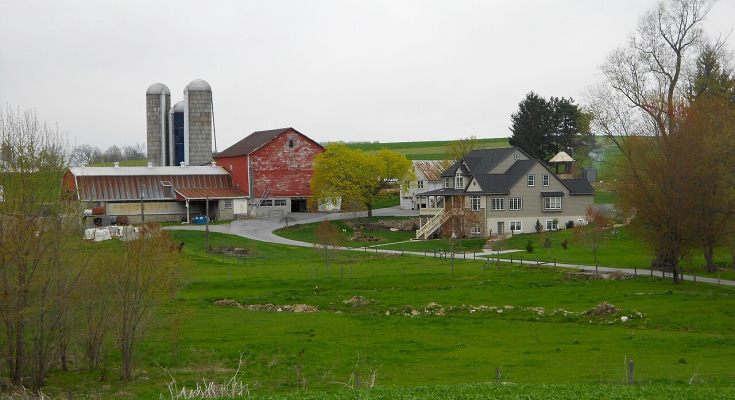
Morning traffic moves steadily along the Lincoln Highway. A tractor-trailer passes a weathered stone mile marker half-hidden in the roadside grass. A pickup turns toward a farm stand stacked with sweet corn and tomatoes. Beyond the pavement, fields rise toward wooded hills, and the first sunlight settles across barns, church steeples, and houses set back from the road.
West Sadsbury Township has always understood the pull of movement.
Travelers have crossed this western edge of Chester County for generations, following roads that linked farms to markets, villages to rail lines, and local life to the wider region. Yet even as modern traffic pushes through on U.S. Route 30, Route 10, Route 41, and Route 372, the township retains a rural steadiness that resists being reduced to a corridor.
That balance matters now.
As commercial and industrial growth gathers along major routes near Parkesburg and the Lancaster County line, West Sadsbury faces the same question confronting many rural-suburban communities: how to welcome economic activity without losing the farmland, woodlands, and civic habits that give the township its character. Here, preservation is not nostalgia. It is a practical strategy for keeping a small community recognizable to itself.
The landscape still carries its agricultural identity.
Across the township’s 10.7 square miles, productive fields, rolling hills, and wooded pockets remain central to daily life. Long-settled families, working farms, and seasonal stands continue to root West Sadsbury in the rhythms of planting, harvest, and roadside exchange.
In summer, the farm stands become landmarks of their own.
Drivers pull over for sweet corn, tomatoes, melons, and peaches. In autumn, pumpkins and gourds brighten the roadside. These small transactions carry a kind of intimacy that larger markets cannot replicate: food grown nearby, sold close to where it was picked, by people who know the land and the season.
The township has worked to protect that landscape.
Agricultural Security Areas and conservation easements help preserve farmland from subdivision, while a recently acquired 30-acre woodland preserve adds another layer of open-space protection. In a community bordered by Parkesburg, Atglen, Christiana, and several rural townships, that conservation work helps maintain the visual and environmental buffer that defines West Sadsbury’s sense of place.
The preserve tells a quieter story.
Its mature hardwoods, understory growth, and small clearings provide habitat for songbirds, deer, and other wildlife. More importantly, it gives residents a public green refuge close to home—an acknowledgment that open space matters not only when it is productive farmland, but also when it is simply allowed to remain woods.
Still, roads remain the township’s organizing force.
The Lincoln Highway is the most visible example. Its preserved mile markers stand as modest artifacts of America’s early automobile age, when U.S. Route 30 formed part of the nation’s first transcontinental highway. Weathered and easy to miss, the stones give the road a historic cadence, reminding travelers that today’s traffic follows a route shaped by more than a century of long-distance movement.
Those roads also bring pressure.
Recent retail, service, warehouse, distribution, automotive, and light-industrial development has concentrated along the township’s major corridors. The growth remains modest compared with larger suburban centers, but in a small township, even incremental change can alter the feeling of a place.
That is why West Sadsbury’s civic culture matters.
As a Second Class Township governed by a three-member Board of Supervisors, the municipality handles the practical work of local life: roads, land use, public safety coordination, permits, and planning. These may sound like ordinary functions, but in West Sadsbury they shape the line between corridor growth and countryside preservation.
Community life remains close to the ground.
Families gather around Octorara Area School District events. Churches, youth sports, 4-H, Scouts, Lions Club, Rotary, Habitat for Humanity, and Meals on Wheels sustain the networks that give small communities resilience. In a township with a younger median age than Chester County overall, those organizations help connect longtime residents with newer families drawn by affordability, schools, space, and access to regional employment.
The result is a place still defined by participation.
West Sadsbury is not a polished historic village or a destination built around a single landmark. Its identity is more practical and lived-in: roads maintained, fields protected, children coached, churches opened, neighbors fed, corn sold at the roadside before supper.
That ordinary continuity is easy to overlook.
But it may be the township’s most durable inheritance.
As evening settles over the Lincoln Highway, the last light catches the face of an old mile marker. Traffic continues west toward Lancaster and east toward Coatesville. Beyond the road, farm fields darken, and the woods at the township preserve gather into shadow.
The highway keeps moving.
The fields remain.
And in West Sadsbury Township, the old road still tells the story of a community determined to grow without forgetting what it was built beside.
Support the local news that supports Chester County. MyChesCo delivers reliable, fact-based reporting and essential community resources—free for everyone. If you value that, click here to become a patron today.