
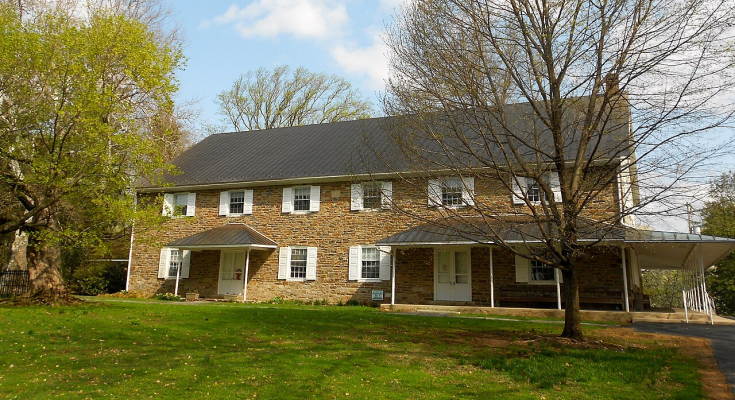
Morning comes quietly to the Doe Run Valley. Mist lingers over the pastures before lifting slowly from the grass. Horses graze behind weathered board fences. A narrow lane curves past old stone houses and broad fields that roll toward the horizon in long, unbroken lines. The landscape feels less like a view than a kind of inheritance—something handed down, protected, and still very much alive.
In West Marlborough Township, open space is not background scenery.
It is the story.
This rural corner of Chester County has remained one of the county’s most visually intact agricultural landscapes, not by accident but through generations of land stewardship. At a time when development pressure has transformed much of southeastern Pennsylvania, West Marlborough offers a rare example of what happens when farms, pastures, villages, and historic estates are preserved at a landscape scale.
The township’s roots reach back to 1729, when the original Marlborough Township was divided into East and West Marlborough.
For centuries, the community remained small, agricultural, and deeply tied to the rhythms of the land. Fields, mills, farmsteads, and small villages formed around waterways and rural roads. The population stayed sparse, and even today fewer than 1,000 residents live across more than 17 square miles of countryside.
That quiet scale is part of the township’s power.
There are few places in Chester County where the distance between buildings matters as much as the buildings themselves. In West Marlborough, the open fields are not empty. They are what allow the historic farms, stone houses, and villages to retain their meaning.
Much of that character is tied to one extraordinary chapter in the township’s modern history.
For a significant portion of the 20th century, the King Ranch—operating locally as Buck and Doe Run Valley Farms—became the dominant landowner in the area. Santa Gertrudis cattle were shipped north to graze and fatten on the rich pastures of southern Chester County, linking this quiet Pennsylvania valley to one of the most famous ranching operations in America.
The scale of the holdings shaped the township’s future.
Rather than being broken into dense subdivisions, large tracts of farmland remained intact. In the 1980s, conservation easements permanently protected major portions of the ranch lands, preserving the sweeping rural views that continue to define West Marlborough today.
That preservation effort remains one of the township’s defining achievements.
It safeguarded more than land. It protected the feeling of a place.
In Doe Run Village, that feeling is especially vivid.
The historic district preserves a small mill hamlet set among rolling pastures and narrow lanes. Stone and frame buildings cluster near the creek, while former mills, farmhouses, and worker dwellings reflect the township’s early agrarian and industrial life. The village does not feel staged or frozen. It feels lived in, shaped by centuries of work and restraint.
Nearby, Primitive Hall offers a more formal expression of the township’s early history.
Built around 1738 for Joseph Pennock, the brick Georgian house stands as one of Chester County’s finest colonial-era residences. Its Flemish-bond brickwork, balanced façade, and surviving interior details speak to the refinement and prosperity of early landowners in the Quaker-influenced Doe Run agricultural district.
Brooklawn tells a similar story in stone.
Set within a mature rural landscape, the historic estate reflects the evolution of working farmland into a refined country seat. Its proportions, outbuildings, and setting preserve the long relationship between architecture and agriculture that defines so much of West Marlborough.
Elsewhere, the Cyrus Hoopes House and Barn and the House at Springdell reinforce the same theme.
These are not isolated relics. They are pieces of a broader rural composition—farmhouses, barns, pastures, stream corridors, and roads that remain connected to one another in ways modern development often destroys.
That connection has attracted people deeply invested in land, horses, and preservation.
The township’s equestrian culture is among the most prominent in Chester County. Broad pastures, quiet roads, and preserved farms have supported generations of breeders, riders, and trainers. Professional horse trainer Michael R. Matz, best known for conditioning 2006 Kentucky Derby winner Barbaro, is among the figures associated with the area’s world-class horse culture.
The township’s notable lives extend beyond the equestrian world.
Joseph McMinn, born in the area in 1758, later became the fourth governor of Tennessee, carrying the legacy of a Pennsylvania farming community into the politics of the early American South. John Berne Hannum, a federal judge in the Eastern District of Pennsylvania, lived in the Doe Run Valley and became part of the township’s modern civic and preservation landscape.
Esther D. du Pont’s conservation legacy is especially central.
Through stewardship of large portions of the Buck and Doe Run Valley Farms holdings, she helped ensure that West Marlborough’s landscape would not be consumed by the suburban expansion reshaping much of the region. Her work helped preserve the township’s defining character: broad fields, working farms, historic structures, and open views that still feel continuous from one property to the next.
Even West Marlborough’s darker folklore belongs to the land.
James Fitzpatrick, the Revolutionary-era outlaw later romanticized as a local Robin Hood, is tied to the secluded roads and farmsteads of the Doe Run Valley. Whether viewed as criminal, folk figure, or symbol of wartime disorder, his story reflects the township’s remoteness during the Revolutionary period—a place of hidden lanes, divided loyalties, and hard-to-police countryside.
Today, West Marlborough remains quiet by design.
There are no major highways cutting through the township. Travel depends on rural roads that rise and fall with the terrain. Civic life centers on local meetings, land-use decisions, and the careful balancing of private ownership with public responsibility to a shared landscape.
That may sound modest.
But in West Marlborough, modesty is part of the achievement.
The township has not become famous for growth. It has not chased density, commercial corridors, or dramatic reinvention. Its identity rests instead on patience, restraint, and the recognition that some landscapes are more valuable intact than subdivided.
As evening settles over the Doe Run Valley, the last light stretches across the pastures. Horses lower their heads to graze. Stone houses glow softly beneath old trees. The roads grow quiet.
The fields remain open.
And in West Marlborough Township, that may be the most remarkable story of all: a community that understood, before it was too late, that the countryside itself was worth saving.
Support the local news that supports Chester County. MyChesCo delivers reliable, fact-based reporting and essential community resources—free for everyone. If you value that, click here to become a patron today.