
Morning light breaks across Nottingham County Park in uneven patches. It catches first on the greenish stone outcrops, then on the pale grasses and twisted pitch pines that rise from the serpentine barrens. The ground underfoot feels different here—thin, mineral-rich, and stubborn. A breeze moves across the open landscape, carrying the dry scent of grass, pine needles, and exposed rock.
This is not the gentle postcard countryside many people associate with Chester County.
West Nottingham Township is rougher-edged, older, and more geologically revealing. Its fields, Quaker meetinghouses, mining villages, and rare serpentine barrens tell a story shaped not only by settlement and agriculture, but by the minerals beneath the soil. In a region where development often smooths away local character, West Nottingham remains a place where the land still shows its seams.
That makes its story especially important now.
As southern Chester County continues to balance rural preservation, housing pressure, environmental protection, and historic identity, West Nottingham offers a striking reminder that landscapes are never just scenery. Here, the past is embedded in stone, soil, roads, and meetinghouse walls—evidence of a community shaped by border disputes, religious conviction, wartime necessity, farming, and 19th-century mining.
The township’s roots reach back to the Nottingham Lots.
In the early 1700s, followers of William Penn settled a 20,000-acre tract divided into 37 parcels under Cornelius Empson. The land soon became entangled in the Penn-Baltimore boundary dispute, a long-running colonial conflict over whether Pennsylvania or Maryland controlled the region. Only the eventual drawing of the Mason-Dixon Line settled the question.
The dispute left more than survey lines behind.
It helped shape the township’s identity as a borderland—part Quaker settlement, part Scotch-Irish frontier, part agricultural community looking south toward Maryland and west toward Lancaster County as much as east toward Philadelphia.
At the center of that early world stood the Nottingham Friends.
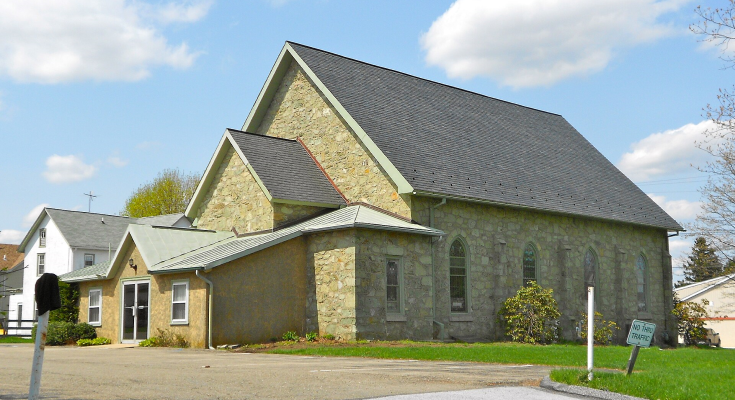
While West Nottingham built its simple stone meetinghouse, its sister congregation just down the road—the East Nottingham Brick Meetinghouse—became a literal casualty of the Revolutionary War. In 1778, General William Smallwood’s Maryland troops seized the brick building to use as a makeshift military hospital, uprooting the congregation and forcing them to crowd into West Nottingham’s quieter stone house for refuge.
The image is striking.
A pacifist community, built for silence and worship, suddenly split open—refugees in their own township, navigating a war its members could not support.
That tension captures something essential about West Nottingham’s early history. Like much of Chester County, it was a place of conviction and compromise, where religious principles, political upheaval, and military necessity often occupied the same room.
For generations, agriculture remained the township’s foundation.
Farms spread across the rolling countryside. Roads connected homesteads to Oxford, Lancaster County, and Maryland. Families built lives around planting, livestock, church, and market days.
Then the ground itself changed the township’s future.
In 1826, chromite mining began in the region, soon drawing the attention of Baltimore industrialist Isaac Tyson, setting off an era that made West Nottingham nationally significant. The township became a center of chromite mining, with operations such as the Scott-Engine-Kirk and Moro-Phillips mines drawing labor, investment, and industry into what had long been a rural landscape.
Mining reshaped both economy and geography.
Small industrial villages emerged at Chrome, Glenroy, Fremont, and Nottingham. Workers lived near pits, quarries, and processing sites. Roads and transportation routes carried minerals out of the township to markets far beyond Chester County. For much of the 19th century, West Nottingham stood at the center of America’s chromite production.
The industry eventually faded.
Global competition and changing mineral markets ended local chromite production around 1900. But the mining era left behind a landscape unlike any other in the county.
Nowhere is that more visible than Nottingham County Park.
Set on former chromite mining lands, the 731-acre park protects one of the East Coast’s most important serpentine barrens. Its open grasslands, pitch pine stands, rare plants, and exposed greenstone create an ecological world shaped by difficult soil and industrial history. Old quarry scars and mining remnants remain woven into the trail system, reminding visitors that conservation and extraction are both part of the park’s story.
The barrens are beautiful precisely because they are severe.
The soil is thin. The vegetation is specialized. The rocks appear almost otherworldly. It is a landscape that refuses to be mistaken for anywhere else.
That distinctiveness has become one of West Nottingham’s greatest assets.
Today, the township remains rural-residential, with agriculture, small businesses, and open land still defining much of daily life. Its population has grown steadily but modestly, reaching 2,760 residents in 2020. Most residents commute by car, and township government continues to focus on the practical concerns of rural life: zoning, building codes, septic maintenance, groundwater protection, and land-use decisions.
Those details may seem ordinary.
But in West Nottingham, they are part of a larger stewardship ethic.
Protecting groundwater matters in a rural community dependent on wells and septic systems. Preserving open land matters where agriculture remains part of local identity. Maintaining historic sites matters when so much of the township’s story is carried by buildings, roads, and landscapes rather than formal monuments.
The result is a place that still feels anchored.
Nottingham village provides a local center of gravity. The historic mining settlements preserve echoes of the 19th century. The Friends Meeting continues to connect the township to its Quaker origins. The county park draws hikers, naturalists, families, and history-minded visitors into a landscape where geology and human ambition are impossible to separate.
As evening settles over Nottingham County Park, the serpentine outcrops hold the last warmth of the day. Shadows lengthen across the barrens. The pitch pines darken against the sky, and the trails grow quiet.
Beneath the grass, the old mining ground remains.
Beyond the park, farms and meetinghouses and villages continue their slower work of memory.
And in West Nottingham Township, the land still tells the truth first—through stone, soil, and the marks people left behind.
Support the local news that supports Chester County. MyChesCo delivers reliable, fact-based reporting and essential community resources—free for everyone. If you value that, click here to become a patron today.