
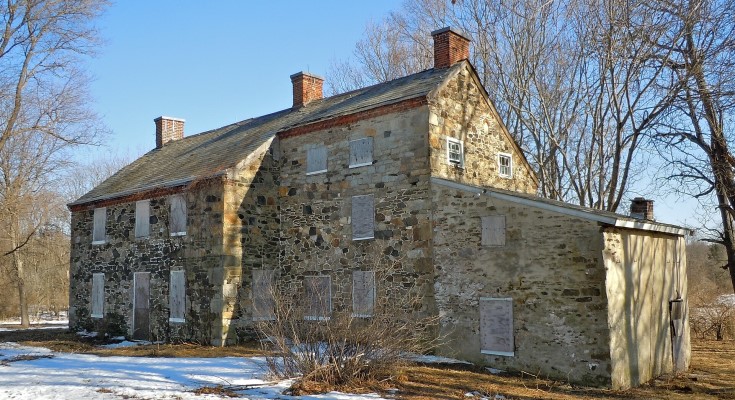
Morning light filters through the trees along Chester Creek, illuminating moss-covered stone walls hidden beneath a canopy of sycamores and tulip poplars. Water slips quietly over rock ledges where millraces once churned with industrial energy. Nearby, a narrow country road curves past farm fields that have changed remarkably little since the days when horsemen carried urgent news toward George Washington’s headquarters.
At first glance, Thornbury Township feels almost invisible.
Though originally a single colonial community, a post-Revolutionary political split in 1789 divided the land down the middle, creating twin Thornbury Townships—one in Chester County and one in Delaware County. Today, drivers pass through this shared borderland without realizing that beneath its quiet, interconnected landscape lies a story that stretches from Pennsylvania’s earliest iron industry to the Revolutionary War and the founding of the nation’s oldest historically Black university.
That story feels increasingly relevant today.
As development continues to reshape much of southeastern Pennsylvania, Thornbury remains one of those rare places where history survives not only in preserved buildings but in the landscape itself. Creeks still follow the same routes that powered colonial industry. Farm fields remain open where soldiers once rode. Historic homes continue to stand within sight of roads first traveled centuries ago. In Thornbury, the past is not a separate attraction—it remains part of everyday life.
The township’s roots reach back to 1687.
Named for Thornbury in Gloucestershire, England, the undivided community was among the earliest municipalities established in William Penn’s Pennsylvania. At the time, only a handful of families occupied the rolling countryside. Dense forests covered much of the landscape, while Chester Creek carved a winding path through the valley below, acting as a boundary line that would later divide the townships but always unite their history.
The creek soon became the township’s economic engine.
By the early eighteenth century, water-powered industry had begun to emerge along its banks. The most significant of these ventures was Sarum Forge, established in 1724 and recognized as Pennsylvania’s first slitting mill operation. Ironworkers, millers, laborers, and investors arrived, transforming what had been frontier farmland into one of the colony’s earliest industrial centers.
The physical evidence remains surprisingly visible.
Just across the modern county line in Thornbury’s Delaware County half, deep in the woods, the Taylor–Frazer Ruins still rise from the creek valley floor. Stone foundations, remnants of raceways, and fragments of industrial structures emerge from the undergrowth like archaeological clues to an earlier era. Nearby, Locksley Mill stands as the last substantial survivor of the once-thriving Sarum and Glen Mills industrial complex, proving how the creek’s economic engine ignored political borders.
Together, they tell the story of a township that helped power colonial Pennsylvania long before factories dominated American manufacturing.
Yet Thornbury’s most famous chapter arrived with the Revolution.
On September 11, 1777, as British forces maneuvered through the Brandywine Valley, local farmer and civic leader Squire Thomas Cheyney became an unlikely figure in one of the war’s most critical moments. Observing British troop movements, Cheyney realized Washington’s army faced a dangerous flanking maneuver.
Rather than assume someone else would deliver the warning, he rode directly to Washington himself.
The intelligence arrived too late to prevent the American defeat at Brandywine, but Cheyney’s determination helped alert Continental commanders to the developing threat. His ride has since become one of Chester County’s defining Revolutionary War stories.
Today, the Squire Cheyney Farm still anchors that legacy.
The stone farmhouse and surrounding agricultural landscape preserve a remarkably authentic view of the countryside Cheyney would have known. Standing among its fields, it becomes easier to imagine the urgency of that September day and the uncertainty facing a young nation fighting for survival.
History takes other forms here as well.
On the grounds of nearby Cheyney University of Pennsylvania stands Melrose Cottage, a Gothic Revival residence that once served as the president’s home. The building offers a tangible connection to an institution whose influence extends far beyond Chester County. Founded in 1837, Cheyney University remains the nation’s oldest historically Black college or university, a distinction that gives the surrounding landscape significance reaching well beyond local history.
Elsewhere, Thornbury Lodge reflects another layer of the township’s past.
Known historically as the William J. Barnard Residence, the elegant stone home recalls a period when prosperous Quaker families shaped much of the Brandywine Valley’s agricultural, industrial, and civic life. Surrounded by mature trees and open grounds, it remains one of the township’s architectural treasures.
What unites these places is not merely their age.
It is their setting.
Unlike many historic landmarks that have become isolated by modern development, Thornbury’s resources remain connected to one another through a largely intact landscape. Creek corridors, wooded ravines, open fields, and winding roads continue to provide the context that gives these sites meaning.
That continuity helps explain the township’s enduring appeal.
Residents enjoy proximity to West Chester, Media, and Philadelphia while living within a community that still feels distinctly rural. Open space remains visible. Chester Creek continues to shape the terrain. Historic properties remain woven into neighborhoods rather than separated from them.
The result is a place where history feels remarkably present.
Not preserved behind glass.
Not confined to plaques.
Simply part of the scenery.
As evening settles across the creek valley, sunlight catches the stone walls of Locksley Mill before disappearing beneath the trees. Water continues its steady journey downstream, moving past ruins, farm fields, and historic homes much as it has for centuries.
The creek powered the forge fires.
It flowed past Squire Cheyney’s farm.
It witnessed the rise of industry, education, and community.
And in Thornbury Township, it continues to carry the story forward—quietly, steadily, and largely unchanged by the passage of time.
Support the local news that supports Chester County. MyChesCo delivers reliable, fact-based reporting and essential community resources—free for everyone. If you value that, click here to become a patron today.