
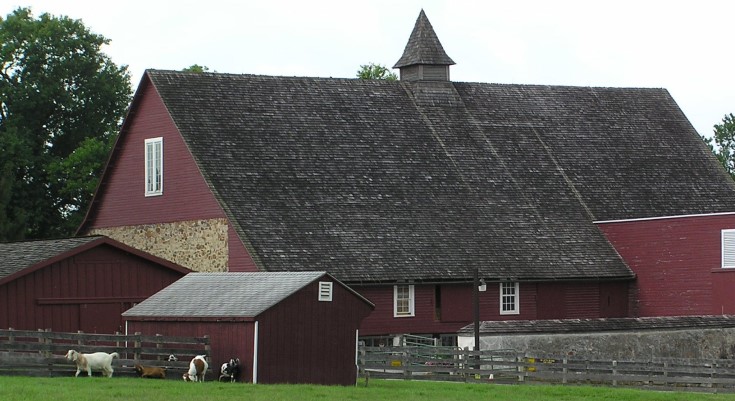
The peacocks usually make themselves known before visitors see them. Their sharp, unexpected calls echo across the pastures at Springton Manor Farm, cutting through the softer sounds of rustling trees, clucking chickens, and the low murmur of children gathered near the fence lines. Morning light spills across the rolling fields in long bands of gold, catching the weathered wood of the Great Barn and the white fencing stretching toward the Manor House on the hill. Near the pond, a father helps a young boy untangle a fishing line while horses shift lazily in the nearby pasture, their movements slow and unhurried in the cool air.
At Springton Manor, the landscape still behaves like a farm first.
By late morning, school groups begin filtering through the barn complex, moving from animal pens to museum exhibits with a mixture of curiosity and disbelief. Inside the Great Barn, the scent of old timber and hay lingers beneath soaring beams that have framed generations of agricultural life. Antique plows, milk cans, and hand tools line the Family Farm Museum, tracing the evolution of Chester County farming from colonial subsistence to industrial efficiency.
Springton Manor Farm matters now because it preserves something increasingly fragile in Chester County: the experience of an active agricultural landscape that remains both historic and accessible. In a region where development continues reshaping farmland into subdivisions and commercial corridors, the 300-acre property offers a rare continuity between past and present—a place where education, recreation, history, and working farm traditions still exist together within the same rolling fields.
“It’s not frozen in time here,” one longtime volunteer says while watching children feed goats near the demonstration farm. “That’s what makes it different. People still interact with the land.”
The farm’s roots stretch back to the early 1700s, when the property formed part of a William Penn manor holding in what is now Wallace Township. Over the centuries, the land evolved repeatedly, reflecting the broader transformation of American agriculture itself—from colonial plantation to scientific farm, from Victorian tenant operation to gentleman’s country estate.
Each era left something behind.
The Manor House, built in 1833 by Abraham R. McIlvaine and later expanded by businessman George Bartol, rises above the property with the quiet confidence of an old estate shaped over generations rather than designed all at once. Its stone façade catches the afternoon light differently as the seasons shift, while century-old trees frame sweeping views across the surrounding pastures and meadows.
“It feels lived in by history,” the volunteer says. “Not staged. Just layered.”
That layering becomes most visible inside the Great Barn.
Constructed in 1888 as part of Bartol’s estate expansion, the barn remains one of the property’s defining landmarks—a massive timber-framed structure whose scale still conveys the ambition of late-19th-century agriculture. Sunlight filters through high windows onto displays of antique farm equipment that once defined daily labor across Chester County.
Visitors move slowly through the museum, pausing beside horse-drawn machinery and hand tools that now feel almost impossibly physical in their design.
“You look at those tools and realize farming used to require your whole body,” the volunteer says with a laugh. “Every day.”
Outside, the demonstration farm brings that history into the present tense. Children crowd around pens housing sheep, goats, pigs, rabbits, and chickens while parents linger nearby, often watching with as much fascination as the kids themselves. The animals are not presented as spectacle so much as connection—a reminder that agriculture remains part of daily life even in one of Pennsylvania’s fastest-growing regions.
For many visitors, that interaction feels surprisingly emotional.
“My daughter thought eggs came from the grocery store,” one parent says while pointing toward the chicken coop. “Now she wants to come back every weekend.”
The trails winding through the property reinforce the sense that the farm exists as a complete landscape rather than a collection of attractions. More than seven miles of paths follow old farm lanes through woodlands, pollinator meadows, and open pastureland where the Manor House and Great Barn appear and disappear through gaps in the trees.
In spring and summer, the pollinator gardens hum with bees and butterflies moving between native flowers. In autumn, the hillsides soften into muted gold and rust beneath broad open skies that feel increasingly uncommon near suburban Philadelphia.
Even the fishing pond near the Manor House seems shaped by the farm’s quieter pace. Children cast lines into calm water framed by mature trees and grazing fields, their reflections broken occasionally by ripples near the shoreline.
“It teaches people to slow down,” the parent says while watching the bobber drift across the pond. “You can’t rush anything out here.”
That slower rhythm may explain why Springton Manor has also become one of Chester County’s most sought-after wedding venues. Couples exchange vows beneath old oaks or beside formal gardens overlooking the same agricultural landscape that has defined the property for centuries. Elegant receptions unfold inside climate-controlled tents while sunset settles across the fields beyond.
The contrast somehow works naturally: refined celebrations unfolding within a landscape still grounded in work, weather, and seasons.
By evening, the crowds thin and the farm begins settling back into itself. The peacocks quiet. Shadows stretch long across the pastures. Somewhere near the barn complex, the last visitors drift toward the parking lot while the horses remain motionless against the fading light.
The land grows quiet again, but never empty.
“You come here and remember what Chester County used to feel like,” the volunteer says softly, glancing across the fields toward the Manor House. “And maybe what parts of it still can.”
As dusk settles over Springton Manor Farm, the old barn darkens against the sky while the pastures hold onto the last traces of sunlight. The fences, trails, and stone buildings remain exactly where they have stood for generations—part working landscape, part memory, and still deeply alive.
Support the local news that supports Chester County. MyChesCo delivers reliable, fact-based reporting and essential community resources—free for everyone. If you value that, click here to become a patron today.