
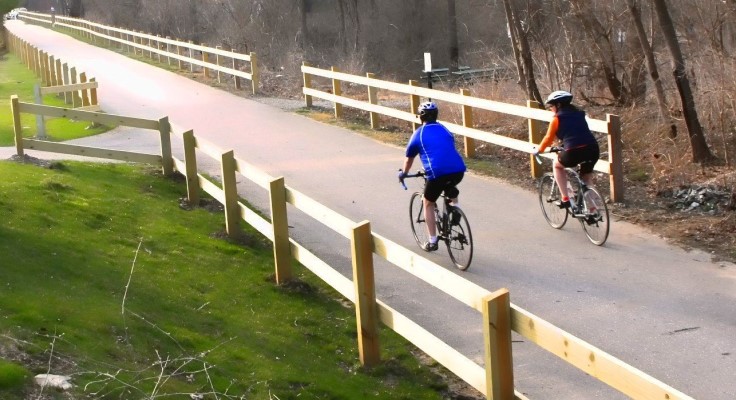
By 7:30 on a weekday morning, the Chester Valley Trail is already moving. Cyclists in reflective jackets glide east out of Exton beneath the soft hum of commuter traffic beyond the tree line. Joggers weave past dog walkers near the Battle of the Clouds trailhead while a man balancing a travel mug in one hand adjusts his pace to catch the green light crossing Swedesford Road. Along the paved corridor, the smell of wet asphalt and freshly cut grass lingers in the cool air, and somewhere farther down the trail, the sharp click of bicycle gears echoes briefly beneath an overpass before fading again into motion.
The trail never seems entirely still.
By midmorning, the rhythm changes. Commuters give way to retirees walking in pairs, parents pushing strollers, and cyclists riding slowly enough to notice the landscape unfolding around them. Office buildings rise unexpectedly behind stretches of meadow and woodland. The route slips quietly past municipal parks, corporate campuses, wetlands, apartment complexes, and fragments of old Chester County farmland that survived suburban expansion almost accidentally.
The Chester Valley Trail matters now because it has become more than recreational infrastructure. Stretching 13.5 miles across Chester County along the former Chester Valley Railroad corridor, the trail functions simultaneously as commuter route, public park, historical corridor, and connective tissue for communities that long developed around cars rather than pedestrians. In a region increasingly defined by congestion and rapid growth, the trail offers something surprisingly rare: continuous public space that allows people to move through the county at a human pace.
“It changes the way you experience this area,” one daily cyclist says while pausing near the Exton Park trailhead. “When you drive everywhere, Chester County feels fragmented. On the trail, it suddenly feels connected.”
That connection begins with the railroad itself.
The Chester Valley Railroad opened in 1853, later operating as a Reading Railroad branch hauling limestone, livestock, dairy products, and agricultural goods from the Great Valley into Philadelphia. For decades, trains carried the economic life of Chester County eastward along the corridor before passenger service ended in 1935 and freight operations gradually faded in the late 20th century.
What remained was a narrow strip of land running quietly through the county’s changing landscape.
Rather than abandon it entirely, planners transformed the former rail corridor into a multi-use trail—preserving the original alignment while adapting it for an entirely different kind of movement. Today, the paved asphalt route stretches from Exton eastward into Montgomery County, with future extensions planned toward Downingtown and the western borders of the county.
“It’s funny,” the cyclist says with a laugh while watching another commuter pass at speed. “The railroad connected people to work back then. The trail still does.”
That dual identity—practical infrastructure and recreational escape—is part of what makes the trail feel unusually alive throughout the day.
Near Exton, office workers use it to bypass traffic between corporate campuses and residential developments. In Malvern and Tredyffrin, runners and cyclists move through stretches where the corridor narrows between wooded embankments and busy roads.
The trail’s accessibility shapes much of its appeal. At 10 feet wide with gravel shoulders and ADA-compliant design, the route accommodates wheelchairs, strollers, inline skaters, and casual walkers alongside more serious cyclists moving steadily through the corridor.
“It’s one of the few places where everybody fits,” says a woman walking her dog near the East Whiteland access point. “You’ve got commuters flying by, kids learning to ride, older people walking for exercise—it somehow all works.”
Yet despite its modern function, the trail still carries visible traces of older landscapes.
Near Phoenixville Pike and Swedesford Road, portions of the route parallel troop movements associated with the 1777 Battle of the Clouds campaign during the Revolutionary War. Elsewhere, remnants of old rail infrastructure appear unexpectedly beside the pavement—stone embankments, bridge abutments, subtle curves shaped by 19th-century engineering decisions still determining movement today.
And then there are the quieter moments.
In early spring, red-winged blackbirds settle into wetlands bordering the trail near Exton. During autumn, leaves gather in thick drifts along the shoulders beneath tunnels of gold and copper trees. After snowfall, cross-country skiers sometimes reach the trail before plows arrive, gliding silently along the old railroad grade while the surrounding suburbs remain half asleep.
“There are mornings out here that don’t even feel suburban,” the dog walker says softly. “Especially in winter.”
The trail’s popularity has transformed it into one of Chester County’s most heavily used public spaces, but it rarely feels crowded in the traditional sense. Instead, movement disperses naturally along the corridor—people entering and leaving through trailheads tucked behind municipal buildings, office parks, and neighborhood access points.
At Westlakes Drive in Berwyn, office workers emerge onto the trail during lunch breaks. Near the West Whiteland Municipal Building, cyclists stop briefly before continuing west. At Battle of the Clouds Park, families gather beside open fields where Revolutionary War troops once maneuvered beneath gathering storm clouds.
The trail absorbs all of it without demanding attention to itself.
“It feels like infrastructure people actually love,” the cyclist says while clipping back into his pedals. “That’s pretty rare.”
By evening, the Chester Valley Trail begins shifting again. The commuter rush returns in waves as cyclists stream west toward Exton and east toward the Main Line. Sunlight drops low across the pavement, filtering through rows of trees planted beside the corridor. The sounds of traffic remain nearby, but softened somehow by distance and movement.
And beneath the wheels, footsteps, and steady rhythm of modern life, the old railroad route continues carrying people across Chester County—just as it always has, only quieter now.
Support the local news that supports Chester County. MyChesCo delivers reliable, fact-based reporting and essential community resources—free for everyone. If you value that, click here to become a patron today.