
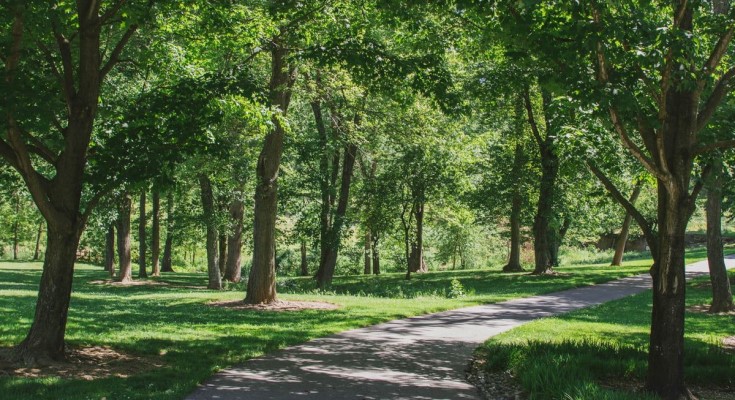
The trail narrows quickly at Wolf’s Hollow County Park, slipping beneath a canopy of hardwood trees where sunlight reaches the forest floor only in scattered fragments. Dry leaves crack softly underfoot while the distant sound of Octoraro Creek rises faintly from somewhere below the ridge. Along the Charcoal Trail, the woods carry the earthy smell of damp moss, old bark, and decomposing leaves, but now and then the ground changes unexpectedly—flattening into strange circular clearings darkened with black soil that seems almost scorched even after centuries.
At Wolf’s Hollow, the forest does not hide its history so much as absorb it.
By late morning, the park feels profoundly quiet in a way increasingly rare in southeastern Pennsylvania. No bicycles cut through the trails. No playground noise drifts through the woods. Hikers move carefully along narrow ridgelines overlooking the creek valley while birdsong echoes through mountain-laurel glades and deep ravines. The stillness sharpens every sound: the tap of a woodpecker somewhere beyond the trees, the rush of wind through the upper branches, the low movement of water below the bluffs.
Wolf’s Hollow matters now because it preserves one of Chester County’s least-altered industrial landscapes—not through reconstruction or monuments, but through terrain itself. The park’s nearly ten miles of foot-only trails move directly through the remnants of an early ironmaking district where charcoal forges, collier camps, and water-powered ironworks once operated beside the Octoraro Creek. In an era when many historic sites survive only through interpretation, Wolf’s Hollow still feels physically connected to the labor that shaped it.
“You don’t really visit this park,” one regular hiker says while pausing near an old charcoal platform hidden beside the trail. “You disappear into it.”
That immersion begins with the land itself.
The park’s steep wooded slopes and narrow creek valleys once made the area ideal for charcoal iron production. Beginning in the late 18th and early 19th centuries, local forges used the Octoraro Creek for waterpower while surrounding forests supplied the hardwood needed to create charcoal—the essential fuel of early American ironmaking.
The process was relentless.
Colliers stacked cords of hardwood into carefully shaped mounds, covering them with earth and slowly burning them under controlled conditions for days at a time. The resulting charcoal burned hotter and cleaner than raw wood, allowing nearby finery and chafery hearths to refine pig iron into wrought iron used in tools, wagon parts, hardware, and industrial equipment across the growing nation.
And the evidence remains startlingly visible.
Along the Charcoal Trail, hikers pass dozens of preserved charcoal pits—large, circular platforms carved into the hillsides where those slow-burning fires once smoldered. Some date back more than 200 years. Their outlines remain etched into the terrain like quiet industrial fingerprints beneath the trees.
“The first time you notice them, you suddenly realize the whole forest was working,” the hiker says softly. “Every ridge. Every slope.”
Farther down the trail, stone ruins emerge near the creek banks, partially swallowed by roots and undergrowth. Historians believe these remnants may have belonged to forge buildings, worker housing, or transport routes tied to the Wolf’s Hollow ironmaking community that once operated beside the Octoraro.
Unlike larger industrial centers such as Coatesville, Wolf’s Hollow remained relatively isolated and lightly documented. Yet that obscurity may be part of what preserved it. Without large-scale redevelopment or tourism infrastructure, the landscape retained much of its original topography and ecological character.
The result is a park that feels almost wilderness-like despite sitting within Chester County.
“It’s the silence people remember,” the hiker says. “There’s nothing competing with the woods here.”
That silence deepens along the Octoraro Ridge Trail, where steep overlooks reveal long views across the creek valley and heavily forested slopes below. In spring, wildflowers spread across the forest floor in bursts of white and violet. During summer, dense foliage cools the trails even on hot afternoons. Autumn transforms the ridges into sweeping bands of copper and gold.
Birdlife thrives in the relative isolation. Thrashers, tanagers, and orioles move through the mature woodlands while hawks circle above the open clearings near the ridge edges. The absence of bikes and horses gives the trails a slower rhythm, encouraging hikers to notice smaller details—the texture of old stonework, the blackened earth of charcoal pits, the subtle depressions left behind by wagon roads.
Even the paved Wolf’s Hollow Drive feels subdued compared to more heavily developed parks. There are few facilities, no visitor center, and little signage beyond what is necessary. The park operates on a carry-in, carry-out philosophy that reinforces its low-impact identity.
“It feels honest,” the hiker says with a small laugh. “The park isn’t trying to entertain you. It’s asking you to pay attention.”
By late afternoon, the woods begin settling into shadow as sunlight filters low across the ridges. The creek below grows darker beneath the bluffs while cool air rises steadily through the hollow. Somewhere along the Forest Loop Trail, a pileated woodpecker breaks the silence with a sharp echoing strike against dead timber.
The industrial world that once consumed these forests vanished long ago. Anthracite coal and larger furnaces rendered the charcoal forges obsolete by the mid-19th century, leaving behind abandoned pits, collapsed structures, and roads slowly reclaimed by trees.
But the land remembers.
As evening settles across Wolf’s Hollow County Park, the last hikers move quietly back toward the trailheads while the forest closes around the old iron landscape once again. The charcoal pits darken beneath fallen leaves. The creek continues moving through the valley below.
And somewhere beneath the silence of the woods, the shape of the old furnace world still lingers—hidden, persistent, and not entirely gone.
Support the local news that supports Chester County. MyChesCo delivers reliable, fact-based reporting and essential community resources—free for everyone. If you value that, click here to become a patron today.