
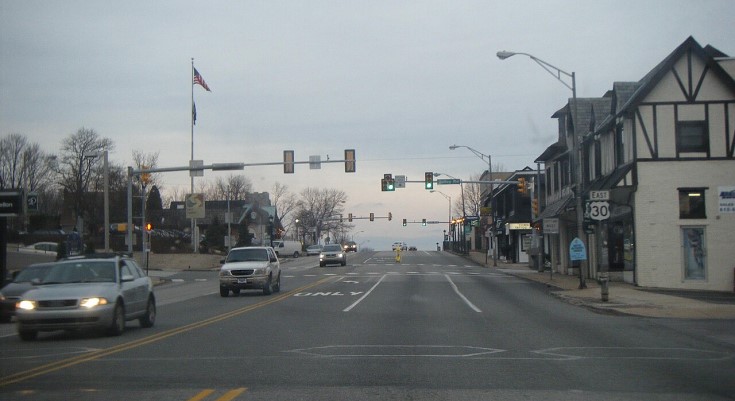
The hum of traffic along Lancaster Avenue never quite fades. It rises and falls like a tide—tires against asphalt, a distant horn, the low rhythm of commuters moving through—but just beyond the road, the sound softens. Step back a few paces, and Paoli reveals itself in layers: a canopy of mature trees, homes set with deliberate distance, and a stillness that feels preserved rather than accidental.
It’s easy to miss, at first, how much has happened here.
On a quiet patch of land not far from the road, the ground holds memory. In the dim hours before dawn on September 20, 1777, British troops advanced in silence, their muskets unloaded, bayonets fixed. The attack on American forces under General Anthony Wayne would become known as the Paoli Massacre—a sudden, brutal clash that left dozens dead and reshaped the emotional arc of the Revolutionary War. Today, the battlefield remains intact, marked not by spectacle but by restraint. Visitors walk the same terrain, past monuments and subtle markers, where history is less displayed than felt.
Paoli’s enduring pull lies in that tension between movement and memory. Positioned about 25 miles west of Philadelphia, it has long been a place people pass through—and a place they choose to stay.
The town began, as many do, with an inn. In 1769, Joshua Evans established a roadside stop along what would become the Philadelphia–Lancaster Turnpike, naming it after Pasquale Paoli, a Corsican leader admired by American revolutionaries. The location made practical sense: a midpoint between city and countryside, a place for travelers to rest. Over time, that practicality became identity.
Now, Paoli functions as both waypoint and destination. Its train station—serving regional rail and intercity lines—anchors a steady flow of daily commuters, connecting residents to Philadelphia, Harrisburg, and beyond. The station district itself is in transition, evolving into a walkable center of shops, offices, and public space, where the rhythm of arrivals and departures shapes daily life.
Yet the town resists becoming purely transitional.
Much of Paoli’s character is residential, shaped by neighborhoods that feel measured and intentional. Median incomes place it among the region’s more affluent communities, and its schools—part of the Tredyffrin/Easttown School District—draw families seeking both academic rigor and stability. Tree-lined streets and preserved green spaces offer a sense of continuity, even as development edges forward.
“There’s a balance here,” one longtime resident says. “You can get anywhere you need to go—but you don’t feel like you have to leave.”
That balance extends to Paoli’s cultural life. While small in size, the town has long participated in the broader Main Line tradition of community-driven events. The Paoli Blues Fest, once held annually, drew thousands with its mix of music, food, and local vendors before evolving into a larger regional festival. The spirit of it—informal, communal, rooted in place—remains.
Even Lancaster Avenue reflects this duality. It is both corridor and connector, lined with a mix of older storefronts and newer development, where daily errands and long commutes intersect. The road carries volume, but not urgency. Life here moves, but rarely rushes.
And beneath it all, there is that persistent sense of layering—of a place shaped not by a single moment, but by accumulation.
At dusk, when the traffic thins and the light settles across the trees, Paoli feels closest to itself. The sounds recede again, the same way they always do, and the landscape holds steady. Somewhere beyond the road, the past lingers quietly, not demanding attention, only presence—waiting, as it has for generations, to be noticed.
Support the local news that supports Chester County. MyChesCo delivers reliable, fact-based reporting and essential community resources—free for everyone. If you value that, click here to become a patron today.