
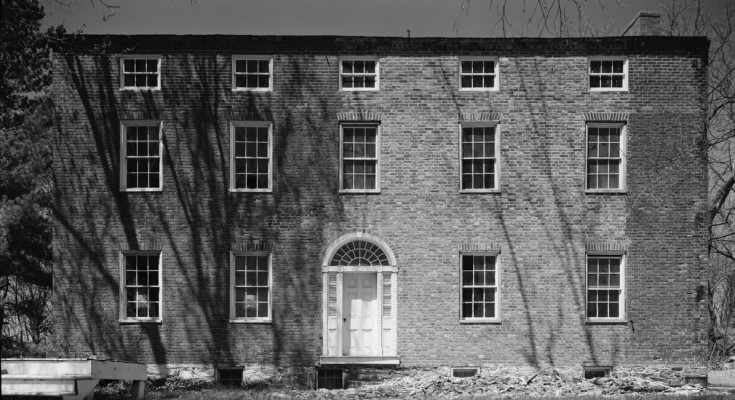
The creek slips quietly beneath the trees, its surface broken only by the slow, steady movement of water over stone. Along its edge, the land flattens just enough to hint at what once stood here—foundations tucked into the slope, walls that seem to rise out of the earth rather than sit upon it. The road curves through the valley without ceremony, passing houses that feel less like arrivals and more like continuations.
Hopewell doesn’t announce itself. It unfolds.
There is no clear boundary between past and present here, only a subtle shift in texture—the way the buildings align, the way the creek bends, the way the village seems to hold its shape even as its purpose has changed. It is the kind of place where history is not displayed, but embedded.
That quiet continuity is what makes Hopewell matter now.
In a region where former industrial sites are often erased or repurposed beyond recognition, this small corner of southern Chester County remains legible. Its mill-era layout, its worker housing, its relationship to water and terrain—all still visible, if you know how to read them.
“It’s still a village built for work,” a local resident says, standing near the edge of Tweed Creek. “Even if the work itself is gone.”
In the early 19th century, that work defined everything.
The Hopewell Cotton Works, established between 1809 and 1812 by Samuel Dickey III, transformed what had been farmland into a functioning industrial community. Two cotton mills rose along the creek, their operations powered by the same water that now moves almost unnoticed through the landscape. Nearby, his brother David expanded the system with flour and wood-product mills, creating a network of production that extended beyond a single industry.
The result was not just a set of buildings, but a self-contained village.
Workers needed housing, and so rows of stone and frame homes took shape along the road. A general store followed. Shops—blacksmith, wheelwright, machine—filled in the spaces between. By the 1830s, Hopewell had become something more than a rural outpost. It was a place of coordinated activity, structured around the rhythms of production.
“Everything revolved around the mills,” the resident says. “The hours, the houses, even the way the village was laid out.”
For a time, that system thrived.
The mills produced cotton yarn and, eventually, more than 100 varieties of fabric, drawing skilled labor into what had once been a quiet agricultural valley. The creek powered not just machinery, but the growth of a community whose identity was tied to output, efficiency, and proximity.
This is why Hopewell’s story resonates today.
It offers a rare, intact example of a rural industrial village—one that has not been flattened into abstraction or redeveloped into something unrecognizable. Instead, it remains largely as it was, its structure intact even as its function has faded.
“It didn’t disappear,” the resident says. “It just slowed down.”
That slowing began in the late 19th century, as industrial patterns shifted and larger manufacturing centers drew activity away from smaller operations like Hopewell. The village, once incorporated as a borough in 1853, saw its population decline. By 1914, it relinquished its borough status, returning to township governance.
But the physical place endured.
The mill buildings, or what remains of them, still anchor the landscape. Worker housing continues to line the roads, their proportions and materials unchanged. The village layout—compact, functional, oriented toward the creek—remains intact, preserved within what is now recognized as the Hopewell Historic District.
Nearby, the site of the Palmyra estate marks the origin point of it all.
The Dickey family’s homestead, once the administrative and agricultural heart of their operations, still defines the geography of the area, even if it is no longer accessible to the public. It was from here that the vision of a working village took shape—a vision that would carry Hopewell through its most active decades.
Beyond the village, the land returns to its quieter rhythm.
Fields stretch outward. Roads connect to Oxford and the surrounding townships without drawing attention to themselves. The absence of commercial development is not a void, but a continuation of the area’s rural character—a reminder that not every place evolves by adding more.
As the day settles into evening, the creek darkens slightly, its surface reflecting less light, more shadow. The houses along the road take on a softer tone, their edges blending into the landscape that has always defined them.
“It feels like it remembers,” the resident says, watching the water move past. “Even if no one else does.”
The current continues, steady and unhurried.
And in that movement—in the alignment of water, road, and stone—Hopewell remains what it was built to be: a village shaped by work, preserved by time, and still grounded in the quiet logic of the place that made it possible.
Support the local news that supports Chester County. MyChesCo delivers reliable, fact-based reporting and essential community resources—free for everyone. If you value that, click here to become a patron today.