
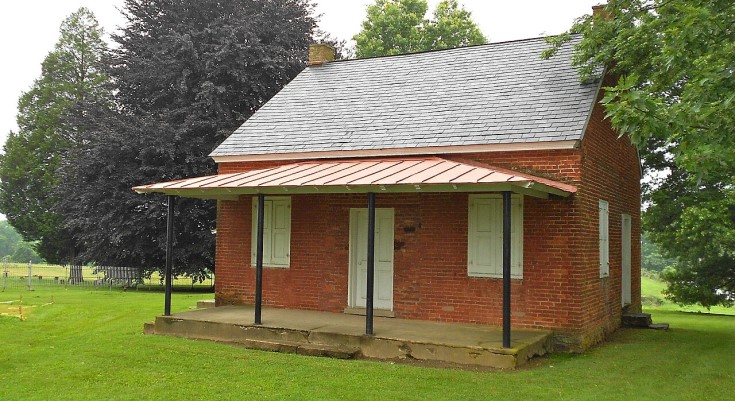
The lane narrows as it approaches the crossroads, the pavement giving way to something softer at the edges—grass pushing inward, trees leaning just enough to filter the light. Set back from the road, the small meetinghouse waits without announcement, its walls pale and steady against the surrounding green. There is no sign, no sense of arrival, only the quiet understanding that this is where people once came together.
The door, when opened, reveals a space defined by absence.
No ornament. No pulpit commanding attention. Just benches arranged in careful order, worn smooth by use, and a stillness that feels preserved rather than imposed. Even the air seems undisturbed, as if the room has learned to hold its breath.
That restraint is not incidental—it is the point.
At a moment when so many historic places are reinterpreted, restored, or reimagined for modern use, Homeville remains something rarer: a place that has simply been left intact. Its significance lies not in what has been added, but in what has been allowed to remain unchanged.
“It’s exactly what it was meant to be,” one local states, standing just outside beneath the shade of an old tree. “Nothing more, nothing less.”
Homeville emerged as part of the broader Oxford region in the early 18th century, shaped by a mix of English, Scottish, Irish, and Swedish settlers who found their way into this rolling corner of southern Chester County. But the village itself never grew around commerce or industry. It grew around gathering—specifically, the quiet, deliberate gathering of Quaker worship.
The Homeville Friends Meeting House, built in 1839, became the center of that life.
Established as the Oxford Preparative Meeting under the Fallowfield Monthly Meeting, it served a dispersed farming community spread across Upper and Lower Oxford Townships. Families traveled along narrow roads—routes once used by drovers and early settlers—to sit together in silence, to listen, to wait.
“They didn’t come for spectacle,” the local continues. “They came for reflection.”
By 1842, the meeting had joined with Pennsgrove to form the Pennsgrove Monthly Meeting, part of a broader reorganization within Quaker communities following the Hicksite–Orthodox separation. Even then, Homeville remained modest in scale—a satellite gathering place rooted in rural life rather than village density.
That modesty is what has preserved it.
Unlike many meetinghouses of its era, Homeville was never significantly altered. There are no later additions, no modern utilities quietly reshaping the interior. It was never electrified. The structure stands much as it did in the 19th century, its simplicity intact, its purpose undiluted.
“It didn’t have to change,” the local says. “The world around it did.”
Outside, the cemetery stretches gently outward, its earliest burials predating the building itself. Fieldstone markers lean at subtle angles, their inscriptions softened by time but still legible enough to trace generations of Quaker families who lived, worked, and remained tied to this land.
Beyond the trees, the landscape opens into farmland.
Fields follow the natural contours of the Piedmont terrain, rising and falling in quiet succession. Water moves through the area almost invisibly—Little Elk Creek, Big Elk Creek, and smaller runs threading through the soil, shaping both the land and the livelihoods built upon it. It is a place defined not by boundaries, but by flow.
There are no commercial centers here, no central district to gather around. The meetinghouse is the closest thing to a focal point, and even it resists that role, sitting slightly apart, as if to remind visitors that presence does not require prominence.
Today, Homeville exists in a kind of careful continuity.
The meeting itself was laid down in 1915, its regular gatherings coming to an end as populations shifted and communities reorganized. Yet the building remains under the care of the Homeville Cemetery Company, one of the village’s oldest civic bodies, preserving not just the structure but the conditions that define it.
Occasionally, in the summer, the space fills again.
A small group gathers. The benches are occupied once more. The silence returns—not as an absence, but as a shared experience.
“It doesn’t feel like it ever left,” the local says quietly. “Just paused.”
As the afternoon light softens, the meetinghouse takes on a warmer tone, the edges of the building blending into the surrounding landscape. The trees shift slightly in the breeze, their movement subtle, almost measured.
The road remains quiet. The fields hold their shape.
And within that stillness, Homeville endures—not as a relic, but as a place where the original intention has never quite faded.
Support the local news that supports Chester County. MyChesCo delivers reliable, fact-based reporting and essential community resources—free for everyone. If you value that, click here to become a patron today.