
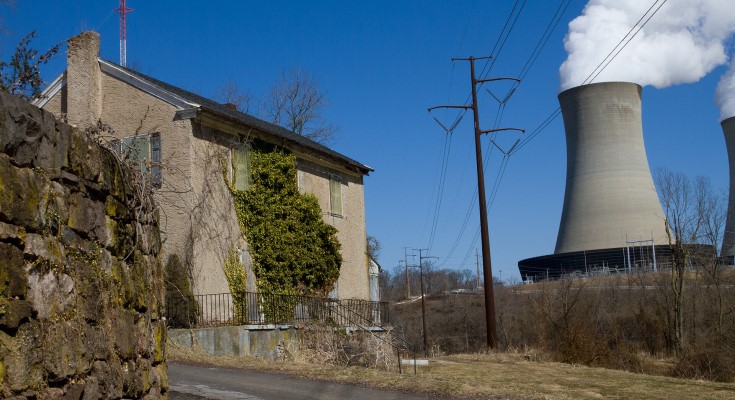
Morning fog rises slowly from the Schuylkill River near Fricks Locks, drifting between abandoned stone houses whose shuttered windows still face the water as though waiting for canal boats that will never return. The river moves quietly past overgrown towpaths and weathered foundations while birds settle into the sycamores lining the bank. A cyclist glides along the nearby trail without stopping, unaware that beneath the trees sits one of Chester County’s strangest surviving landscapes — a village that was never destroyed, only emptied.
East Coventry Township carries that feeling often: not abandoned, but suspended between eras.
Stretching along the northern edge of Chester County beside the Schuylkill River, the township blends suburban growth with remnants of an older Pennsylvania landscape shaped by waterways, crossings, mills, and transportation corridors. New residential developments rise only minutes from colonial taverns and canal ruins. Commuters head daily toward Route 422 while the river continues tracing the same curves that determined settlement patterns here nearly three centuries ago.
What makes East Coventry distinctive is not simply its history, but how visibly that history still inhabits the landscape.
In many fast-growing suburban communities, the past survives mainly through plaques or preserved buildings isolated from their surroundings. In East Coventry, the older geography remains deeply intact. Roads still follow historic travel routes. Villages still cluster around river crossings. Canal-era architecture still emerges from wooded bends beside the Schuylkill with startling immediacy.
“You can feel how transportation built this place,” says a local resident walking near Parker Ford on a cool autumn afternoon. “First the river, then the canal, then the roads. Every era left something behind.”
Few places capture that layering more powerfully than Fricks Locks Historic District.
The preserved canal village sits quietly near the Schuylkill Navigation system, where Locks #54 and #55 once handled steady commercial traffic moving coal, lumber, grain, and manufactured goods through southeastern Pennsylvania. During the canal’s peak in the 19th century, boats passed through constantly, transforming the small riverside settlement into an active transportation waypoint.
Today, the village feels almost cinematic in its stillness.
Boarded homes, stone farm buildings, and canal-related structures remain standing beneath dense tree cover, preserved not through prosperity but through abandonment. After the canal declined and finally closed by 1930, Fricks Locks gradually emptied. Construction of the nearby Limerick Generating Station accelerated that process, leaving behind an eerily intact village where time appears to have paused somewhere between the late 19th and early 20th centuries.
“It doesn’t feel haunted,” the resident says softly while looking toward the riverbank. “It feels paused.”
That atmosphere has turned Fricks Locks into one of the most unusual historic sites in Chester County — less a restored attraction than a preserved absence.
Elsewhere in the township, the Schuylkill continues shaping daily life in quieter ways.
At River Bend Farm, the relationship between settlement and river geography becomes immediately clear. The 1765 farmhouse sits within a broad curve of the Schuylkill surrounded by fields and mature trees, its thick stuccoed stone walls reflecting centuries of river-oriented agriculture and early American commerce. Once owned by Michael Hillegas, the first Treasurer of the United States, the privately preserved property stands as a silent monument to the early environmental and political history of the river corridor itself.
The township’s modern identity, however, extends well beyond preservation.
East Coventry has steadily grown into a prosperous residential community shaped increasingly by suburban commuting patterns and regional development pressures. Population growth continues. New housing developments rise along former agricultural corridors. Retail and professional employment connect residents to nearby employment centers in Pottstown, Phoenixville, King of Prussia, and beyond.
Yet despite that growth, much of the township retains a noticeably open character.
Fields still break up stretches of development. Riverfront landscapes remain protected in large sections. Parker Ford still feels distinctly separate from surrounding suburban expansion, preserving the scale and rhythm of an earlier travel corridor along the Schuylkill.
At the heart of Parker Ford stands the old sandstone tavern that once welcomed travelers crossing the river on the Great Road between Philadelphia and Reading. George Washington’s Continental Army crossed nearby during the Philadelphia campaign in 1777, linking the small river settlement directly to one of the most consequential military movements in Pennsylvania history.
The river crossing itself shaped everything that followed.
“People forget how much rivers determined where communities existed,” the resident says. “Before highways, this crossing was everything.”
As evening settles over East Coventry Township, the Schuylkill darkens beneath the tree line while mist begins gathering again near the old canal village at Fricks Locks. Cars move steadily along modern roadways above the river corridor, their headlights briefly flashing across stone walls and old foundations hidden beneath the woods.
And below the traffic and suburban growth, the river continues carrying the memory of every community that once depended on its current.
Support the local news that supports Chester County. MyChesCo delivers reliable, fact-based reporting and essential community resources—free for everyone. If you value that, click here to become a patron today.