
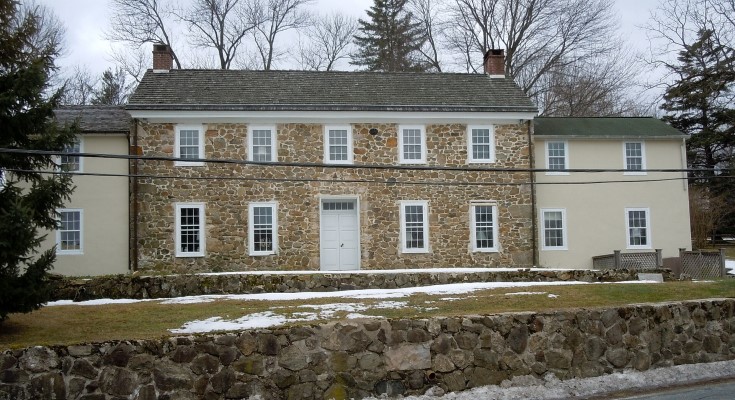
Morning settles slowly over Charlestown Township. Along the narrow roads winding through the Pickering Creek valley, mist hangs low above open fields while old stone farmhouses emerge gradually from behind rows of sycamores and split-rail fences. Near Charlestown Village, the sound of rushing water slips through wooded hollows beside remnants of old mill sites, and in the distance, church steeples and weathered barns rise above rolling hills that still look remarkably unchanged from two centuries ago.
The landscape feels restrained in the best possible way.
Commuters pull quietly from long driveways hidden behind tree lines while cyclists move carefully along Charlestown Road beneath canopies of mature oak and tulip poplar. By midmorning, sunlight reaches across preserved meadows and stone walls bordering the Middle Pickering valley, illuminating a landscape where wealth, conservation, and history exist in unusually close balance.
Charlestown Township has managed to preserve its rural and historical identity even as development pressures continue transforming much of central Chester County. Though the township sits only minutes from corporate corridors, the Pennsylvania Turnpike, and expanding suburban growth around Malvern and Exton, large portions of its landscape still retain the rhythm and visual character of an earlier Chester County—one shaped by mills, farms, creeks, and long agricultural continuity.
“You can drive ten minutes in any direction and feel the region changing,” one longtime resident says while standing near Pickering Creek. “But here, the landscape still slows you down.”
That sense of continuity begins with the valley itself.
Charlestown Township’s geography unfolds in gentle rises and wooded stream corridors surrounding the Pickering Creek watershed. Unlike more heavily developed portions of the county, much of the township remains defined by open space protections, conservation zoning, and preserved historic districts that limit the fragmentation visible elsewhere across the Main Line’s outer edge.
The result is a community where historic properties remain embedded within functioning landscapes rather than isolated from them.
In the Middle Pickering Rural Historic District, rolling fields still stretch outward from early farmsteads and mill ruins much as they did in the 18th and 19th centuries. Stone barns sit beside narrow country roads. Old springhouses remain tucked into wooded slopes above the creek. Long sightlines across preserved farmland create the unusual feeling that the valley itself—not just individual structures—has survived intact.
“That’s what makes this place feel authentic,” the resident says. “The setting survived along with the buildings.”
The township’s historic architecture reflects that same layered continuity.
At the Martin-Little House, thick fieldstone walls and narrow windows preserve the practical craftsmanship of early colonial settlement in the Pickering valley. Nearby, the John Williams Farm remains surrounded by open agricultural land that reinforces its identity as a working historic landscape rather than a preserved artifact.
Even Charlestown Village itself retains the scale and quiet intimacy of a rural crossroads community. Stone and frame buildings cluster gently around old road alignments that once connected farms, mills, taverns, and trade routes throughout the valley.
And then, almost unexpectedly, modernism appears.
Hidden within a wooded section of the township stands the Oskar G. Stonorov House, one of Chester County’s most architecturally significant modern residences. Designed in 1938 by the influential architect himself, the home seamlessly integrated International Style principles directly into the standing stone walls of a classic 1800s vernacular farmhouse.
Glass walls open toward the surrounding woods. Clean geometric forms sit low against the terrain. The structure feels simultaneously radical and deeply connected to its environment.
“It’s such an unusual contrast,” says the resident with a smile. “You go from 18th-century farmhouses to high modernism within a few miles.”
Yet even that contrast feels somehow consistent with Charlestown Township’s broader identity—a place shaped less by uniformity than by stewardship.
Today, the township’s population reflects the evolution of Chester County itself: highly educated professionals, growing cultural diversity, and increasing wealth tied to the region’s corporate and technology economy. Large homes now occupy former farmland in some areas, and proximity to Route 202 and the Pennsylvania Turnpike has steadily increased development pressure.
But Charlestown has resisted wholesale transformation more successfully than many neighboring communities.
Much of that resistance comes through planning rather than nostalgia. Open-space preservation, watershed protection, and low-density zoning have helped preserve wooded corridors and historic landscapes even as residential growth continues.
The Pickering Creek basin remains central to that effort.
The creek threads quietly through much of the township, shaping both its environmental priorities and its historical development. Early mills and industrial sites depended on its current for power, while surrounding farms relied on the fertile valley floor for agriculture. Today, the creek anchors conservation efforts focused on water quality, habitat protection, and maintaining the township’s rural character.
“It’s easy to think preservation is only about old buildings,” the resident says while looking across the creek. “But it’s really about protecting the relationships between things—the roads, the water, the fields, the houses.”
That relationship becomes especially visible in late afternoon, when sunlight settles low across the valley and the stone buildings begin reflecting warm amber tones beneath the trees. Traffic remains distant. The roads narrow again. Even newer homes seem softened by the surrounding landscape.
In many parts of southeastern Pennsylvania, growth erased the physical memory of earlier communities long ago. Here, however, the contours of the older valley still remain readable.
As evening settles across Charlestown Township, mist begins rising once more from the Pickering Creek while shadows lengthen across old fields and stone walls. The township grows quiet except for the sound of water moving through the valley below.
And for a little while longer, the landscape still feels connected to the lives that shaped it centuries ago.
Support the local news that supports Chester County. MyChesCo delivers reliable, fact-based reporting and essential community resources—free for everyone. If you value that, click here to become a patron today.