
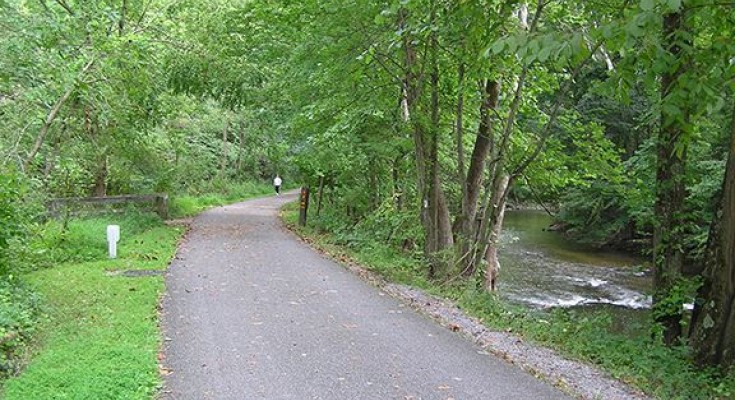
The sound arrives before the creek comes fully into view. Beneath the canopy of sycamores and tulip poplars lining the Struble Trail, the East Branch of the Brandywine moves in restless currents over stone and shale, sometimes loud enough to overpower the hum of bicycle tires passing on the pavement above. In spring, wildflowers crowd the trail edges in bursts of yellow and violet. By midsummer, the shaded corridor feels several degrees cooler than the subdivisions and shopping centers only minutes away, carrying the damp scent of river water, moss, and freshly cut grass drifting from nearby backyards.
The trail unfolds quietly, almost modestly at first glance.
A runner moves north from Kardon Park just after sunrise, passing anglers already standing knee-deep in the Brandywine below Dowlin Forge Road. A father steadies a wobbling child learning to ride a bicycle along the flat asphalt while two older cyclists slow near the creek overlook to watch trout rise briefly in the current. Somewhere farther ahead, the trail bends beneath overhanging branches where sunlight flickers across the pavement like moving water.
The Struble Trail matters now because it preserves something increasingly difficult to find in fast-growing Chester County: a sense of intimacy between recreation, landscape, and local history. Running just 2.6 miles through Downingtown and Uwchlan Township, the trail is smaller than the county’s larger regional corridors, but its scale is part of its identity. Rather than functioning as a commuter artery, the Struble feels personal—woven directly into neighborhoods, creek banks, fishing spots, and daily routines.
“It’s the trail people grow up with,” one longtime Downingtown resident says while pausing beside the Brandywine near Dorlan Mill Road. “You don’t just pass through it. You keep coming back to it.”
That familiarity is built into the corridor itself.
Opened in 1979 along the former Waynesburg rail line, the trail follows a historic Pennsylvania Railroad right-of-way tracing the East Branch of the Brandywine Creek northward through wooded lowlands and old industrial sites. It was named for Robert G. Struble, the conservationist and county commissioner whose efforts helped preserve open space across Chester County, including land associated with Marsh Creek State Park.
“People forget how easily these corridors could’ve disappeared,” the resident says. “Especially here.”
The trail’s landscape still carries visible reminders of that earlier world.
Near Dowlin Forge Road, remnants of the region’s industrial history linger close to the creek. Old stonework and mill-era traces sit partially hidden beneath vegetation while the Brandywine continues moving past them much as it did when forges and mills depended on its current for power. The trail itself follows the same gentle grades once designed for rail transport, making it accessible to nearly everyone—walkers, cyclists, wheelchair users, parents pushing strollers.
And always, the creek remains beside you.
Unlike many suburban trails separated from water by roads or development, the Struble stays closely tied to the East Branch for much of its route. The relationship shapes everything about the experience: the cooling air, the wildlife, the soundscape, even the shifting pace of movement along the path.
“You notice people naturally slow down near the water,” says an angler standing near the Delayed Harvest Artificial Lures Only section south of Dorlan Mill Road. “Even the cyclists.”
That stretch of creek has become one of the trail’s defining features for local fishermen.
Managed under special Pennsylvania Fish & Boat Commission regulations, the delayed-harvest trout waters attract anglers throughout much of the year. Brook and brown trout move through the shaded current while fly fishermen work quietly along the banks, threading casts beneath overhanging branches.
In autumn, fallen leaves drift across the creek’s surface while fishermen stand motionless in the cool water below the trail. During spring stocking season, the banks grow busier with families and longtime regulars carrying tackle boxes toward familiar access points.
“It’s not dramatic fishing,” the angler says with a grin while adjusting his line. “That’s kind of the beauty of it.”
The same understated quality defines the trail itself.
There are no sweeping mountain overlooks or massive visitor centers here. The Struble succeeds through rhythm rather than spectacle. Neighborhood footpaths connect quietly into the corridor from Uwchlan Woods and Williamsburg developments. Children ride scooters across the paved surface after school. Runners use the trail for daily miles before work. Older residents walk short sections simply to spend time beside the creek.
Even the infrastructure feels restrained. There is only one major road crossing along the open section—Dowlin Forge Road—and traffic remains light enough that the trail rarely loses its calm.
That calm, however, has proven fragile at times.
In 2021, Hurricane Ida flooded portions of the trail, damaging sections of the corridor and temporarily closing access. The storm served as a reminder that the Brandywine remains a living waterway capable of reshaping the landscape quickly and violently despite the suburban growth surrounding it.
Yet restoration efforts returned the trail to use, reinforcing how deeply the corridor has become woven into community life.
“It’s part of people’s routines now,” the resident says. “When it closed, people really felt it.”
By evening, the trail begins settling into softer light beneath the trees. Cyclists head south toward Kardon Park while the creek darkens beneath the wooded banks. Crickets emerge in the brush, and the last fishermen work the slower pools near Dowlin Forge before packing up for the night.
The old railroad corridor remains narrow, quiet, and deeply local. But that may be exactly why it endures so powerfully in memory.
Here, the Brandywine still sets the pace. And for a few miles beneath the trees, Chester County slows down long enough to follow it.
Support the local news that supports Chester County. MyChesCo delivers reliable, fact-based reporting and essential community resources—free for everyone. If you value that, click here to become a patron today.