
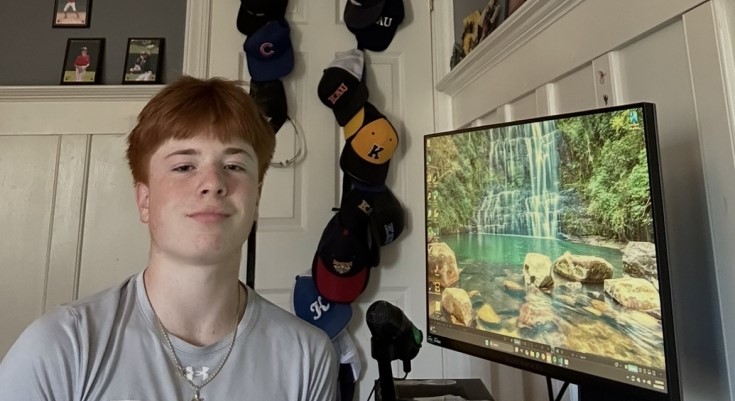
KENNETT SQUARE, PA — A 14-year-old Kennett High School freshman is developing a locally operated artificial intelligence platform through his Pennsylvania company, Nolvion LLC, targeting a November 20 early-access release as an alternative to cloud-based AI services that require internet connectivity and recurring subscriptions.
Sean Nolvion, the company’s founder, is building the software on a single gaming computer without cloud computing resources. The platform is designed to run AI models, coding assistants, and automated agents directly on users’ computers, keeping files and conversations stored locally.
The project remains in development, with several features operational, but its underlying AI models and offline security controls still undergoing work. No outside users have tested the platform.
Nolvion is intended to combine AI models, autonomous agents, project management capabilities, and persistent memory within a single desktop environment. Users would be able to control internet access separately for individual functions rather than granting unrestricted connectivity.
Sean began developing his own AI model in early September after encountering usage restrictions and subscription costs while using existing AI services. By late September, the project had expanded into plans for a broader software platform.
“At one point I hit a usage limit and was locked out for a day and a half,” he said. “That got me thinking about why the AI I depend on lives on someone else’s servers.”
The company is positioning the software for individuals and organizations that want greater control over their computing resources and information.
“A lot of people can’t put their files into cloud AI, like schools, small businesses, or anyone with private information,” Sean said. “And when your AI depends on someone else’s servers, you depend on their prices, their limits and their rules.”
The software currently includes account setup, business accounts with team chat and a project-planning interface.
In one working example, a user describes a proposed project, and the system generates a plan identifying how tasks would be divided, which AI models would run locally, and how long the work might take.
Additional planned capabilities include teams of AI agents that can perform assigned tasks and a developer marketplace called the Hub, where third parties could distribute tools.
The underlying AI models, called Tirric, are being developed from Qwen, an open-source model released under the Apache 2.0 license.
Sean is training a model with approximately 4 billion parameters and plans a smaller version with approximately 1 billion parameters for computers with less processing capacity.
Both are intended to support instruction-following and software development tasks, although he acknowledged that their performance remains below his targets, particularly on difficult coding problems.
The platform uses open-source software including Ollama and llama.cpp to operate AI models locally.
Development and testing are taking place on a gaming graphics card with 8 gigabytes of memory. The software is intended to assess available hardware and select smaller models when necessary.
Sean uses AI-assisted programming tools, primarily Claude Code, to help generate and review software. He directs the platform’s design, evaluates its functionality, and tests individual features.
The development process reflects a broader approach to software creation in which AI coding assistants enable individual developers to build applications without conventional engineering teams.
Security and access controls are another component of the project.
Nolvion is being designed with internet connectivity disabled by default, individual permissions for AI agents, and a systemwide control intended to terminate network connections.
Sean said the development version already includes its permission system and connection kill switch, which he tests against 38 different attack scenarios.
The full offline-control system is not yet complete, and the security measures have not undergone independent testing.
The company is targeting November 20 for its first early-access release, which would provide downloadable software to a limited group of users selected from a registration list.
Participants will be invited in the order they joined, with additional access granted in stages as problems are identified and addressed.
Early access is planned to be free.
Following the initial release, Sean is considering a pricing structure that would include a free version, a $20 monthly individual subscription, and a $500 monthly business subscription. Those prices remain preliminary.
Nolvion LLC was established in Pennsylvania before the current software project took shape, initially providing AI automation services to local businesses.
Sean redirected the company’s focus toward the Nolvion platform in September. He remains its sole founder, while his mother assists with legal paperwork and agreements requiring adult involvement.
The development schedule runs alongside his responsibilities as a Kennett High School freshman and travel baseball player.
He works on the software primarily during evenings and weekends, with the longer-term objective of attracting thousands of users and outside developers contributing tools through the Hub.
For now, the immediate test will be whether the software performs reliably on computers outside his development environment.
“It’s meant to be a whole AI environment that lives on your computer,” Sean said. “And it’s still in development. I’d rather be honest about what works and what doesn’t than overpromise.”
Information about the platform and its early-access registration is available at nolvion.com.
Support the local news that supports Chester County. MyChesCo delivers reliable, fact-based reporting and essential community resources—free for everyone. If you value that, click here to become a patron today.