
Morning comes slowly to French Creek. Mist lifts from the water in pale ribbons, threading through hemlocks, hardwoods, and the dark shoulders of the Hopewell Big Woods. Along the trail, the forest floor is damp with leaves, and the creek moves over stone with a sound that feels older than the roads leading into Warwick Township. Somewhere beyond the trees, the remains of old furnaces, mines, and mill sites sit quietly in the landscape, their fires long extinguished.
At first, Warwick feels like a place defined by stillness.
But beneath the forest canopy lies one of Chester County’s most powerful industrial stories. Ironmasters, miners, charcoal burners, soldiers, quarrymen, and farmers all shaped this rugged northern township. Today, as development pressure reaches deeper into southeastern Pennsylvania, Warwick stands apart as a community where conservation has preserved not only woodlands and streams, but the physical memory of early American industry.
That is what makes the township matter now.
Warwick is not simply rural. It is protected, layered, and historically dense—a place where forests conceal the foundations of furnaces that helped supply a revolution, where old quarry villages still cling to creek valleys, and where public lands safeguard one of the largest contiguous forest landscapes in the region.
The township was formally established in 1842, when land north of the South Branch of French Creek was separated from East Nantmeal Township.
Its history, however, begins much earlier.
By the early 1700s, northern Chester County had become one of colonial America’s most important ironmaking regions. Coventry Iron Works, Reading Furnace, Warwick Furnace, and later Hopewell Furnace drew power from the forests, ore, water, and labor of the French Creek Valley. These were not isolated workshops. They were self-contained industrial worlds, with ironmasters’ houses, worker dwellings, charcoal hearths, farms, roads, and forests all tied to the production of iron.
Hopewell Furnace remains the clearest window into that world.
Established in 1770 by ironmaster Mark Bird, the furnace became part of a vast charcoal-fueled operation that produced pig iron and castings for everyday use and, during the Revolutionary War, materials tied to the military effort. Today, the National Park Service preserves the furnace stack, ironmaster’s house, barns, worker buildings, and rural landscape, allowing visitors to see how industry once rose directly from the land.
The place still feels inhabited by work.
One can imagine teams hauling charcoal from the woods, oxen moving ore, and furnace workers laboring in heat and smoke while the surrounding forest slowly fed the fires. The industrial rhythm depended on nature even as it consumed it.
Warwick’s Revolutionary War ties extend beyond production.
After the Battle of the Clouds in 1777, George Washington’s army moved through the region, and the iron furnaces of northern Chester County became part of the war’s broader supply network. In a landscape now associated with hiking trails and quiet creeks, the Revolution left a harder imprint—one of movement, scarcity, strategy, and survival.
Reading Furnace Historic District preserves another chapter of that story.
Set along the South Branch of French Creek, the district reflects the influence of the Potts-Rutter iron network, whose operations helped make the region a center of colonial industry. The surviving architecture, farmland, and furnace-related landscape show how economic power once gathered around remote valleys where water, timber, and ore could be put to use.
The forest eventually reclaimed much of it.
That is part of Warwick’s fascination.
The township’s industrial past is not always obvious. It reveals itself in stone ruins, old roads, archaeological remnants, and village names. It appears in the quiet geometry of former furnace lands and the unexpected presence of historic houses tucked into heavily wooded hillsides.
In St. Peters Village, the past becomes more visible.
The village sits along French Creek in a dramatic corridor of boulders, stone buildings, and former quarry sites. Developed around the Saint Peters Granite Company, it became a nineteenth-century company village where workers lived close to the quarries that defined the local economy. The granite extracted there helped shape buildings far beyond Chester County, including nationally known structures such as the Franklin D. Roosevelt Presidential Library and the Whitney Museum of American Art.
Today, St. Peters carries a different rhythm.
Visitors come for the creek, the boulder fields, the shops, and the sense of entering a place set apart from ordinary suburban life. Yet the village’s beauty is inseparable from its working past. The stone houses, narrow road, quarry remnants, and forested gorge all speak to a community built around labor as much as scenery.
That same relationship between industry and landscape is visible throughout Warwick.
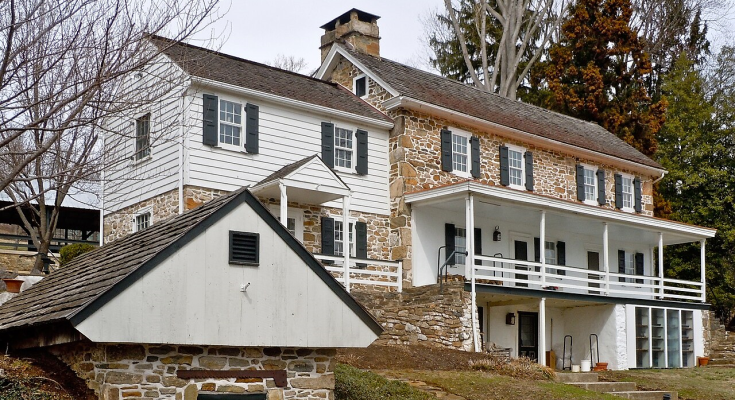
Hockley Mill Farm preserves traces of small-scale milling along the French Creek Valley. The Jacob Winings House and Clover Mill recall a specialized agricultural economy tied to clover seed processing. The Philip Rogers House reflects the prosperity and craftsmanship of the post-Revolutionary countryside.
Together, these sites reveal a township shaped by work that was both industrial and agricultural.
But Warwick’s modern identity rests just as firmly on preservation.
The township lies within the Hopewell Big Woods, the largest remaining contiguous forest in southeastern Pennsylvania. French Creek State Park, Warwick County Park, State Game Lands No. 43, and other protected areas create a vast conservation landscape of hardwood forest, wetlands, rocky ridges, and stream valleys.
The effect is immersive.
Roads narrow beneath the trees. Trails disappear into deep woods. French Creek runs cold and clear through land that has been protected from the kind of intensive development seen elsewhere in the region. The township’s small population and limited commercial activity reinforce that sense of retreat.
Yet Warwick is not empty.
It is inhabited by memory, by wildlife, by hikers and anglers, by residents who understand that the township’s quiet is part of its value. Its villages—Knauertown, Pine Swamp, St. Peters, Trythall, and Warwick—remain small points of settlement within a much larger natural and historical landscape.
As evening settles over French Creek, the forest darkens first.
The boulders at St. Peters hold the last warmth of the day. The water continues moving past old quarry walls, furnace lands, and wooded slopes where charcoal once burned. In the distance, the trail bends out of sight beneath the trees.
The fires are gone now.
But in Warwick Township, the forest still remembers where they burned.
Support the local news that supports Chester County. MyChesCo delivers reliable, fact-based reporting and essential community resources—free for everyone. If you value that, click here to become a patron today.