
Morning arrives quietly in Wallace Township. Mist drifts above the East Branch of the Brandywine as sunlight filters through towering tulip poplars and white oaks. Along Creek Road, weathered stone farmhouses stand behind split-rail fences, their fields stretching toward the wooded ridges beyond Glenmoore. A red-tailed hawk circles overhead while the only sounds are birdsong and the distant rumble of traffic headed for the Pennsylvania Turnpike.
It is a landscape that reveals little of the centuries it has witnessed.
Long before subdivisions appeared on former farmland or commuters discovered its rural appeal, Wallace Township was home to Lenape communities, colonial manor lands, iron forges, railroads, and generations of farming families. Today, despite steady residential growth, much of that history remains remarkably visible. Here, open fields still outnumber shopping centers, historic villages retain their original character, and some of Chester County’s oldest stories remain rooted in the land itself.
That continuity feels increasingly significant.
As development continues to reshape communities throughout southeastern Pennsylvania, Wallace Township has managed to preserve much of the landscape that defines its identity. Historic districts, protected farmland, archaeological sites, and expansive open space offer more than scenic beauty—they provide a tangible connection to the people who lived here long before modern roads and neighborhoods transformed the region.
Those stories begin thousands of years before the township itself existed.
The Brandywine Valley supported Lenape communities for generations before European settlement. Members of the Brandywine and Okehocking bands established camps and villages along the waterways, relying on the creek for transportation, fishing, hunting, and trade. One of the township’s most significant reminders of that heritage survives at the Brandywine Indian Burial Site, also known as the Montgomery Site, where archaeological excavations during the twentieth century confirmed a sacred Lenape burial ground.
Today, the site remains intentionally understated.
Protected by a permanent historic conservation easement rather than operated as a tourist attraction, it stands as a place of remembrance—a quiet acknowledgment that Wallace Township’s history began long before colonial maps assigned names to the landscape.
European settlement arrived during William Penn’s vision for Pennsylvania.
Much of present-day Wallace Township formed part of Springton Manor, one of Penn’s original proprietary manors warranted and surveyed between 1729 and 1730. The fertile countryside soon supported farms, mills, and iron forges, creating a rural economy that would endure for generations.
That legacy lives on at Springton Manor Farm.
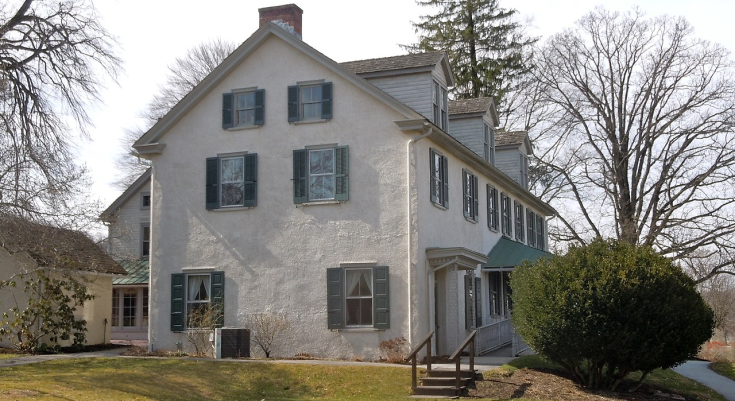
Rolling pastures surround an imposing stone manor house and towering nineteenth-century barn, while heritage livestock graze fields that have been cultivated for nearly three centuries. Today preserved as a Chester County park, the property offers visitors more than picturesque scenery. It provides an unusually complete window into the agricultural landscape that shaped this part of the county from the colonial era through the Victorian age.
Elsewhere across the township, that same story unfolds in quieter ways.
The William Ferguson Farm preserves another chapter of Wallace Township’s agricultural heritage. Its stone farmhouse, traditional barn, and surrounding fields illustrate the rhythms of nineteenth-century farm life, when families measured time by planting seasons, harvests, and livestock rather than highway traffic.
The arrival of the railroad changed everything.
During the late nineteenth century, rail service connected Wallace Township more directly to regional markets, encouraging commercial growth while strengthening Glenmoore as the township’s principal village. Decades later, the opening of a nearby Pennsylvania Turnpike interchange accelerated another wave of change, making the once-isolated countryside increasingly attractive to commuters seeking rural living within reach of Philadelphia’s growing suburbs.
Yet Glenmoore never lost its sense of place.
Walking through the Glenmoore Historic District today, visitors still encounter a village that feels remarkably connected to its nineteenth-century origins. Historic homes, churches, and former commercial buildings line quiet streets where architectural details have changed little over the decades. Rather than overwhelming the historic core, newer development has largely grown around it, allowing the village to retain its distinctive identity.
That balance defines Wallace Township today.
Residents enjoy proximity to employment centers throughout Chester County while remaining surrounded by preserved farmland, wooded stream valleys, and historic landscapes. Local government has reinforced that identity through conservation efforts, stewardship of archaeological resources, and planning decisions that continue to value open space alongside thoughtful growth.
It is a community that understands preservation as something larger than protecting old buildings.
It is about protecting context.
Fields surrounding a farmhouse.
Woodlands bordering a creek.
The quiet distance between villages.
Those elements give Wallace Township its character just as surely as its historic landmarks do.
As evening settles over Glenmoore, the last sunlight washes across the stone walls of Springton Manor Farm. Shadows lengthen beneath old sycamores along the Brandywine, while the creek continues its steady course through fields that have nourished generations of residents.
The landscape has witnessed Indigenous communities, colonial surveyors, farmers, railroad workers, and families seeking a quieter place to call home.
And in Wallace Township, that landscape remains the community’s greatest storyteller—its past still visible in the fields, forests, and villages that continue to shape its future.
Support the local news that supports Chester County. MyChesCo delivers reliable, fact-based reporting and essential community resources—free for everyone. If you value that, click here to become a patron today.