
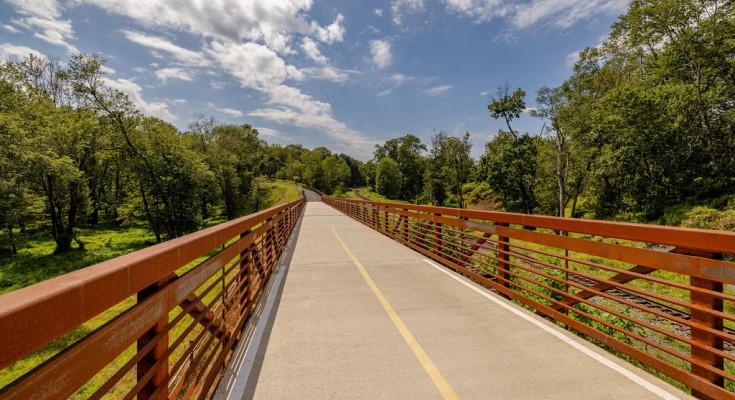
In the early morning, the Schuylkill River Trail feels almost weightless. Cyclists move quietly through the mist near Cromby, their tires humming softly over smooth asphalt while the river drifts beside them in slow, gray silence. Great blue herons stand motionless near the shoreline, watching the current slide past abandoned industrial structures softened now by vines and weather. The smell of damp earth and river water hangs in the cool air, mingling with the faint metallic scent that still seems to rise from the old rail corridors threading through the valley.
By sunrise, the trail has already begun carrying people somewhere.
A runner from Phoenixville heads north toward Spring City with headphones tucked beneath a knit cap. A retired couple walks side by side near Parker Ford, pausing occasionally to watch birds gather along the riverbank. Farther south, a cyclist rides toward Valley Forge and eventually Philadelphia, tracing a route once defined by locomotives, canal barges, and factory shipments moving through the Schuylkill corridor.
The Schuylkill River Trail matters now because it has become one of southeastern Pennsylvania’s most ambitious acts of reinvention. Built atop abandoned railroad and canal alignments, Chester County’s 9.75-mile segment transforms former industrial infrastructure into a continuous public landscape linking communities, ecosystems, and histories that once developed entirely around the movement of goods. In a region still shaped by its manufacturing past, the trail offers a different relationship to the river—one built around access, restoration, and connection rather than extraction.
“It feels like the river belongs to people again,” one longtime rider says while stopping near the old Cromby Generating Station. “For a long time, these corridors were hidden behind industry.”
That industrial history still shadows the trail in subtle ways.
The Schuylkill River corridor powered Pennsylvania’s rise long before the modern suburbs emerged around it. Railroads and canals once lined the riverbanks, carrying coal, steel, lumber, and manufactured goods between small industrial towns and Philadelphia. Much of Chester County’s trail segment follows those same transportation routes, preserving their gentle grades and direct alignments even as the purpose of movement has changed completely.
“You can still feel the engineering logic underneath it,” the rider says. “The curves. The elevation. It was all designed to move something.”
Now it moves people instead.
Opened in phases between 2013 and 2022, Chester County’s section of the Schuylkill River Trail forms part of a much larger regional vision—a 120-mile greenway eventually stretching from Philadelphia to Frackville. Within Chester County, the trail links Phoenixville, Spring City, Parker Ford, and East Coventry while connecting seamlessly into Montgomery County and the broader Circuit Trails network.
The scale of that connectivity becomes more obvious the longer one stays on the trail.
Southbound riders can continue through Mont Clare, Oaks, Valley Forge, and Norristown before eventually reaching Philadelphia. Heading north and west, the corridor extends toward Pottstown, Reading, and beyond. What appears at first to be a local recreation path gradually reveals itself as regional infrastructure.
“It changes your sense of distance,” the rider says. “You realize how connected these towns always were.”
The trail’s atmosphere shifts constantly along its Chester County stretch.
Near Phoenixville, the corridor brushes against industrial remnants and redeveloped riverfront spaces where old factories have given way to breweries, apartments, and trail access points. Around Spring City and Parker Ford, the environment softens into wooded riverbanks and quieter stretches where the river becomes the dominant presence again.
The surface itself reflects that balance between preservation and modern accessibility. Rather than the rugged ballast of the old rail beds, the trail is laid with a smooth ribbon of asphalt—clean and flat beneath running shoes, effortless for bicycle tires, and fully ADA-accessible. While it traded the crunch of cinder for the quiet glide of pavement, the route still retains a texture and pace closer to the old historic towpaths than a bustling suburban highway.
“It slows you down in a good way,” says a walker near Linfield Road, watching kayakers move through the river below. “You notice more.”
And there is much to notice.
Bald eagles occasionally appear above the river corridor. Deer emerge quietly from wooded edges near dusk. In spring, sycamores leaf out over sections of the trail while migratory birds settle into the wetlands bordering the water. Even the industrial remnants—the old rail alignments, bridge structures, and power station silhouettes—have become part of the landscape’s visual rhythm rather than interruptions within it.
That coexistence between nature and infrastructure may be what makes the trail feel uniquely Pennsylvanian. Unlike trails designed to erase the industrial past, the Schuylkill River Trail acknowledges it openly. The river valley remains layered with evidence of labor, transportation, and economic change.
But now, people move through it differently.
Commuters bike between towns. Families push strollers along the flat grades. Birders stop along quiet stretches near the riverbank while endurance cyclists continue for dozens of miles across county lines.
“The trail kind of teaches you the geography of the river,” the walker says softly. “Not from a car window. At human speed.”
By evening, the light settles low across the Schuylkill, turning the river bronze beneath the trees. Cyclists heading home pass through long stretches of shadow while the sound of crickets begins rising from the riverbanks. The old industrial corridor grows quiet again except for footsteps, tires, and moving water.
The trains are gone now. The canal boats disappeared long ago. But the route remains, still carrying movement through the valley just as it always has.
Only now, the journey belongs to everyone.
Support the local news that supports Chester County. MyChesCo delivers reliable, fact-based reporting and essential community resources—free for everyone. If you value that, click here to become a patron today.