
The morning fog lingers over the fields just north of Chatham, softening fence lines and blurring the edges of distant barns. Along a narrow country road, a tractor moves methodically through a patchwork of crops while sunlight slowly spills across rolling hills. In the distance, the sound of birds rises from a wooded creek valley where White Clay Creek winds through forests that have escaped the reach of modern development.
A few miles away, golfers step onto a ridge at Inniscrone and pause before their first shot. Below them, fairways follow the contours of former farmland, rising and falling with the landscape rather than imposing themselves upon it. The view stretches across preserved fields, woodlots, and neighborhoods that seem carefully woven into the countryside.
This balancing act—between growth and preservation, tradition and change—is what defines London Grove Township today. As southern Chester County continues to evolve, London Grove has become a case study in how a community can accommodate new residents while protecting the agricultural heritage and open spaces that have defined it for more than three centuries. The question facing many communities along the Route 1 corridor is whether rural character can survive modern development. In London Grove, that question is being answered every day across farm fields, historic villages, and conservation lands.
The township’s story begins with the same forces that shaped much of Chester County itself.
Founded in 1723 on lands originally granted by William Penn, London Grove emerged from a landscape settled largely by Quaker farming families who viewed the fertile soils of southern Chester County as both livelihood and legacy. Agriculture quickly became the foundation of the local economy. Mills, farmsteads, and small crossroads communities appeared across the countryside, creating a network of settlements tied together by commerce, faith, and family.
One of those settlements still stands.
At the intersection of Routes 41 and 841, the Village of Chatham remains one of the township’s most tangible connections to its colonial past. Brick and stone buildings line the historic crossroads, many tracing their origins to the 18th and 19th centuries. The village grew around the Half-Way House tavern, opened around 1763 by Andrew Caldwell, and eventually took its name from William Pitt, the Earl of Chatham, whose opposition to British taxation resonated with colonial residents.
Today, Chatham remains small enough that a visitor could easily pass through without realizing its significance. Yet that modest scale is precisely what makes it compelling. The village feels less like a preserved attraction and more like a place that simply continued living while history accumulated around it.
That continuity extends well beyond the village center.
London Grove Township occupies more than 17 square miles of rolling Piedmont countryside, much of it underlain by some of the region’s most productive agricultural soils. More than 70 percent of the township contains prime farmland, an increasingly rare distinction in a rapidly developing region positioned between Philadelphia and Wilmington.
The land remains productive.
Dairy farms, horse farms, mushroom operations, and crop fields continue to shape the landscape. Agricultural buildings punctuate ridgelines. Fields stretch toward wooded stream corridors. Even as residential neighborhoods have expanded—particularly south of U.S. Route 1—the countryside retains a distinctly rural rhythm.
The township’s commitment to preserving that character is visible in its tax structure, planning policies, and open-space investments. Conservation is not treated as an afterthought but as a defining element of community identity.
Nowhere is that commitment more evident than along White Clay Creek.
Flowing through the heart of the region, the creek forms part of the first watershed in the nation to receive protection in its entirety under the National Wild and Scenic Rivers Act. Its wooded valleys shelter mature forests, trout streams, and sensitive habitats that support species ranging from migratory songbirds to the endangered bog turtle.
The creek is also deeply woven into daily life.
On spring mornings, hikers follow trails beneath newly unfurled leaves. Anglers cast into shaded pools. Families gather for walks along streamside paths. School groups arrive to learn about watersheds, wildlife, and conservation. In a county where development pressure remains constant, White Clay Creek serves as both refuge and reminder.
The same appreciation for landscape has helped shape some of the township’s most popular destinations.
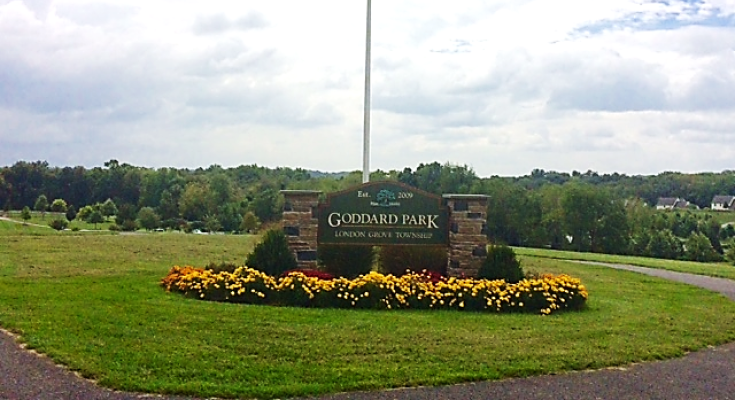
At Goddard Park, 145 acres of preserved open space provide room for nearly every kind of outdoor activity. Children race across playgrounds. Gardeners tend community plots. Dog owners gather at one of the area’s most popular fenced dog parks. Walkers and runners follow trails through meadows and woodlands.
A few minutes away, Inniscrone Golf Club offers a different way to experience the terrain.
Designed by acclaimed architect Gil Hanse, the course embraces rather than alters the rugged contours of the former farmland on which it sits. Fairways twist through valleys and climb steep hillsides. Elevation changes reveal expansive views of the surrounding countryside. The course feels inseparable from the landscape itself, a quality that has made it one of the region’s most distinctive golfing destinations.
The township’s connection to horses is equally rooted in history, fondly remembered by generations who gathered for the historic Laurels at Landhope Combined Driving Competition.
For twenty-five years, competitors from across North America converged on these fields, where elegant carriages navigated precision courses, and drivers guided teams through water hazards and tight gates. While that signature event has passed into local lore, the landscape it celebrated remains unbroken. Today, the area’s deep equestrian traditions live on through local events at the neighboring Glen Willow grounds and across miles of preserved riding trails, continuing to bring together residents and conservation advocates around a shared appreciation for the land.
That combination of heritage and prosperity has helped attract a growing population. Nearly one-third of residents are under 18, while more than half of adults hold bachelor’s degrees or higher. Household incomes rank among the highest in the region, yet the township’s appeal extends beyond economic statistics.
People come here for the space.
For the fields that still separate neighborhoods.
For the winding roads that reveal another barn, another pasture, another glimpse of open countryside around the next bend.
As evening settles across London Grove Township, shadows lengthen over the fields surrounding Chatham. The last golfers make their way toward the clubhouse at Inniscrone. Along White Clay Creek, the sounds of rushing water grow more prominent as birds settle into the trees.
The landscape remains in motion, but not in haste.
And in the fading light, London Grove offers a vision that many communities strive for but few achieve—a place where growth has arrived, yet the countryside still feels like the main character in the story.
Support the local news that supports Chester County. MyChesCo delivers reliable, fact-based reporting and essential community resources—free for everyone. If you value that, click here to become a patron today.