
The water bends before you see it, the sound arriving first—a low, steady rush slipping over stone and settling into something quieter as it curves through the valley. The road narrows along Route 162, dipping just enough to bring the creek into view. Trees lean inward, their branches softening the light, their roots holding the banks in place.
Embreeville reveals itself in fragments.
A stone wall here. The outline of a foundation there. A building that still stands, and others that exist only in the way the land rises and falls around them. It is not a place that tells its story outright. It asks you to piece it together.
That layered presence is what makes Embreeville feel especially relevant now. As Chester County continues to evolve—preserving land in some places, redeveloping it in others—this stretch of the Brandywine holds a more complicated narrative. One shaped not just by agriculture or industry, but by care, confinement, and the shifting definitions of what a community is meant to be.
“It’s not just one story,” a local observer says, standing near the edge of the creek. “It’s a lot of them, all in the same place.”
The earliest of those stories begins with water.
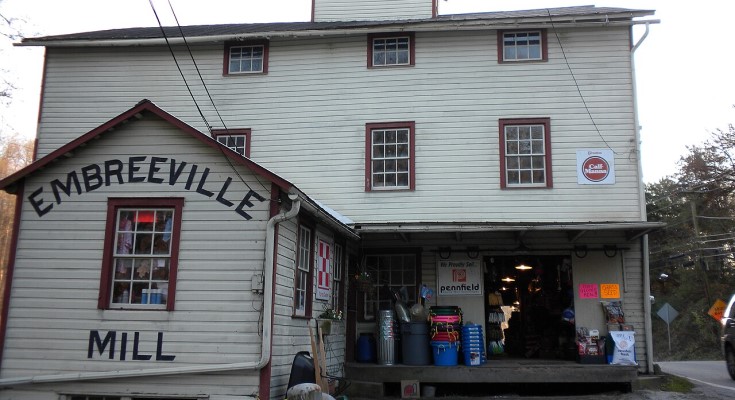
By the late 18th century, the creek powered a gristmill that became the center of local life. The Embreeville Mill, built of stone and positioned to harness the current, processed grain from surrounding farms, tying the area into a broader agricultural network that stretched across the Brandywine Valley. The dam that fed it still shapes the water’s path, its presence subtle but persistent.
The work was steady. The scale was small.
But even then, Embreeville was something more than a typical rural settlement.
In the 1790s, the county established a poorhouse here, using the same landscape that supported farming and milling to sustain those who had nowhere else to go. Over time, that institution expanded, eventually becoming the Chester County Asylum—later known as Embreeville State Hospital—a place that would define the community for nearly two centuries.
“You can feel that part of it,” the observer says. “Even if you don’t see the buildings anymore.”
What remains is not the institution itself—the hospital closed in 1980—but the imprint it left behind. Open land where structures once stood. Roads that lead to spaces that no longer function the way they once did. The sense that this was, for a long time, a place set apart.
And yet, it was never entirely separate.
The same land that held the institution also carried older histories—some quieter, but no less significant. Not far from the creek, the Star Gazers’ Stone marks a point where Mason and Dixon stood in 1764, using the sky itself to draw a boundary that would shape the nation. Nearby, a simple gravesite marks the resting place of Hannah Freeman—“Indian Hannah”—a Lenape woman whose life bridged the gap between the region’s Indigenous past and its colonial future.
“She’s part of this place, too,” the observer says, glancing toward the wooded edge beyond the open ground. “All of it is.”
That convergence—of industry, care, displacement, and measurement—gives Embreeville a density that belies its quiet setting.
Today, the activity is different.
There are no operating mills, no institutional complex, no central hub of commerce. Instead, the focus has shifted toward preservation and reimagining. Plans for Embreeville Park suggest a future that emphasizes access—trails, open space, a way for people to move through the land without reshaping it entirely.
“It’s changing again,” the observer says. “But maybe this time, it stays closer to what it is.”
The surrounding landscape reinforces that possibility.
Fields stretch outward beyond the creek, bordered by woods that have reclaimed ground once cleared. The terrain rises gently, then settles again, creating a sense of enclosure without confinement. It is rural, but not remote. Connected, but not defined by connection.
As the day begins to fade, the light shifts across the water, catching briefly on the surface before slipping into shadow. The sound of the creek becomes more pronounced as everything else quiets.
For a moment, the layers seem to align—the past, the present, the traces of what once was and what might come next.
“It’s all still here,” the observer says softly. “You just have to listen for it.”
The water continues its path through the bend, unchanged in its direction. The land holds its shape. And in that quiet stretch between what was built and what remains, Embreeville endures—not as a single story, but as a place where many still flow together.
Support the local news that supports Chester County. MyChesCo delivers reliable, fact-based reporting and essential community resources—free for everyone. If you value that, click here to become a patron today.