
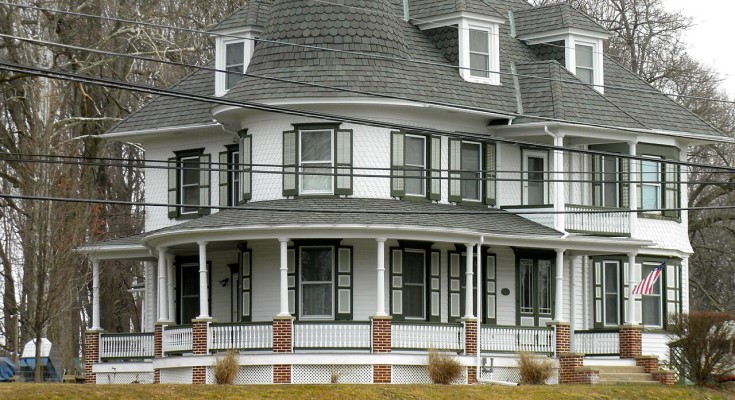
On a humid summer evening in Ercildoun, the air smells faintly of cut hay and damp earth drifting up from Buck Run. A screen door creaks open somewhere along the village crossroads while cicadas pulse from the trees surrounding the old Friends Meeting House. The stone buildings here sit close to the road, softened by centuries of weather and shade, their windows glowing briefly in the last amber light before dusk settles fully across the valley.
Nothing about East Fallowfield Township announces itself loudly.
The roads curve gently through farmland and wooded stream corridors west of Coatesville, passing horse pastures, old bridges, and long stretches of stone fencing before disappearing into small crossroads communities that feel remarkably untouched by modern suburban tempo. Even now, despite steady residential growth and rising development pressure across Chester County, East Fallowfield retains the slower cadence of a place shaped by agriculture, Quaker settlement, and generations of families tied closely to the land.
That sense of continuity defines the township as much as any single landmark.
In an era when many communities struggle to preserve historic identity amid rapid expansion, East Fallowfield still carries visible traces of nearly every chapter of its past — from colonial-era taverns and abolitionist meeting halls to mill villages and stone arch bridges tucked quietly into the Buck Run valley. The township’s landscape remains less curated than lived-in, preserving history not as spectacle, but as part of everyday surroundings.
“You don’t stumble onto places like this very often anymore,” says a longtime resident driving along Strasburg Road near the White Horse Tavern. “Out here, the old buildings still belong to the landscape. They don’t feel separated from it.”
That relationship between history and landscape is perhaps most powerfully felt in Ercildoun Historic District.
Centered around the 1811 Fallowfields Friends Meeting House, the small Quaker hamlet became one of Chester County’s strongest anti-slavery communities during the 19th century. The village’s quiet roads and restrained stone architecture still reflect the plainspoken values of the Quaker families who settled here — but beneath that simplicity lies a deeply consequential history.
People’s Hall, one of the district’s defining structures, survives as a rare physical reminder of reform movements that once transformed rural communities across southeastern Pennsylvania. Abolitionist meetings, educational programs, and civic gatherings unfolded here in a landscape that outwardly appeared calm and isolated, yet played a meaningful role in broader national debates over slavery, morality, and equality.
Today the village remains strikingly intact.
Large trees shade narrow lanes where fieldstone houses sit much as they did generations ago. The absence of heavy commercial development gives Ercildoun an almost suspended quality, as though the township deliberately resisted the urge to modernize too quickly.
Elsewhere in East Fallowfield, the story becomes more industrial.
Along Buck Run, traces of the township’s early milling and ironmaking economy still emerge through places like Glen Rose Historic District, where stone buildings cluster beside the stream in one of Chester County’s most atmospheric surviving mill hamlets. Water powered nearly everything here once — mills, workshops, and eventually some of the region’s earliest iron operations.
Local historians have long noted that the first iron mill in America may have operated along Buck Run at Rokeby as early as 1793, giving the township an understated but important connection to the rise of American industry.
Even the roads themselves tell stories.
The old Strasburg Road corridor remains lined with historic taverns and farmsteads that once served travelers, livestock drovers, and wagon traffic moving westward through Pennsylvania. Places like the Drovers Inn and the Philip Dougherty House & Tavern preserve the architecture of that movement economy — thick fieldstone walls, symmetrical façades, practical outbuildings, and broad roadside positioning meant to welcome exhausted travelers after long journeys through the countryside.
At the Mary Ann Pyle Bridge, Buck Run slips quietly beneath the weathered timbers and stark stone abutments of a classic 1881 covered bridge. The bridge appears almost inseparable from its surroundings now, its historic vertical masonry walls blending seamlessly into the creek banks and surrounding trees with the kind of craftsmanship that feels increasingly rare.
For many residents, that quiet integration is precisely what makes East Fallowfield distinctive.
The township continues growing steadily, with new homes and residential developments gradually reshaping parts of the landscape. Yet unlike more densely suburbanized areas of Chester County, large stretches of East Fallowfield still preserve open farmland, wooded stream valleys, and long rural sightlines that soften the pace of modern growth.
“People come out here because it still breathes differently,” the resident says. “There’s space between things. You can still hear the creek at night.”
As darkness settles over Buck Run, porch lights begin flickering on across scattered farmhouses while mist gathers low along the streambanks near Ercildoun. The roads quiet. The old stone buildings fade into shadow beneath the trees.
And somewhere beyond the fields, the same water that powered mills, carried industry, and shaped an abolitionist village continues moving slowly through the valley, as steady now as it was three centuries ago.
Support the local news that supports Chester County. MyChesCo delivers reliable, fact-based reporting and essential community resources—free for everyone. If you value that, click here to become a patron today.