
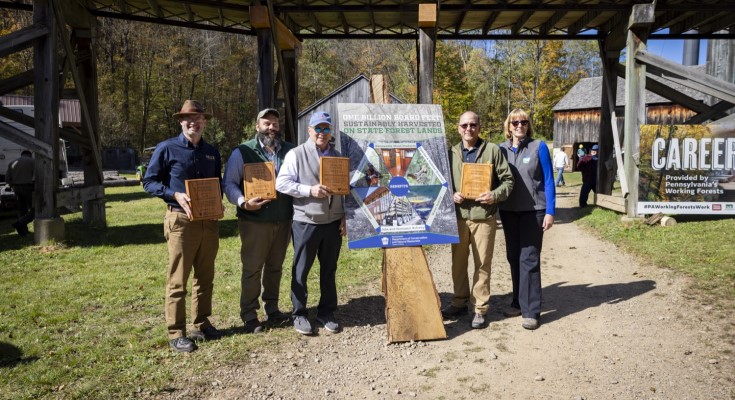
HARRISBURG, PA — Pennsylvania has harvested 1 billion board feet of timber from state forests since adopting a long-term allocation system in 2004, sustaining a public resource that generates more than $20 million in annual timber revenue while supporting the state’s forest products industry and conservation programs.
The Pennsylvania Department of Conservation and Natural Resources (DCNR) marked the milestone Friday, October 9, at the Pennsylvania Lumber Museum in Potter County, recognizing more than two decades of timber production under a management system designed to balance commercial harvesting with forest regeneration and environmental protection.
The cumulative harvest represents timber removed from state forestlands under the Bureau of Forestry’s Harvest Allocation Model, established in 2004 to guide production within sustainable limits.
The model helps determine harvesting levels while accounting for forest health, wildlife habitat, water resources and public access.
Pennsylvania manages approximately 2.2 million acres of state forestland, where timber harvesting is one component of a broader land management program that also supports recreation, habitat protection and long-term forest productivity.
State Forester Seth Cassell, director of the Bureau of Forestry, said the system produces substantial revenue while maintaining other public uses of forestland.
“The collaborative work to manage 2.2 million acres of state forestlands to provide more than $20 million on timber revenues annually, while managing forest health, public safety, and offering top notch recreational opportunities is a result of a lot of collaborative work and commitment to our mission,” Cassell said.
The revenue underscores the economic role of publicly managed forests in Pennsylvania, where timber production supplies the forest products industry while requiring continued investment in sustainable resource management.
DCNR Secretary Cindy Adams Dunn said the volume harvested since 2004 is equivalent to enough lumber to circle the Earth approximately eight times.
“We have a responsibility to balance timber production with protecting forest health, wildlife habitat, water resources, and public access so Pennsylvania’s forests remain healthy and productive for generations to come,” Dunn said.
The harvesting framework operates alongside Pennsylvania’s State Forest Resource Management Plan, which establishes broader objectives for the management of public forestlands.
DCNR’s strategic plan, Forests for All – A Plan for Pennsylvania’s Forests and People, also identifies priorities for maintaining forest resilience, expanding public engagement and preserving forest resources for future generations.
The state’s approach reflects a shift from the extensive logging practices that depleted much of Pennsylvania’s forest cover during the 19th century.
By 1900, Pennsylvania had lost more than 60% of its forests, leaving large areas of cut-over and damaged land.
The Commonwealth established its forestry agency in 1895 to address wildfires and begin restoring heavily logged and burned landscapes.
Early conservation leaders Joseph Rothrock and Gifford Pinchot helped develop policies emphasizing reforestation, public ownership and sustained management of forest resources.
Pinchot, who served as the first chief of the U.S. Forest Service and later as Pennsylvania governor, also supported the Civilian Conservation Corps’ work restoring forests and constructing roads, trails and fire towers.
The Pennsylvania Lumber Museum documents that history, including the timber industry’s role in supplying materials for transportation, construction and industrial development.
Andrea Lowery, executive director of the Pennsylvania Historical & Museum Commission, said the industry’s history illustrates the relationship between commercial timber production and conservation policy.
“That history of intensive logging sparked an early conservation movement, transforming Pennsylvania into a leader in sustainable forestry,” Lowery said.
The state’s current timber management system is intended to avoid the widespread depletion associated with earlier logging practices while maintaining a continuing supply of forest products.
Harvesting also serves as a forest management tool, allowing the Bureau of Forestry to address vegetation conditions, support wildlife habitat and maintain productive forestland.
Beyond timber production, DCNR oversees 125 state parks and the Commonwealth’s 2.2 million acres of state forests, all of which provide free public access for recreational activities.
The agency’s broader conservation priorities include protecting old-growth forests, improving Chesapeake Bay water quality, expanding renewable energy and enhancing biodiversity.
The 1 billion board-foot milestone establishes a cumulative measure of timber production under Pennsylvania’s allocation model, while the more than $20 million in annual revenue demonstrates the continuing economic contribution of state forestlands.
Future harvesting will remain governed by the state’s long-term management framework, which seeks to maintain timber production without compromising the environmental and recreational functions of Pennsylvania’s public forests.
Support the local news that supports Chester County. MyChesCo delivers reliable, fact-based reporting and essential community resources—free for everyone. If you value that, click here to become a patron today.