
The morning fog lifts slowly from the East Branch of the Octoraro Creek, revealing a red covered bridge tucked among the trees. A pickup truck turns onto Mercer’s Mill Road, passing hayfields and white farmhouses where silos rise above the landscape like old sentinels. In nearby Cochranville, the first customers step into a local café while church bells echo faintly across the valley.
It is a landscape built on routine.
Planting and harvest. School events and church suppers. Quiet roads that connect one farm to another. In a county increasingly defined by growth and development, West Fallowfield Township still moves to a distinctly rural rhythm.
That rhythm has become one of its greatest assets.
As open land disappears across much of southeastern Pennsylvania, West Fallowfield remains one of Chester County’s most enduring agricultural communities—a place where historic farms, covered bridges, and crossroads villages continue to define everyday life. The township’s modest population growth and deep attachment to its rural identity have created something increasingly uncommon: a community where the landscape still looks remarkably like the one earlier generations would recognize.
The story begins with the land itself.
Rolling fields and fertile valleys attracted some of Chester County’s earliest farming families, many of them influenced by Quaker traditions that shaped settlement throughout the region. Rather than concentrating in dense villages, residents established dispersed farmsteads connected by a network of roads and creek crossings that encouraged both independence and community.
That pattern remains visible today.
Drive along Limestone Road or Gap Newport Pike and the countryside still unfolds in broad stretches of farmland and wooded stream valleys. Barns and silos punctuate the landscape. Long driveways disappear behind stands of mature trees. The sense of openness feels increasingly rare.
Perhaps no place captures that feeling better than Mercer’s Mill Covered Bridge.
The red Burr-arch truss bridge spans the Octoraro Creek much as it has for more than a century and a half, its timber frame and stone abutments preserving the look and feel of nineteenth-century rural travel. Once part of a busy farm-to-market route, the bridge today feels almost suspended in time.
It is one of those places that seems to slow people down.
Visitors pause for photographs. Cyclists stop to admire the view. Local residents still use it as a landmark when giving directions.
Nearby, another historic bridge quietly tells a similar story.
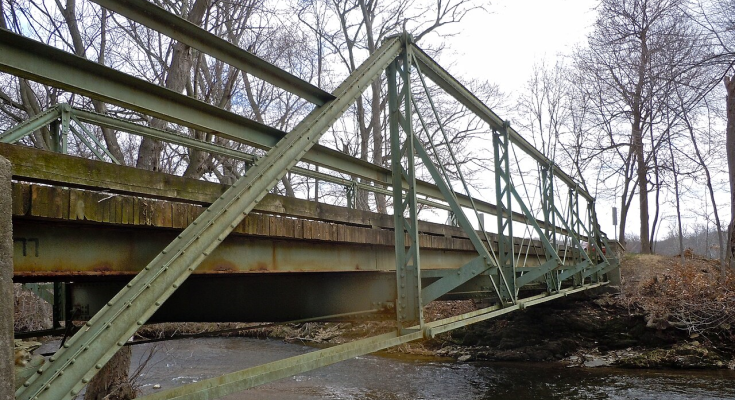
The iron framework known simply as the Bridge in West Fallowfield Township reflects the industrial craftsmanship that once connected rural communities throughout Chester County. Built in 1885, its historic metal truss design remains intact, a reminder that infrastructure was once built not merely to function but to endure.
The township’s agricultural roots run even deeper.
The Joseph and Esther Phillips Plantation preserves one of West Fallowfield’s earliest farm landscapes, a property that illustrates the transition from frontier settlement to established agricultural prosperity. The stone house and surrounding fields speak to generations of families whose lives were measured by seasons and harvests rather than clocks and calendars.
For much of its history, farming was not simply an occupation here.
It was the organizing principle of community life.
That tradition continues in and around Cochranville, the township’s principal village and social center. Located at the intersection of Routes 10 and 41, the crossroads community serves as the everyday heart of West Fallowfield. Shops, churches, local businesses, and community institutions provide the kind of familiarity that has become increasingly difficult to find elsewhere.
People know one another here.
School events become community events. Agricultural fairs draw neighbors together. Churches and civic organizations remain important gathering places. The township’s population has changed and grown over the decades, but its sense of connection has remained remarkably stable.
Even its political leaders often emerged directly from the agricultural community.
Men such as Robert Futhey and Robert E. Monaghan represented Chester County in the Pennsylvania House of Representatives while remaining deeply rooted in the life of West Fallowfield’s farms and businesses. Their stories reflect a long local tradition of civic leadership grounded in community rather than ambition.
Today, the township finds itself balancing two realities.
Its proximity to employment centers and major transportation corridors makes it increasingly attractive to newcomers. Yet its identity remains inseparable from the farmland, historic landscapes, and slower pace that define the community.
The challenge is not preserving a museum piece.
It is preserving a way of life.
As evening settles over West Fallowfield Township, the last sunlight catches the red siding of Mercer’s Mill Covered Bridge. Fields darken beneath a summer sky, and the lights of Cochranville begin to glow at the crossroads.
The roads remain quiet.
The farms remain productive.
And across this corner of western Chester County, the landscape continues to tell a simple but increasingly rare story: that a community can still be shaped by its fields, its traditions, and the enduring rhythm of rural life.
Support the local news that supports Chester County. MyChesCo delivers reliable, fact-based reporting and essential community resources—free for everyone. If you value that, click here to become a patron today.