
The morning rush begins early in Valley Township. Traffic rolls steadily along Lincoln Highway as commuters head toward Coatesville, Downingtown, and beyond. School buses navigate neighborhoods that only a generation ago were open fields. Near Wagontown Road, the West Branch of the Brandywine Creek slips quietly beneath a century-old stone bridge, its waters moving past landscapes that have witnessed blacksmiths, steelworkers, farmers, and factory owners.
At first glance, Valley Township feels like a place defined by transition.
Part suburban community, part industrial corridor, and part agricultural landscape, it occupies a unique position in western Chester County. It partially surrounds Coatesville, sits at the crossroads of historic transportation routes, and continues to evolve as new residents arrive. Yet beneath that growth lies a story rooted in iron, industry, and the people who helped build one of Pennsylvania’s most important manufacturing regions.
That story matters now because Valley Township represents a version of Chester County often overshadowed by more familiar narratives.
The county is frequently associated with horse farms, historic villages, and affluent suburbs. Valley Township offers a different perspective—one shaped by factories, railroads, working farms, and generations of families whose livelihoods were tied to the rise of American industry. As redevelopment and residential growth continue to reshape the region, the township remains a living reminder of Chester County’s industrial heritage.
Its history begins with agriculture.
For much of the eighteenth and early nineteenth centuries, the area consisted primarily of farms spread across gently rolling terrain west of present-day Coatesville. Families cultivated the land, established homesteads, and built the rural communities that would define the landscape for generations.
Everything changed when industry arrived.
In 1816, Dr. Charles Lukens and his wife, Rebecca, took control of the Brandywine Iron Works, leasing the operation from her father, who had established it a few years prior. What began as a modest iron mill would eventually evolve into the Lukens Iron and Steel Company, one of the most influential industrial enterprises in Pennsylvania.
No figure looms larger in that story than Rebecca Lukens.
Following her husband’s death, she assumed leadership of the business at a time when few women held such positions. Through determination, innovation, and business acumen, she transformed the struggling operation into a thriving manufacturer known nationally for its boilerplate steel.
Her influence extended beyond the mill itself.
The industrial growth that followed shaped the broader Brandywine Valley, creating jobs, attracting workers, and helping establish Coatesville as one of America’s leading steel-producing communities. Valley Township became part of that expanding economic landscape, its farms, roads, and neighborhoods increasingly connected to the rhythms of industrial life.
The traces of that era remain visible.
Near Rock Run, blacksmith shops once served local residents and industries. Rail lines crossed the township, linking factories and farms to broader markets. A trolley line connected Coatesville and Parkesburg through Westwood until the late 1930s, carrying workers, shoppers, and families through the countryside.
Yet agriculture never disappeared.
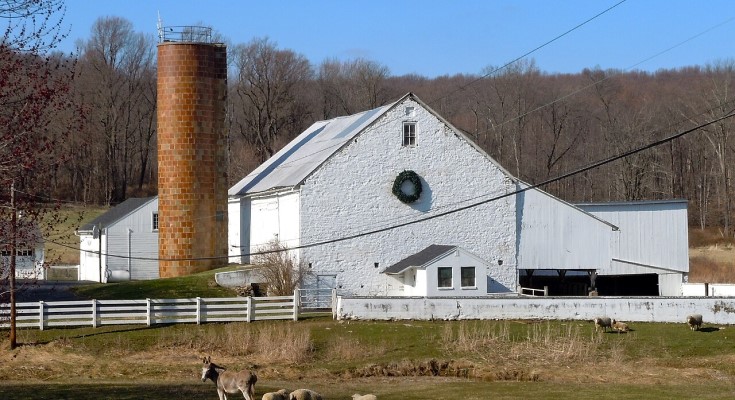
Properties such as Hopewell Farm continue to preserve the rural heritage that predates the steel mills. Its stone farmhouse, bank barn, and surrounding fields offer a glimpse into the agricultural landscape that once dominated the township. Standing among its rolling acres, it becomes easy to imagine a time when harvest schedules mattered more than factory shifts.
Other landmarks tell equally important stories.
The Passtown School reflects a different, equally vital chapter in local history. Built in 1923 to serve the historically African American community of Hayti, the simple stone schoolhouse functioned as both an educational institution and a neighborhood anchor.
Its preservation carries significance far beyond architecture.
The building represents generations of local families whose stories are often absent from broader accounts of Chester County history. After serving for over half a century as the Valley Township municipal building, the structure entered a new era of transition when township offices relocated in 2019. Today, championed by local preservationists, it stands as a cultural landmark poised to become a community center and museum—safeguarding the past for future generations.
A few miles away, County Bridge No. 101 spans the Brandywine with quiet elegance.
Constructed in 1918, the stone arch bridge reflects the craftsmanship that once defined public infrastructure throughout rural Pennsylvania. More than a century later, it continues to carry traffic across the creek while preserving its original character and setting.
The surrounding landscape continues to evolve.
Former farmland has given way to residential neighborhoods, shopping centers, and commercial development. New residents arrive each year, drawn by affordable housing, access to employment, and proximity to major transportation corridors.
Yet Valley Township retains a distinctly grounded identity.
Unlike communities built around a single historic village or natural landmark, its character emerges from the intersection of multiple histories. Industrial workers and farmers. Railroads and highways. Steel mills and schoolhouses. Longtime residents and newcomers.
Those layers create a community that feels authentic precisely because it has never been defined by a single story.
Instead, it reflects the broader story of Chester County itself—a place continually adapting to change while carrying the influence of what came before.
As evening settles over Valley Township, sunlight fades across the fields near Hopewell Farm. Traffic slows along Lincoln Highway. The Brandywine flows beneath County Bridge No. 101, just as it did when farmers first settled the valley and when steelworkers headed home after long shifts at the mills.
The water keeps moving.
Past farms and factories.
Past schoolhouses and rail lines.
Past generations who built lives in a township shaped equally by hard work and constant change.
And in Valley Township, that ongoing journey remains the story that connects everything else.
Support the local news that supports Chester County. MyChesCo delivers reliable, fact-based reporting and essential community resources—free for everyone. If you value that, click here to become a patron today.