
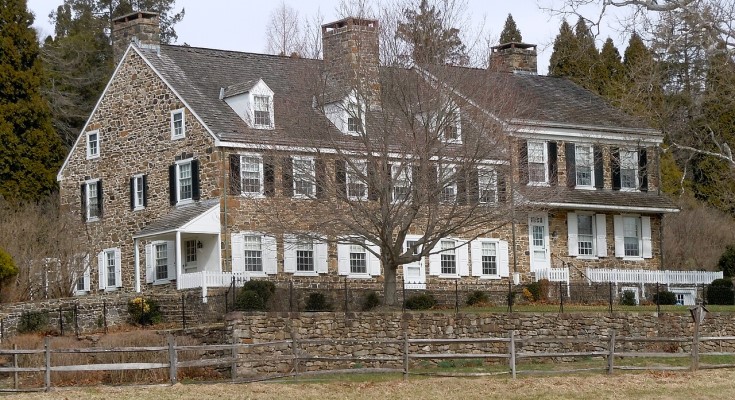
The fog rises slowly from Valley Creek in the early morning, drifting low across the meadow before dissolving into the bare branches above the water. Hoarfrost clings to split-rail fences and the edges of stone walls, while the distant crunch of gravel beneath a visitor’s boots briefly interrupts the stillness. Near the creek, the small stone house that once sheltered George Washington sits quietly in the pale winter light, its narrow windows reflecting a sky not unlike the one soldiers would have seen here nearly 250 years ago. Even now, before the park fully wakes, the landscape feels heavy with memory.
By sunrise, the silence gives way to movement. Cyclists pass along the Schuylkill River Trail. Runners weave through the rolling fields. School groups gather near reconstructed huts where smoke once curled from rough stone chimneys into bitter winter air. The park is alive, but not hurried. People lower their voices here without quite realizing they’ve done it.
Valley Forge matters now because it remains one of the rare places where American history still feels physical rather than symbolic. The village and surrounding encampment grounds are not simply monuments to the Revolutionary War; they are a preserved landscape of hardship, endurance, and transformation. At a moment when national identity is often debated in abstract terms, Valley Forge offers something tangible—a place where the fragility of the American experiment once stood exposed against hunger, disease, and winter cold.
“It’s easy to romanticize it until you actually stand here in January,” one park visitor says while looking across the open fields near the reconstructed encampment huts. “Then you realize how impossible it must have felt.”
The village itself began long before Washington’s arrival. By the mid-18th century, an iron forge stood near the confluence of Valley Creek and the Schuylkill River, producing bar iron from pig iron hauled from Warwick Furnace. The forge gave the area its name and shaped the small industrial settlement that emerged beside it.
That industry would make the site strategically important during the Revolutionary War—and ultimately vulnerable.
In September 1777, British forces burned the forge to prevent its use by the Continental Army. Just months later, Washington selected the high ground across Valley Creek as the site for his winter encampment, positioning nearly 12,000 soldiers within reach of Philadelphia while protecting the army from direct British attack.
What followed became one of the defining chapters of the war.
“It wasn’t a battlefield victory,” the visitor says. “It was survival.”
The reconstructed soldiers’ huts scattered across the park offer the clearest glimpse into that reality. Built according to surviving specifications, the rough-hewn cabins are startlingly small inside—tight quarters of logs, dirt floors, narrow bunks, and smoke-darkened fireplaces where soldiers endured one of the harshest winters of the war.
Standing inside one of the huts, the cold feels immediate even now.
The structures were arranged with military precision across the hillsides, forming what was essentially a temporary city built under impossible conditions. Disease spread quickly. Supplies ran short. Clothing and blankets remained scarce. Yet it was here, amid deprivation and exhaustion, that the Continental Army began to transform.
Baron Friedrich von Steuben arrived at Valley Forge in February 1778 carrying European military experience and a relentless approach to discipline. On the frozen parade grounds near Washington’s headquarters, he drilled soldiers in coordinated movement, sanitation practices, and battlefield organization.
“He taught them how to function as one army instead of separate militias,” a historical interpreter says near the training grounds. “That changed everything.”
At the center of it all stood Washington’s headquarters inside the modest Isaac Potts House beside Valley Creek. The building remains remarkably intact, its low ceilings, thick stone walls, and narrow rooms emphasizing the contrast between the simplicity of the setting and the magnitude of the decisions made there.
Within those rooms, Washington managed military strategy, political tensions, supply crises, and the morale of an army that might easily have collapsed. Letters moved constantly between the headquarters and Congress. Officers crowded into adjoining rooms. Maps covered tables beside deep hearths struggling against the winter cold.
“The scale of responsibility feels almost impossible when you see how small the space actually was,” the interpreter says. “That’s what surprises people most.”
Over time, Valley Forge evolved from a place of wartime survival into one of national memory. The towering National Memorial Arch, completed in 1917, now rises above the landscape as a monumental tribute to the army’s endurance. Its pale limestone structure frames the surrounding hills like a ceremonial gateway, linking the suffering of the encampment to the mythology of the nation that emerged from it.
Yet despite its symbolic weight, Valley Forge never feels entirely detached from ordinary life.
The Schuylkill River Trail cuts through the landscape, connecting the park to nearby communities and drawing thousands of cyclists and walkers each year. Families picnic in open meadows where regiments once drilled. Deer move quietly through wooded areas at dusk. The village itself remains small and understated, tucked between major regional highways and the commercial intensity of nearby King of Prussia.
That contrast—between preservation and modern life—gives Valley Forge much of its emotional force.
“You come here and everything slows down,” the visitor says, watching the fog begin to lift from the creek. “Not because it’s frozen in time. Because it reminds you how much happened here.”
As afternoon fades into evening, the winter light softens across the fields and settles against the stone walls of Washington’s headquarters. The crowds thin. The trails grow quieter. Smoke no longer rises from soldiers’ huts, but the outlines remain against the hillsides, stark and unmistakable.
The creek keeps moving past them, just as it did during the winter of 1777.
And in the fading light of Valley Forge, the distance between past and present suddenly feels very small.
Support the local news that supports Chester County. MyChesCo delivers reliable, fact-based reporting and essential community resources—free for everyone. If you value that, click here to become a patron today.