
Morning arrives slowly in Upper Oxford Township. A veil of mist hangs over freshly cut hayfields as the first sunlight spills across rolling farmland near the Maryland border. Red barns emerge from the haze one by one. A tractor moves deliberately along a distant ridge. Along quiet country roads, white fences trace property lines that have remained largely unchanged for generations. The only sounds are birdsong, the rustle of leaves in scattered woodlots, and the low hum of a pickup truck heading toward a day’s work.
In much of southeastern Pennsylvania, landscapes like this have become increasingly difficult to find.
Yet in Upper Oxford Township, agriculture still defines both the scenery and the rhythm of daily life. Here, development exists, but it has not overwhelmed the countryside. Farm fields continue to stretch toward the horizon. Historic crossroads villages remain intact. Open space remains the dominant feature rather than the exception.
That distinction feels especially significant today.
As population growth and suburban expansion continue to reshape portions of Chester County, Upper Oxford has emerged as one of the region’s strongest examples of rural preservation. Through a combination of agricultural stewardship, conservation easements, and community planning, the township has maintained a landscape that looks remarkably similar to the one early settlers encountered centuries ago.
Those roots run deep.
Like much of southern Chester County, Upper Oxford developed through a pattern of agricultural settlement shaped by Quaker influence. Farmers established homesteads across the gently rolling terrain, creating a patchwork of fields, orchards, pastures, and woodlots that would define the community for generations.
Unlike many neighboring areas, growth arrived gradually.
For much of the twentieth century, Upper Oxford remained sparsely populated. In 1930, roughly 1,100 called the township home. Even as nearby communities expanded, the township retained its agricultural identity, growing steadily rather than rapidly. Today, just over 2,500 residents live across nearly 17 square miles of countryside.
The roads tell part of that story.
U.S. Route 1 cuts through the township as a modern transportation corridor, while Routes 10 and 896 connect residents to Oxford, Kennett Square, Lancaster County, and northern Delaware. Yet despite those regional connections, much of Upper Oxford still feels removed from the pace of suburban development.
Drive a few miles beyond the highway and the landscape changes quickly.
Cornfields replace commercial centers. Historic farmhouses stand back from narrow country roads. Tree-lined streams wind through protected valleys. The township’s elevation offers broad views across one of Chester County’s most expansive agricultural regions.
Few places capture that character more clearly than Homeville.
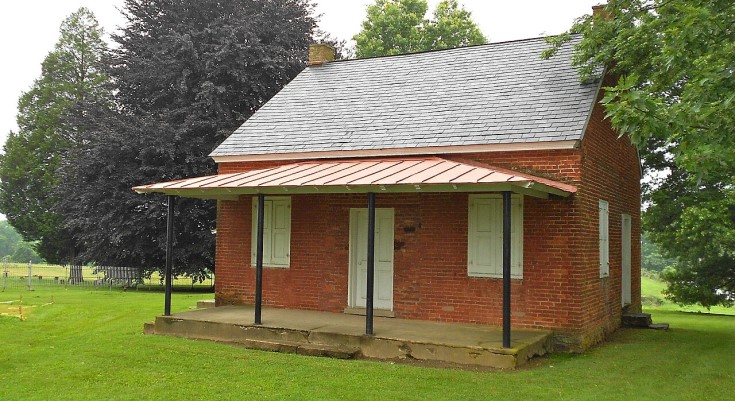
The tiny crossroads village appears almost frozen in time. At its center stands the Homeville Friends Meeting House, a simple brick structure built in 1839. Its architecture reflects the Quaker values that helped shape the community—plain, functional, and quietly enduring.
Surrounded by mature trees and an adjoining burial ground, the meetinghouse remains one of the township’s most evocative landmarks.
Generations of local families gathered there for worship, community decisions, and shared milestones. Though regular meetings ceased more than a century ago, the building continues to anchor the village, preserving a tangible connection to the township’s earliest cultural traditions.
The surrounding landscape is equally important.
Across Upper Oxford, thousands of acres of farmland and open space remain intact through conservation efforts led by landowners, local governments, and organizations such as the Brandywine Conservancy and The Land Conservancy for Southern Chester County. Conservation easements have helped protect working farms while preserving the scenic vistas that define the region.
The result is not merely attractive scenery.
It is an agricultural landscape that continues to function.
Fields produce crops. Families maintain active farms. Hedgerows provide wildlife habitat. Stream corridors help protect water quality. The countryside remains productive rather than ornamental.
That balance has become increasingly valuable.
Residents enjoy the benefits of rural living while remaining connected to employment centers throughout Chester County, Delaware, and beyond. Many commute to work, while a growing number work remotely from homes surrounded by open space. The township’s strong household incomes and relatively young median age reflect a community that continues to attract families seeking room to breathe without sacrificing regional access.
Education also plays a role in that appeal.
Students attend the Oxford Area School District, while nearby institutions such as Lincoln University provide additional educational opportunities just beyond the township’s borders. The presence of both historic and modern educational institutions reinforces the area’s longstanding connection to learning and civic life.
Yet for many residents, the landscape itself remains the greatest asset.
It is visible in every direction.
A line of sycamores marking a stream corridor. A weathered barn standing against a summer sky. Fields turning gold before harvest. A quiet cemetery beside a Quaker meetinghouse. Together, they create a sense of continuity that is increasingly uncommon in rapidly changing regions.
As evening settles over Upper Oxford Township, long shadows stretch across pastureland and freshly plowed fields. The last light catches the brick walls of the Homeville Friends Meeting House before fading behind distant tree lines. Along country roads, farmhouses glow softly beneath porch lights as another day comes to an end.
The landscape grows quiet once again.
Much as it has for generations.
And in Upper Oxford Township, that enduring rhythm may be the most remarkable story of all.
Support the local news that supports Chester County. MyChesCo delivers reliable, fact-based reporting and essential community resources—free for everyone. If you value that, click here to become a patron today.