
Morning settles softly over Pocopson Township. Fog rises from the Brandywine Creek and drifts across hayfields bordered by split-rail fences. Along Wawaset Road, sunlight filters through towering sycamores and tulip poplars, illuminating stone farmhouses tucked behind centuries-old trees. The creek moves steadily through the valley below, winding past wooded banks much as it did when Lenape families camped along its shores and Quaker settlers first arrived in the region.
The landscape feels quiet, almost understated.
Yet beneath that calm surface lies one of the most layered stories in Chester County—a place where Indigenous history, Revolutionary War movements, abolitionist courage, industrial enterprise, and modern conservation all occupy the same terrain. In an era when rapid growth continues to reshape much of southeastern Pennsylvania, Pocopson Township has become something increasingly rare: a community where the land itself remains the primary storyteller.
That story matters now because so much of it has survived.
While many historic communities preserve individual buildings, Pocopson has retained entire landscapes. Its creek valleys, historic villages, farm fields, and wooded corridors continue to provide the physical context for events that shaped both local and national history. As township leaders update long-range plans and residents debate the future of growth and preservation, Pocopson finds itself protecting not merely structures, but a living historical environment.
Long before township boundaries existed, the area belonged to the Lenni Lenape.
Archaeological evidence and historical records document multiple Lenape villages and seasonal camps along the Brandywine and Pocopson Creek corridors. The waterways provided food, transportation, and access to trade routes that connected communities across the region. Even the township’s name carries that legacy, derived from the Lenape word Pocaupsing, meaning “roaring waters.”
The creeks remain central to the landscape today.
They shaped where roads developed, where mills were built, and where communities emerged. In the 1720s, Joseph Taylor established one of the area’s earliest mills along Pocopson Creek on land he acquired in 1711, harnessing the waterway’s power to support a growing agricultural economy. Similar enterprises soon followed, helping transform the Brandywine Valley into one of colonial Pennsylvania’s most productive regions.
By the time the American Revolution arrived, the countryside had become strategically important.
In September 1777, British troops moved through portions of what is now Pocopson Township during the Battle of Brandywine campaign. The creeks, ridges, and fords that define the landscape today influenced military decisions during the largest land battle of the Revolutionary War. Nearby crossings helped shape troop movements as British forces maneuvered around Washington’s army.
The terrain still tells that story.
In Trimbleville, a small crossroads village nestled along the West Branch of the Brandywine, stone houses and farm buildings stand within sight of the creek crossings that once carried soldiers through the valley. The village remains remarkably intact, preserving not only its architecture but also the relationship between roads, waterways, and settlement patterns that made it significant.
Elsewhere, another chapter of American history unfolded with far less noise.
The Barnard House, historically known as Barnard Station, stands as a testament to the township’s role in the Underground Railroad. Built by a Quaker family deeply committed to abolition, the stone house became a documented refuge for freedom seekers moving north through Chester County.
Its significance extends far beyond architecture.
For decades, the building quietly witnessed acts of extraordinary courage. Families risked social standing, financial security, and legal consequences to provide shelter and assistance to people escaping slavery. Today, an ambitious restoration effort is bringing new life to the property, transforming it into one of the region’s most important reminders of Chester County’s abolitionist heritage.
The restoration has become a source of community pride.
Stone walls that had deteriorated through years of neglect now stand stabilized. Original structural elements have been preserved. The building’s future appears increasingly secure, ensuring that future generations can engage directly with one of the township’s most meaningful stories.
Pocopson’s historic resources extend well beyond a single house.
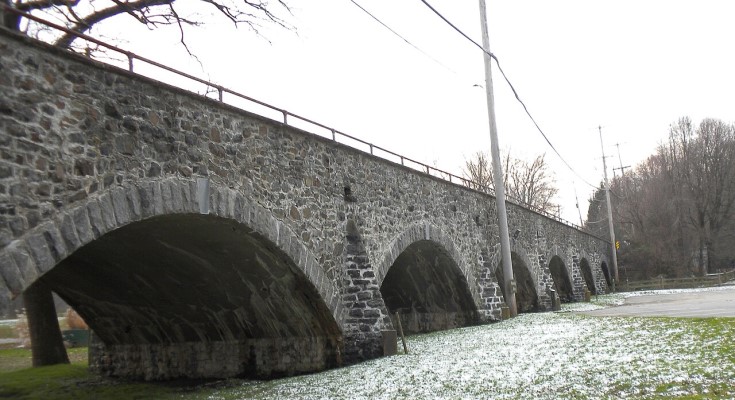
The Northbrook Historic District preserves a picturesque mill village where homes, workshops, and community buildings cluster along a sweeping bend of the Brandywine. Nearby, the Wilkinson House reflects the late 19th century with its distinct Rural Gothic style. The Lenape Bridge spans the creek with graceful stone arches that have carried travelers across the water for generations.
Each site contributes to a larger narrative.
Together they reveal a community shaped by waterways, agriculture, transportation, and an enduring commitment to stewardship.
That stewardship remains one of Pocopson’s defining characteristics.
Despite its proximity to West Chester, Wilmington, and Philadelphia, the township has retained a distinctly rural identity. Open-space preservation, agricultural conservation, and careful planning have helped maintain the rolling fields and wooded corridors that distinguish the community from many neighboring suburbs.
Pocopson Park embodies that philosophy.
Families gather for community events. Children ride bicycles along trails. Walkers follow paths beside the creek. The park functions not simply as recreation space but as a continuation of the township’s broader commitment to preserving the relationship between people and landscape.
That relationship helps explain why Pocopson consistently ranks among Chester County’s most desirable communities.
Residents are drawn by excellent schools, preserved scenery, and a quality of life rooted in open space rather than density. Yet what many discover after arriving is something deeper—a sense that history remains unusually present here.
Not frozen.
Not staged.
Simply woven into daily life.
As evening settles over the Brandywine Valley, shadows lengthen across the fields surrounding Northbrook and Trimbleville. The last sunlight catches the stone arches of Lenape Bridge before fading into the creek below. Along the Brandywine, water continues its steady journey through a landscape shaped by centuries of human stories.
The creek has witnessed all of them.
And in Pocopson Township, it remains both a constant presence and a quiet reminder that some places are defined not by what has changed, but by what has endured.
Support the local news that supports Chester County. MyChesCo delivers reliable, fact-based reporting and essential community resources—free for everyone. If you value that, click here to become a patron today.