
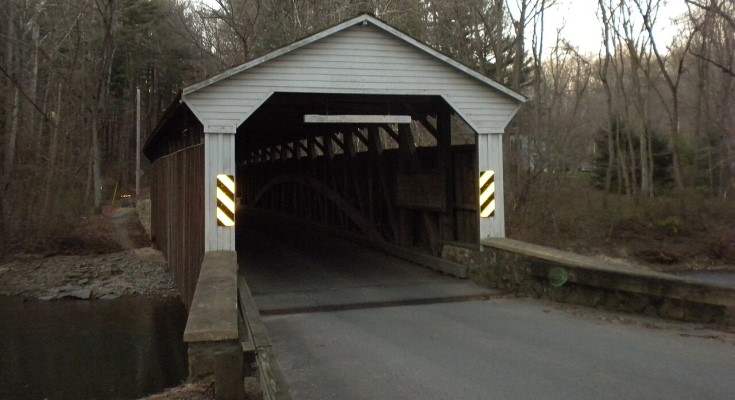
The morning sun filters through the sycamores lining Big Elk Creek, casting shifting patterns across the water below. Along Kings Row Road, the red timbers of a covered bridge emerge from the trees, their reflection rippling gently in the current. Beyond the creek, fields stretch toward the horizon, interrupted only by weathered barns, church steeples, and winding roads that have connected this corner of Chester County for nearly three centuries.
A few miles away, the crossroads village of New London is beginning to stir. Traffic moves quietly through the community that once served as a bustling stagecoach stop between Baltimore and Philadelphia. The pace is slower now, but traces of the township’s remarkable past remain visible in nearly every direction.
Few communities of its size have exerted such influence on American history. As growth continues to transform parts of southern Chester County, New London Township remains a place where the landscape still tells stories of colonial settlement, revolutionary politics, and educational ambition. At a time when many historic communities struggle to maintain a connection to their origins, New London offers something increasingly rare: a living link between rural Pennsylvania and the founding of the nation itself.
The township’s story begins before there was a United States.
Long before European settlers arrived, Lenni Lenape communities traveled the waterways and ridges that cross the area today. By the early eighteenth century, immigrant farmers began settling lands subdivided by the London Company, establishing homesteads across rolling farmland near the Maryland border. Swedish settlers arrived from New Castle, followed by large numbers of Scots-Irish Presbyterians whose influence would shape the community for generations.
What emerged was more than a farming settlement.
It became one of the region’s most important centers of learning.
In 1741, Presbyterian minister Rev. Francis Alison founded the New London Academy, a classical school that would eventually become recognized as the parent institution of the University of Delaware. From this rural crossroads came an educational legacy that reached far beyond Chester County.
The academy’s students included three future signers of the Declaration of Independence.
- Thomas McKean.
- George Read.
- James Smith.
The list reads less like the enrollment records of a small frontier school and more like a roster of the American founding generation.
For New London Township, that legacy remains a source of quiet distinction.
The original academy building no longer survives, but the site continues to symbolize the extraordinary influence that education wielded in colonial America. Young men traveled considerable distances to study under Alison, whose rigorous curriculum helped prepare future lawyers, judges, governors, and statesmen.
Among them was Thomas McKean, perhaps New London’s most accomplished native son.
Born in the township in 1734, McKean would go on to sign the Declaration of Independence, serve as President of Delaware, and later become Governor of Pennsylvania. His career spanned some of the most consequential years in American history, yet its roots can be traced back to the rural landscape surrounding New London.
History lingered here in other ways as well.
During the Revolutionary era, the village served as an active transportation and communication hub. Benjamin Franklin encouraged local support for militia efforts, while George Washington maintained a relay of coach horses in the community. By the early nineteenth century, New London Crossroads had become a thriving stagecoach stop where travelers exchanged news, merchants conducted business, and residents gathered in inns that served as the social centers of the day.
Though the stagecoaches disappeared long ago, the township’s connection to its past remains unusually tangible.
The New London Presbyterian Church stands as one of the most visible reminders. Closely linked to the academy and the early Scots-Irish settlement, the congregation became both a spiritual and intellectual center for the growing community. Its presence continues to anchor the landscape much as it did generations ago.
Elsewhere, two covered bridges offer a different connection to history.
The Rudolph and Arthur Covered Bridge and the Linton Stephens Covered Bridge span Big Elk Creek near the township line, preserving a form of engineering once common throughout rural Pennsylvania. Their red-painted timber construction, graceful Burr-arch trusses, and creekside settings create scenes that feel almost untouched by time.
The Rudolph and Arthur Bridge carries an especially poignant story.
Destroyed by the remnants of Hurricane Ida in 2021, the beloved crossing seemed lost. Yet community commitment and preservation efforts ultimately led to a meticulous reconstruction that reopened in 2025, restoring both a transportation link and a cherished landmark.
That determination reflects something fundamental about New London itself.
The township continues to evolve, yet remains deeply connected to its agricultural foundations. Farms still define much of the landscape. Open fields stretch across gently rolling terrain. Rural roads wind through woodlots and pastures before connecting residents to nearby Oxford, Avondale, and Newark.
The balance between preservation and change has become part of the township’s identity.
Today, more than 5,800 residents call New London home. Families are drawn by highly regarded schools, open space, and a quality of life that feels increasingly uncommon in a rapidly developing region. Yet despite modern growth, the township retains the visual character of a place shaped by agriculture, education, and community rather than by expansion alone.
As evening settles over New London Township, shadows lengthen across the fields surrounding Big Elk Creek. The covered bridges darken against the fading sky. The last sunlight catches the steeple of the historic Presbyterian church before slipping beyond the horizon.
The scene feels familiar, even after centuries of change.
And perhaps that is New London’s greatest achievement—not simply that it helped educate founders, hosted statesmen, and witnessed the birth of a nation, but that it remains a place where history still feels present, carried quietly through the landscape like the creek flowing beneath its bridges.
Support the local news that supports Chester County. MyChesCo delivers reliable, fact-based reporting and essential community resources—free for everyone. If you value that, click here to become a patron today.