
Before dawn breaks over southern Chester County, headlights begin tracing their way along Baltimore Pike. Delivery trucks rumble toward packing facilities. Workers arrive at mushroom houses hidden behind rows of trees. The earthy scent of compost drifts across the countryside, mingling with the damp smell of fields still carrying the night’s dew.
As the sun rises, New Garden Township reveals itself in layers.
Mist lifts from the White Clay Creek valley. Water-filled quarry pits reflect the morning light like fragments of glass scattered among the trees. In Toughkenamon, the day begins early as one of the nation’s most productive mushroom-growing regions comes to life. A few miles away, the quiet grounds of New Garden Friends Meeting stand beneath centuries-old trees, their stillness offering a striking contrast to the activity unfolding across the township.
Few places in Chester County embody the intersection of history, agriculture, industry, and cultural change quite like New Garden. As population growth continues to reshape southern Chester County, the township stands at the center of a conversation about identity: how a community built by Quaker farmers, transformed by industry, and sustained by agriculture continues to evolve while preserving the landscapes and traditions that made it distinctive in the first place.
Its story stretches back more than three centuries.
Organized in 1714, New Garden Township took its name from the New Garden Friends Meeting, which served as the spiritual and civic heart of an early Quaker settlement. The land itself originated from a 1706 patent issued to William Penn Jr., later passing into the hands of settlers who established farms, mills, schools, and villages along the valleys of the White Clay and Red Clay creeks.
Those waterways shaped everything.
Water-powered gristmills and manufacturing sites emerged along their banks. Roads followed the contours of the valleys. Small settlements grew around crossroads, taverns, and industrial enterprises. Communities such as Landenberg, Toughkenamon, and Kaolin developed their own identities while remaining connected through commerce and agriculture.
The traces remain visible today.
In Landenberg, the landscape still bears the imprint of an industrial past. Stone mill buildings stand near the bends of White Clay Creek. Former rail corridors weave through wooded hillsides. Old bridges span rocky waters that once powered mills producing flour, wool, paper, and other goods essential to a growing region.
The scenery feels almost cinematic.
Steep forested slopes rise above the creek. Massive boulders line the water’s edge. The sound of rushing water echoes through a valley where industry and nature have become inseparable parts of the same story.
Elsewhere, another chapter of New Garden’s history lies hidden beneath the surface.
The village of Kaolin owes its existence to deposits of fine white clay that fueled a thriving mining industry during the 19th and early 20th centuries. Rail lines carried the material to distant markets where it became part of ceramics, paper products, and industrial manufacturing. Though the mines have long since fallen silent, their legacy remains etched into the landscape through water-filled quarry pits and subtle changes in topography that reveal where the earth was once opened and reshaped.
Yet no industry has defined New Garden more profoundly than mushrooms.
Today, the township sits at the heart of a regional agricultural enterprise that supplies a substantial share of the nation’s mushroom production. Along the roads surrounding Toughkenamon, mushroom houses, composting facilities, packaging operations, and distribution centers form an economic network unlike anywhere else in Pennsylvania.
The industry has shaped more than the local economy.
It has influenced demographics, attracted generations of immigrant workers, and contributed to the cultural diversity that now defines much of southern Chester County. In Toughkenamon, Latino businesses, restaurants, and community organizations have become an integral part of the area’s identity, reflecting decades of growth tied to agricultural employment.
For many residents, that diversity is one of New Garden’s greatest strengths.
The township’s population now exceeds 11,000 residents, creating a community that blends longtime farming families, newer suburban households, and workers connected to the agricultural economy. Different histories and traditions converge here, creating a township that feels both deeply rooted and constantly evolving.
That balance is visible throughout the landscape.
The New Garden Friends Meeting House remains one of the township’s most enduring landmarks. Established in 1714, the meetinghouse stands as a reminder of the Quaker values that shaped the community’s earliest years. Its plain architecture and quiet burial grounds reflect an emphasis on simplicity that continues to resonate amid the township’s growth.
Nearby, Merestone offers a glimpse into a different era.
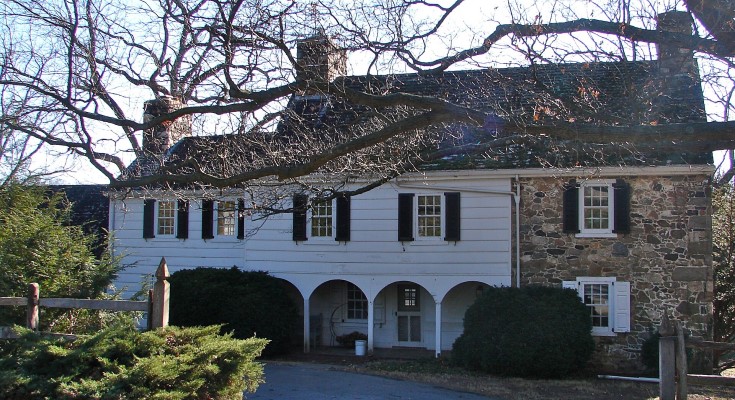
The National Register-listed estate blends colonial roots dating back to the 1720s with a mid-20th-century Colonial Revival vision of country living. Straddling the state line, its stone buildings, formal gardens, and mature trees create a landscape that feels carefully composed, yet remains deeply connected to the agricultural setting surrounding it.
Even the skies play a role in New Garden’s identity.
At New Garden Flying Field, small aircraft rise above fields and forests throughout the year. Pilots gather for fly-ins and educational programs. Families attend aviation events. Gliders circle overhead on summer afternoons. What began as a functional airfield has evolved into one of the township’s most visible community gathering places.
As evening settles across New Garden Township, the activity of the day gradually slows. The last trucks leave the packing facilities. Shadows lengthen across the mushroom houses of Toughkenamon. Along White Clay Creek, the water catches the fading sunlight before slipping into darkness beneath the trees.
The landscape grows quiet once again.
Yet beneath that quiet lies the story of a community that has continually reinvented itself—from Quaker settlement to industrial center, from mining village to agricultural powerhouse, from rural crossroads to one of Chester County’s most dynamic townships.
And as the first stars appear above the valleys and fields, New Garden remains what it has always been: a place where work, community, and the land are inseparably linked.
Support the local news that supports Chester County. MyChesCo delivers reliable, fact-based reporting and essential community resources—free for everyone. If you value that, click here to become a patron today.