
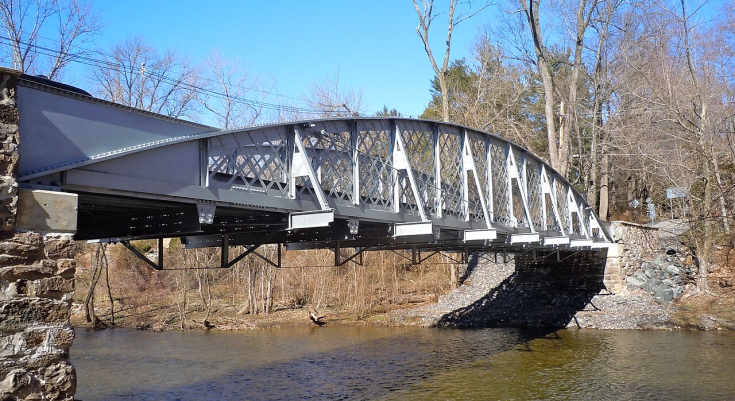
The morning sun catches the iron lattice of Silver Bridge before it reaches the water below. French Creek slides quietly beneath the 19th-century span, reflecting flashes of silver-gray metal and the deep green canopy that crowds its banks. A cyclist coasts past on a nearby road. Downstream, the creek bends toward Kimberton, carrying with it stories that stretch from the American Revolution to the present day.
In East Pikeland Township, history rarely announces itself. It reveals itself gradually — in a timber-framed bridge tucked into a wooded valley, in a centuries-old church, or in the remnants of an industrial site that once helped supply George Washington’s army.
The township occupies a unique place in Chester County, balancing a growing suburban population with a landscape still shaped by French Creek, historic villages, and some of the region’s most significant Revolutionary-era landmarks. As development continues across southeastern Pennsylvania, East Pikeland remains a place where layers of history are not confined to museums but woven into daily life.
That balance between preservation and progress helps explain the township’s enduring appeal. Residents are drawn not only by highly rated schools, strong household incomes, and proximity to employment centers, but also by the sense that East Pikeland retains a tangible connection to the people and events that shaped the region centuries ago.
Much of that identity centers on Kimberton.
The village appears almost unexpectedly along winding roads and creek crossings, its collection of stone buildings, historic homes, and preserved landmarks creating one of Chester County’s most distinctive historic districts. The Kimberton Inn, which has welcomed travelers since 1796, remains a focal point. Nearby, Chrisman’s Mill continues serving the community in a different role as the local post office, while Victorian-era homes and former railroad-era structures line the streets.
The village grew from the economic power of French Creek.
For generations, the waterway fueled mills, supported commerce, and connected the community to broader transportation networks. Today, the creek remains East Pikeland’s defining natural feature, winding through wooded corridors and open landscapes that provide a scenic backdrop for daily life.
Its most consequential role, however, may have come during the Revolution.
Hidden among the trees along French Creek are the remains of the Continental Powder Works, established in 1776 during one of the most precarious periods of the war. At a time when the Continental Army desperately needed munitions, the complex produced gunpowder and military supplies using the creek’s dependable waterpower.
Little remains of the operation today beyond foundations and landscape traces, yet the site represents one of Pennsylvania’s most important wartime industrial efforts.
The story feels almost improbable now.
Birdsong fills the creek valley where workers once manufactured explosive powder. Deer move through the woods where wagons once carried critical supplies to American forces. The landscape has softened, but the significance remains.
Elsewhere across the township, history reveals itself in more visible ways.
Rapps Bridge spans French Creek with a classic silhouette, its weathered wooden siding and heavy timber Burr arch truss reflecting the timeless craftsmanship of Chester County’s 19th-century covered bridge builders. Nearby, Silver Bridge offers a radically different chapter of engineering history. Built in 1869 by the Moseley Iron Bridge and Roof Company, the rare wrought-iron bowstring lattice girder structure remains one of the region’s most visually striking historic crossings, its delicate, patented geometry contrasting with the rugged natural setting surrounding it.
The township’s connection to early settlement is equally apparent at Zion Lutheran Church.
Formally organized in 1743 under the leadership of patriarch Henry Melchior Muhlenberg, the congregation ranks among the oldest continuously active Lutheran communities in the United States. Its historic sanctuary and cemetery tell the story of German-speaking settlers who established roots here long before the nation itself existed. Generations of baptisms, weddings, funerals, and Sunday gatherings have unfolded on the same ground for nearly three centuries.
For many residents, those layers of continuity are part of East Pikeland’s appeal.
The township has grown steadily, with its population increasing over recent decades and highly educated professionals drawn by access to nearby employment centers. Yet French Creek still defines the landscape. Historic structures remain integrated into daily life rather than isolated from it. Village centers continue serving as community gathering places.
That combination gives East Pikeland a distinctive rhythm.
Children attend school in the shadow of Revolutionary-era sites. Commuters travel country roads laid out before the automobile existed. Residents gather in a village whose commercial heart began taking shape before the Civil War.
As evening settles over French Creek, the last light filters through the iron framework of Silver Bridge. The water moves steadily beneath it, just as it has for centuries. The creek that powered mills, supplied soldiers, and sustained villages continues its quiet journey through East Pikeland — carrying the township’s past forward, one bend at a time.
Support the local news that supports Chester County. MyChesCo delivers reliable, fact-based reporting and essential community resources—free for everyone. If you value that, click here to become a patron today.